Gifts
Smartphone telescope adapters: which one fits, and what it will really photograph
The gift that turns a telescope into something a child can show their friends — within limits worth knowing first.
By Scooter M. · published September 21, 2026
I'm not an astronomer and I don't have a lab. I'm someone who's genuinely into this — I read the manuals, compile the published specs, and do the arithmetic the box doesn't do for you. No lab coat. How we pick.
How this is funded. Lens & Lightyear earns a commission when you buy through a link on this page, at no extra cost to you. It does not change which products we pick or what we say about them — every card below carries a real reason to skip it. Prices are pulled live and were last verified October 18, 2026. Full disclosure.
The short answer
Measure the top of your eyepiece before buying. Celestron's DX kit clamps 29-45mm and includes a Bluetooth remote; the NexYZ clamps 35-60mm and adds a third adjustment axis. For most beginner telescopes the DX kit fits better and costs less.
Every child who gets a telescope tries to photograph the Moon with a phone within the first week, usually by holding it over the eyepiece and getting a wobbling white blob. An adapter fixes the wobble. This page is about which one fits and what the results honestly look like.
The spec that decides fit, and nobody checks
| Smartphone Adapter DX Kit | NexYZ 3-Axis | |
|---|---|---|
| Eyepiece clamp range | 29mm - 45mm | 35mm - 60mm (25mm with adapters) |
| Phone clamp range | 56mm - 97mm | 65mm - 90mm |
| Adjustment axes | Two | Three, rack and pinion |
| Bluetooth remote | Included, with battery | Not included |
| Weight | 6 oz | 10 oz |
| Body | Cast metal | Cast metal and reinforced plastic |
| Also fits | Spotting scopes, binoculars, microscopes | Spotting scopes, binoculars, monoculars, microscopes |
Celestron's published specifications for items 81037 and 81055, linked below. Bold marks the advantage where there is one.
Measure across the rubber eyecup at the top of the eyepiece you will actually use, not the barrel that goes into the focuser. A typical supplied 10mm or 25mm eyepiece measures in the low thirties, which is inside both ranges but comfortably inside the DX kit's.
Quick picks
Two adapters, chosen by the size of your eyepiece
| # | Product | Best for | Price |
|---|---|---|---|
| 1 | 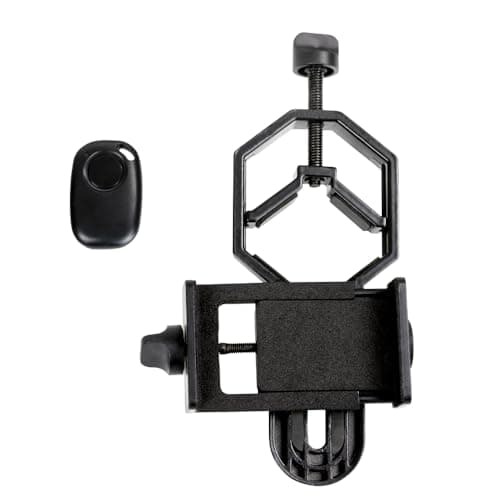 Celestron Smartphone Adapter DX Kit Clamps eyepieces from 29mm to 45mm, includes a Bluetooth shutter remote, weighs 6 oz. | Beginner telescopes with standard 1.25-inch eyepieces | |
| 2 | 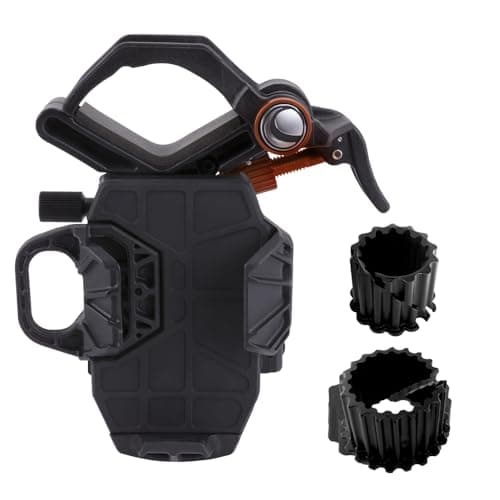 Celestron NexYZ 3-Axis Smartphone Adapter Three rack-and-pinion axes, an eyepiece range of 35mm to 60mm, and cast-metal build. | Larger eyepieces, binoculars and spotting scopes too |
Rows link to the full write-up further down this page. Prices come from the live price layer only; where there is no live figure the button reads “Check price” rather than showing a number we remembered.
What a phone through a telescope actually captures
This is where most guides oversell, so here is the honest ranking, consistent with what you can actually see.
| Target | Realistic phone result | Why |
|---|---|---|
| The Moon | Genuinely good — craters, terminator detail | Bright enough for a short exposure at low ISO |
| Sun with a proper solar filter | Sunspots, if you own a real filter | Never attempt without one. Never look through the eyepiece to aim. |
| Jupiter | A bright dot, sometimes with moons as specks | Small, and phone sensors blow out the disc |
| Saturn | An oval blob, rings implied rather than resolved | Needs long focal length and steady air |
| Bright star clusters | A handful of the brightest stars | Short exposures cannot reach faint stars |
| Galaxies and nebulae | Nothing usable | These need tracking mounts and stacked long exposures |
A phone adapter is a lunar and planetary-snapshot accessory. Deep-sky astrophotography is a different hobby with a different budget, and we would rather say so than sell you an adapter on a false promise.
Five things that fix blurry results, free
- Use the remote or the self-timer. Touching the phone is the single biggest source of blur. The DX kit's Bluetooth remote exists for this; a 3-second timer does the same job for nothing.
- Start at low magnification. Fit the longest eyepiece you own — usually 25mm. High power makes framing and focus dramatically harder and dims the image.
- Turn the flash off and lock the exposure. Tap and hold on the Moon so the phone stops hunting, then drag the exposure slider down until craters appear instead of a white disc.
- Let the telescope settle. Wait a couple of seconds after any adjustment; on a light mount the vibration lasts longer than you would think.
- Shoot a short video and keep the best frame. Air turbulence blurs individual shots at random, so thirty seconds of video almost always contains a sharper frame than a single photo.
Is this a good gift on its own?
For a child who already owns a telescope, yes — it is inexpensive, it produces something they can show people, and it gets the telescope out of the cupboard. That is the same reasoning behind everything on what to buy a kid who already has a telescope.
One telescope on this site arrives with the bracket already built in — the Inspire 100AZ — which is worth knowing before buying both separately. For a child who does not own a telescope, no. The adapter does nothing on its own, and the money is better spent toward binoculars or a first telescope.
What we did and did not do
We have not tested these adapters. Their specifications were read from Celestron's published pages, linked below and checked on the date at the top of this page. The results table describes what the physics of short phone exposures allows, not photographs we took.
No price appears in this prose. Live figures come only from our price feed with the date they were checked. Our full method is on the methodology page.
The picks in full
Pick 1
Celestron Smartphone Adapter DX Kit
Beginner telescopes with standard 1.25-inch eyepieces
The arithmetic
Two published numbers decide whether this or the NexYZ is right for your telescope. Its eyepiece clamp spans 29-45mm where the NexYZ spans 35-60mm, so this one fits the SMALLER eyepieces that come with beginner telescopes and the NexYZ fits the larger barrels. It also weighs 6 oz against 10 — on a light beginner focuser, that difference is felt.
For the telescopes this site recommends, this is usually the right one, and the reason is a number people skip: it clamps eyepieces from 29mm to 45mm, which is the range the supplied eyepieces on beginner telescopes actually fall in.
The included Bluetooth remote solves the problem that ruins most first attempts. Tapping the screen shakes the phone, the telescope and therefore the image; a remote shutter removes the touch entirely. For a child, that single accessory is the difference between a blurred smear and a keeper.
At 6 oz it is light enough not to unbalance a small focuser, which matters more on beginner telescopes than on heavy ones.
The honest downside: two axes of adjustment rather than three, so centering the camera over the eyepiece takes patience — and the remote has to pair with the phone's own camera app.
Skip it if
Your eyepieces are wider than 45mm across the top, which includes many wide-field designs. Measure before ordering — this is the number that decides fit.
| Item number | 81037 |
|---|---|
| Eyepiece clamp range | 29mm-45mm (1.14"-1.77") |
| Phone clamp range | 56mm-97mm (2.20"-3.81") |
| Included | Bluetooth shutter release remote, CR-2032 battery |
| Fits | Telescopes with most 1.25" eyepieces, spotting scopes, binoculars, monoculars, microscopes |
| Materials | Cast metal |
| Weight | 6 oz (170.1 g) |
| Dimensions | 177.8 x 101.6 x 38.1mm (7" x 4" x 1.5") |
| Warranty | 2 year |
| What the box does not do | Two axes of adjustment rather than three, so centering the phone over the eyepiece takes more patience than the NexYZ. It will not fit eyepieces wider than 45mm, which includes some wide-field designs, and the Bluetooth remote needs the phone's own camera app to recognize it. |
Specifications from Celestron — Smartphone Adapter DX Kit, 1.25 inch. We have not handled this one — everything above is the published spec sheet plus our own arithmetic on it.
Pick 2
Celestron NexYZ 3-Axis Smartphone Adapter
Larger eyepieces, binoculars and spotting scopes too
The arithmetic
The three axes are the whole product. A phone camera has to sit centered over the eyepiece AND at the right distance from it, which is three independent adjustments — and a two-axis holder makes you solve the third by hand while the phone slips. At 10 oz it also adds real weight to the focuser end of a small telescope, which is why it belongs on a steady mount rather than a wobbly one.
The three axes are the entire argument for spending more. A phone camera must sit centered over the eyepiece AND at the right distance from it — three independent adjustments, and a two-axis holder makes you solve the third by hand while everything slips.
With X, Y and Z knobs you set it once and the phone stays where you put it, which is what makes it practical on binoculars and spotting scopes as well as telescopes.
Honest costs: no Bluetooth remote is included, so you are back to the phone's self-timer unless you buy one; 10 oz hangs off the focuser end; and the 65-90mm phone clamp excludes the largest handsets in bulky cases.
Skip it if
Your telescope has a light focuser or small eyepieces. It weighs 10 oz and its clamp starts at 35mm — the DX kit above reaches smaller eyepieces and is easier on a beginner focuser.
| Item number | 81055 |
|---|---|
| Eyepiece clamp range | 35mm-60mm (1.37"-2.36"), 25mm with the included adapters |
| Phone clamp range | 65mm-90mm (2.55"-3.54") |
| Adjustment | Three rack-and-pinion knobs, X, Y and Z axis |
| Fits | Telescopes, binoculars, spotting scopes, monoculars, microscopes |
| Materials | Cast metal and fiber-reinforced plastic |
| Weight | 10 oz (283 g) |
| Dimensions closed | 165.1 x 139.7 x 107.95mm (6.5" x 5.5" x 4.25") |
| Included | 2 adapters for microscope eyepieces |
| Warranty | 2 year |
| What the box does not do | No Bluetooth remote — tapping the screen to shoot shakes the view, so you use the phone's timer or buy a remote separately. The 65-90mm phone clamp rules out the largest phones in bulky cases, and it will not make a telescope track: the target still drifts out of frame while you fiddle. |
Specifications from Celestron — NexYZ 3-Axis Universal Smartphone Adapter. We have not handled this one — everything above is the published spec sheet plus our own arithmetic on it.
Questions people actually ask
- Do smartphone telescope adapters actually work?
- For the Moon, yes — they produce genuinely good craters and terminator detail. For planets they give a bright blob with moons as specks, and for galaxies and nebulae they produce nothing usable, because those need tracking mounts and stacked long exposures.
- How do I know if an adapter fits my telescope?
- Measure across the top of the eyepiece you will use, at the eyecup. Celestron's Smartphone Adapter DX Kit clamps 29-45mm and the NexYZ clamps 35-60mm. The eyepiece measurement, not the telescope model, is what decides fit.
- What is the difference between the NexYZ and the cheaper Celestron adapter?
- The NexYZ has three rack-and-pinion adjustment axes and fits larger eyepieces (35-60mm); the DX kit has two axes, fits smaller eyepieces (29-45mm), weighs 6 oz against 10, and includes a Bluetooth shutter remote.
- Why are my phone photos through the telescope blurry?
- Usually because you touched the screen. Use a Bluetooth remote or the self-timer, start with your longest eyepiece, lock the exposure by tapping and holding, and shoot a short video to keep the sharpest frame.
- Can you photograph the Sun with a phone adapter?
- Only with a purpose-made front-mounted solar filter, fitted and checked by an adult, with the finderscope capped. Without one, a telescope pointed at the Sun can destroy an eye instantly and damage the equipment.
- Is a phone adapter a good gift for a child with a telescope?
- Yes. It is inexpensive, it produces pictures they can share, and it tends to get a telescope used again. For a child with no telescope yet it does nothing on its own.
Sources
Read next
Where to go from here
- What to buy a kid who already has a telescope
A telescope's real problems are dark adaptation, steadiness and knowing where to point it. None of them cost much to fix.
- The best telescope for teens
Above about 13 the weight limits and patience limits that shape our age pages stop applying. What to buy when the telescope has to keep up with the person for years.
- What you can actually see with a kids' telescope
The honest target-by-target list for 70mm, 76mm and 114mm telescopes, so nobody is disappointed on night one.
- The best first telescope for a kid
A first telescope has one job: produce a good first night. Which specifications serve that, and which are irrelevant to it.
- Barlow lens for a telescope: the arithmetic before the purchase
One number decides whether a Barlow helps or hurts: your shortest eyepiece, multiplied, against the telescope's published ceiling. Work it out first, then buy.
- Your first night with a telescope
Do these eight things in this order and night one works. Most first nights fail on sequence, not on equipment.
- Celestron Inspire 100AZ review
100mm at 660mm f/6.5 with an integrated phone adapter, an erect image diagonal and a red flashlight in the box. The same optics as the DX 102AZ without the guidance app — and 1.8 lbs lighter.