Telescopes
Celestron AstroMaster LT 70AZ review
The same 70mm optics as our phone-guided pick, minus the phone. That is the whole review.
By Scooter M. · published September 6, 2026
I'm not an astronomer and I don't have a lab. I'm someone who's genuinely into this — I read the manuals, compile the published specs, and do the arithmetic the box doesn't do for you. No lab coat. How we pick.
How this is funded. Lens & Lightyear earns a commission when you buy through a link on this page, at no extra cost to you. It does not change which products we pick or what we say about them — every card below carries a real reason to skip it. Prices are pulled live and were last verified October 20, 2026. Full disclosure.
The short answer
Buy it if an adult in the house can already find things in the night sky. It is optically the same telescope as our phone-guided pick — same 70mm, same 700mm, same published ceiling — on steadier steel legs and without the app. If nobody can find anything, pay for the app instead.
Most reviews of this telescope describe it in isolation. That is not the decision anyone is actually making: it sits on the shelf next to a near-identical Celestron with a phone dock — and next to the longer AstroMaster 70AZ, which shares the badge and the aperture but not the focal length — and the only honest way to review it is against that.
The same tube, twice
| Published spec | AstroMaster LT 70AZ | StarSense Explorer LT 70AZ |
|---|---|---|
| Aperture | 70mm | 70mm |
| Focal length | 700mm | 700mm |
| Focal ratio | f/10 | f/10 |
| Highest useful magnification | 165x | 165x |
| Limiting stellar magnitude | 11.7 | 11.7 |
| Eyepieces supplied | 20mm + 10mm (35x / 70x) | 25mm + 10mm (28x / 70x), plus a 2x Barlow |
| Tripod legs | Steel tube | Aluminum |
| Total kit weight | 7.2 lbs | 7.4 lbs |
| Finding aid | Red dot finder | Red dot finder + phone app |
Both columns are from Celestron's own published specification pages, linked below. The optical rows are identical because it is the same optical tube.
That table is the review. Everything else is a judgment about your household rather than about the telescope.
What the steel legs are worth
Mount stiffness is the most under-reported number in this category, mainly because nobody publishes one. No manufacturer states how long its tripod takes to stop vibrating after you touch the focuser, and that figure would predict a child's experience better than any optical specification.
Steel tube legs are stiffer than aluminum ones of the same diameter, so what you get is a shorter settle. It is not a dramatic difference and we are not going to pretend it is measured — we have not measured it. But it is a real engineering difference in the right direction, and it costs nothing extra here.
Quick picks
The AstroMaster and the telescope it is really competing with
| # | Product | Best for | Price |
|---|---|---|---|
| 1 | No image Celestron AstroMaster LT 70AZ Identical 70mm f/10 optics to our phone-guided pick, on steel legs, without the app. | A household where somebody already knows the sky | |
| 2 | No image Celestron StarSense Explorer LT 70AZ Same 70mm f/10 tube, plus a phone dock that steers you onto the target. | The same optics, with the phone finding things for you | |
| 3 | 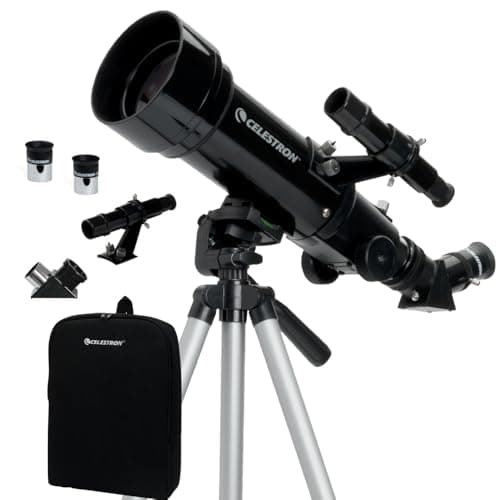 Celestron Travel Scope 70 70mm again, but 3.3 lbs total and it fits in a bag a child can wear. | The same aperture, half the weight, in a backpack |
Rows link to the full write-up further down this page. Prices come from the live price layer only; where there is no live figure the button reads “Check price” rather than showing a number we remembered.
The eyepiece gap, and what to do about it
The supplied eyepieces reach 70x against a published 165x ceiling. That is not a defect — wide, bright, low-power views are the right default for a beginner — but it does mean the box does not show you everything the telescope can do.
- Do not rush it. The first three months should be spent at 35x learning to find things. High magnification on a target you cannot locate is useless.
- When you do upgrade, buy one good eyepiece rather than a set. Something around 6mm would give roughly 117x here, comfortably inside the ceiling and enough for real detail on the Moon and Saturn.
- Skip the cheap Barlow-and-four-eyepieces kits. They are how the sub-$60 shelf manufactures impressive-sounding magnification numbers, which we take apart on toy brands vs real optics.
Availability, and why our buy button is a search
At the time of writing this model is out of stock on Celestron's own store while remaining listed there and stocked at the major retailers. That is normal for a long-running product line and it is not a discontinuation signal.
It is also why every buy button on this site goes to a retailer search rather than a fixed product page: a search finds the model wherever it is currently in stock, and it cannot rot into a dead listing six months from now. Our full method, including what we refuse to publish, is on the methodology page.
The picks in full
Pick 1
Celestron AstroMaster LT 70AZ
A household where somebody already knows the sky
The arithmetic
Optically this is the same 70mm f/10 as the StarSense LT 70AZ — same aperture, same 700mm focal length, same 165x ceiling, same 11.7 limiting magnitude — without the phone dock and app. If the child has no compatible phone, you are paying for the identical optics and skipping a feature they cannot use. Steel legs rather than aluminum is the other quiet difference, and it is the one that stops a nudge from ending the view.
The most useful thing we can tell you about this telescope is a comparison rather than a specification. Set it beside the StarSense Explorer LT 70AZ and the optical tubes are the same instrument: 70mm aperture, 700mm focal length, f/10, a published 165x highest useful magnification, and a published limiting stellar magnitude of 11.7. Identical, line for line, on Celestron's own pages.
What differs is the mount furniture. The AstroMaster comes with steel tube legs rather than aluminum, and it is 7.2 lbs against 7.4 lbs. Steel is the quieter of the two advantages: a stiffer tripod means a nudge of the focuser settles faster, and settling time is what a child experiences as the telescope working or not working.
The supplied 20mm and 10mm eyepieces give 700 / 20 = 35x and 700 / 10 = 70x. Against the published 165x ceiling that is about 42 percent of what the optics could do — there is no Barlow in the box, so a third eyepiece is the natural first upgrade rather than an urgent one.
At f/10 the images are contrasty and forgiving to focus, and false color on bright objects is much better controlled than in the fast, cheap refractors that dominate the shelf below this one.
Skip it if
Nobody in the house can find anything in the night sky. Finding the target is where most first nights fail, and this telescope gives you a red dot finder and nothing else — which is a genuine learning curve on the first two evenings.
| Optical design | Refractor |
|---|---|
| Aperture | 70mm (2.76") |
| Focal length | 700mm (28") |
| Focal ratio | f/10 |
| Eyepieces supplied | 20mm (35x) and 10mm (70x) |
| Finderscope | Built-on StarPointer red dot |
| Mount | Manual alt-azimuth |
| Tripod | 31.75mm (1.25") steel tube legs, pre-assembled |
| Highest useful magnification | 165x |
| Limiting stellar magnitude | 11.7 |
| Total kit weight | 7.2 lbs (3.27 kg) |
| What the box does not do | No Barlow and no app: finding things is entirely on you and a red dot finder. That is a genuine learning curve on the first two evenings, and it is why we send people to the first-night guide before they open the box. |
Specifications from Celestron — AstroMaster LT 70AZ specifications. We have not handled this one — everything above is the published spec sheet plus our own arithmetic on it.
Pick 2
Celestron StarSense Explorer LT 70AZ
The same optics, with the phone finding things for you
The arithmetic
700mm over 25mm and 10mm gives 28x and 70x; the 2x Barlow doubles those to 56x and 140x. Celestron's published ceiling is 165x, so even the Barlowed 10mm stays legal — a rare box where every supplied combination is inside the optics' honest limit. At f/10 the images are contrasty and easy to focus, which is exactly what an inexperienced pair of hands needs.
This is the direct comparison and it is unusually clean, because the optics are not a variable. You are pricing one feature: does a phone tell you where to point?
In a household where no adult can find Jupiter, it is the best money on this site — finding the target is the single biggest cause of a failed first night, and the app removes it. In a household where somebody already knows the sky, it is a feature nobody will open.
It does not track. Neither telescope does. You push the tube by hand in both cases. Full write-up on the StarSense Explorer LT review.
Skip it if
The only available phone is older than an iPhone XR or runs below Android 12. The app will not run, and then you have paid the premium for the identical AstroMaster optics.
| Optical design | Refractor |
|---|---|
| Aperture | 70mm (2.76") |
| Focal length | 700mm (27.56") |
| Focal ratio | f/10 |
| Eyepieces supplied | 25mm (28x) and 10mm (70x) |
| Barlow | 2x (1.25") |
| Finderscope | StarPointer red dot |
| Mount | Manual alt-azimuth |
| Tripod | Aluminum, 1320.8mm (52") max height |
| Highest useful magnification | 165x |
| Limiting stellar magnitude | 11.7 |
| Total kit weight | 7.4 lbs (3.35 kg) |
| Phone requirement | Android 12 and later; iOS 18 and newer, iPhone XR and newer |
| What the box does not do | The phone requirement is a real constraint, not fine print: Android 12+ or iOS 18+ on an iPhone XR or newer. An older hand-me-down phone will not run it, and without the app this is an ordinary 70mm refractor at the price of a guided one. |
Specifications from Celestron — StarSense Explorer LT 70AZ specifications. We have not handled this one — everything above is the published spec sheet plus our own arithmetic on it.
Pick 3
Celestron Travel Scope 70
The same aperture, half the weight, in a backpack
The arithmetic
400mm focal length over the two supplied eyepieces gives 20x and 40x. Celestron's published ceiling for a 70mm objective is 168x, so both eyepieces are comfortably inside it — the box is not overselling. The 3.3 lb total is the number that matters for a gift: a child can carry the whole kit themselves, which is most of why it gets used more than once.
The third way to buy 70mm. Same aperture, a faster f/5.7 rather than f/10, and a total kit weight of 3.3 lbs against the AstroMaster's 7.2 lbs.
What you trade for the portability is exactly the thing the AstroMaster's steel legs are good at: steadiness. The Travel Scope's tripod is light because the whole point is that a child carries it, and light tripods move.
If the telescope will live in one garden, the AstroMaster is the better mount. If it will go to a grandparent's house and on holiday, the Travel Scope gets used more often, and used-more-often beats steadier. Full review.
Skip it if
The child is heavy-handed. The 1.8 lb tripod is the price of the portability and it does wobble — every touch of the focuser moves the view for a second or two.
| Optical design | Refractor |
|---|---|
| Aperture | 70mm (2.8") |
| Focal length | 400mm (15.74") |
| Focal ratio | f/5.7 |
| Eyepieces supplied | 20mm (20x) and 10mm (40x) |
| Finderscope | 5x24 |
| Diagonal | 45 degree erect image, 1.25" |
| Mount | Manual alt-azimuth on aluminum tripod |
| Highest useful magnification | 168x |
| Limiting stellar magnitude | 11.7 |
| Total kit weight | 3.3 lbs (1.5 kg), tripod 1.8 lbs (0.81 kg) |
| Included | Custom backpack, Starry Night Basic software, SkyPortal app access |
| What the box does not do | The tripod is the weak part. At 1.8 lbs it is light enough to carry and light enough to wobble, and a child nudging the eyepiece will lose the target. The 45 degree erect-image diagonal is built for daytime use and costs you a little light at night. |
Specifications from Celestron — Travel Scope 70 specifications. We have not handled this one — everything above is the published spec sheet plus our own arithmetic on it.
Questions people actually ask
- Is the Celestron AstroMaster LT 70AZ good for beginners?
- Yes, provided somebody in the house can find things in the sky. Its 70mm f/10 optics are identical to Celestron's phone-guided model, and its steel tripod legs are marginally steadier — but it gives you a red dot finder and nothing else to locate targets with.
- What is the difference between the AstroMaster LT 70AZ and the StarSense Explorer LT 70AZ?
- Optically, nothing: same 70mm aperture, 700mm focal length, f/10, 165x published ceiling and 11.7 limiting magnitude. The StarSense adds a phone dock and app plus a 2x Barlow; the AstroMaster has steel tripod legs and weighs 0.2 lbs less.
- What magnification does the AstroMaster LT 70AZ give?
- 35x with the supplied 20mm eyepiece and 70x with the 10mm, from its 700mm focal length. Celestron publishes a highest useful magnification of 165x, so the box reaches about 42 percent of the telescope's stated limit.
- Can you see Saturn's rings with the AstroMaster LT 70AZ?
- Yes. The rings resolve as a distinct oval from about 50x, which the supplied 10mm eyepiece comfortably exceeds at 70x. Jupiter's cloud belts show on a steady night.
- Is the AstroMaster LT 70AZ discontinued?
- No. It was out of stock on Celestron's own store at the time of writing while remaining listed there and stocked at major retailers, which is normal for a long-running product line.
Sources
Read next
Where to go from here
- Celestron StarSense Explorer LT: how it works and whether it is worth it
Phone-guided finding removes the main reason first telescopes fail. How the system works, what it costs, and the phone requirement that is easy to miss.
- Which Celestron StarSense Explorer is best for a kid?
LT 70AZ, DX 102AZ or the 114mm tabletop Dobsonian? Compared on published specs, weight, and what the box actually gives you against what it could.
- The best beginner telescopes under $200
Between $100 and $200 you can buy a steady mount, real aperture, or phone-guided finding. What each of those is worth, with the arithmetic.
- The best telescope for a 9 or 10 year old
Nine and ten is the first band where a bigger, heavier telescope is a better telescope. Four picks and the arithmetic behind the jump.
- Refractor or reflector for a child?
Mirrors are cheaper per millimeter of aperture; lenses never need aligning. Which trade suits which child, with the arithmetic on both.
- Your first night with a telescope
Do these eight things in this order and night one works. Most first nights fail on sequence, not on equipment.
- Celestron AstroMaster 70AZ review
70mm at 900mm focal length — f/13, the slowest refractor on this site, with 45x and 90x in the box against a 165x ceiling. Excellent on the Moon, heavy for what it gathers.