Binoculars
Which Celestron SkyMaster should you buy?
Seven models, one set of published specs, and one of them is a trap.
By Scooter M. · published October 6, 2026
I'm not an astronomer and I don't have a lab. I'm someone who's genuinely into this — I read the manuals, compile the published specs, and do the arithmetic the box doesn't do for you. No lab coat. How we pick.
How this is funded. Lens & Lightyear earns a commission when you buy through a link on this page, at no extra cost to you. It does not change which products we pick or what we say about them — every card below carries a real reason to skip it. Prices are pulled live and were last verified October 18, 2026. Full disclosure.
The short answer
For most people, the SkyMaster 15x70: the best balance of exit pupil, field and weight in the line, at the bottom of its price range. Take the 12x60 if you want the widest field and lightest body, the Pro 15x70 if it will live outdoors, and skip the 25x70.
The SkyMaster model numbers look like a quality ladder. They are not. They are seven different trades on the same basic design, and the figure that decides most of them is one Celestron publishes but never explains.
What a SkyMaster is, and who the line is actually for
Every SkyMaster is a porro-prism astronomy binocular with BaK-4 prisms, built around a big objective and a fixed magnification. The range splits into two tiers: the standard models, which are water resistant and multi-coated, and the Pro models, which are waterproof, nitrogen filled and fully multi-coated with Celestron's XLT coatings.
The two numbers in the name are magnification and objective diameter in millimeters. A 20x80 magnifies twenty times through 80mm lenses. Nothing in the name tells you the thing you most need to know, which is how bright the resulting image will be.
That also settles who the line suits. These are adult-scale instruments on a site mostly about children's optics, and we are not going to pretend otherwise: for a child under about twelve, a handheld 7x50 or 10x50 puts more light into a dark-adapted young eye than any SkyMaster does, and it can be picked up without a tripod. Start at binoculars for stargazing or binoculars by age if that is the buyer. The SkyMasters are for a parent who has caught the interest too, or an older teenager who will accept a tripod.
The whole line, side by side
| Model | Objective | Exit pupil | Field | Weight | Sealing |
|---|---|---|---|---|---|
| SkyMaster 12x60 | 60mm | 5mm | 5.3 deg | 39.2 oz | Water resistant |
| SkyMaster 15x70 | 70mm | 4.7mm | 4.4 deg | 48 oz | Water resistant |
| SkyMaster 25x70 | 70mm | 2.8mm | 2.7 deg | 52 oz | Water resistant |
| SkyMaster 20x80 | 80mm | 4mm | 3.7 deg | 75 oz | Water resistant |
| SkyMaster Pro 15x70 | 70mm | 4.6mm | 4.4 deg | 51 oz | Waterproof, nitrogen filled |
| SkyMaster Pro 20x80 | 80mm | 4mm | 3.2 deg | 86.4 oz | Waterproof, nitrogen filled |
| SkyMaster 25x100 | 100mm | 4mm | 3 deg | 140 oz | Water resistant |
Every figure is from Celestron's own published specification page for that model, linked in the sources at the foot of this page. Bold marks the best figure in each column.
A separate Pro ED tier is deliberately missing from that table: Celestron sells ED versions of the 7x50, 15x70 and 20x80, which add extra-low dispersion glass at a further premium. All three now have pages of their own: the Pro ED 20x80 review, where every published light figure matches the non-ED model to the decimal; the Pro ED 7x50 review, the one SkyMaster of any kind you can hold without a tripod; and the Pro ED 15x70 review, which is 44 percent heavier than its non-ED twin and arrives without the tripod adapter and sight rail that cheaper model includes. There is also a 15-35x70 zoom. We leave it out on the arithmetic of its own name: 70mm at 35x is a 2mm exit pupil, less than half the 15x70's, so the top of its zoom range lands below even the 25x70 we tell you to avoid.
Exit pupil is the number that decides it
Divide the objective diameter by the magnification and you get the exit pupil in millimeters — the width of the cone of light leaving the eyepiece. It is the closest thing to a brightness rating a binocular has, and it costs nothing to work out from the name.
| Model | The division | Exit pupil | Surface brightness vs the 12x60 |
|---|---|---|---|
| SkyMaster 12x60 | 60 / 12 | 5mm | baseline |
| SkyMaster 15x70 | 70 / 15 | 4.7mm | about 88% |
| SkyMaster Pro 15x70 | 70 / 15 | 4.6mm | about 85% |
| SkyMaster 20x80 | 80 / 20 | 4mm | 64% |
| SkyMaster Pro 20x80 | 80 / 20 | 4mm | 64% |
| SkyMaster 25x100 | 100 / 25 | 4mm | 64% |
| SkyMaster 25x70 | 70 / 25 | 2.8mm | about 31% |
Exit pupils as published by Celestron. The last column is our arithmetic: surface brightness scales with the square of the exit pupil, so each figure is that model's exit pupil divided by 5mm, squared.
Read that last column carefully, because it describes one thing and not another. Surface brightness is how bright an extended object looks — a nebula, a galaxy, the Milky Way, the sky background itself. For stars, which are points no telescope resolves into discs, what matters is raw aperture, and there the 25x100 wins the line outright regardless of exit pupil.
So the two columns pull in different directions, and that is the real structure of this line. Want the Milky Way to look bright and easy? Favor a wide exit pupil: the 12x60 or either 15x70. Want to reach fainter stars and resolve more of a cluster? Favor aperture: an 80mm or the 25x100. Only the 25x70 manages to be poor at both.
Same glass, different magnification: the 70mm pair
The clearest lesson in the whole range is sitting in the two 70mm standard models, because they hold the optics constant and change only the magnification.
| SkyMaster 15x70 | SkyMaster 25x70 | |
|---|---|---|
| Objective | 70mm | 70mm — identical |
| Exit pupil | 4.7mm | 2.8mm |
| Angular field | 4.4 deg | 2.7 deg |
| Linear field at 1000 yds | 231 ft (77 m) | 141 ft (47 m) |
| Eye relief | 18mm | 13mm |
| Weight | 48 oz | 52 oz |
| Tripod adapter in box | No | Yes |
Published Celestron figures for both models. Bold marks the better figure for night sky use.
Six rows of specification, and the cheaper, lower-magnification model wins five of them on the same aperture. The one row it loses is a tripod adapter worth a few dollars. This is the single most useful thing to take away from the page: on a fixed aperture, magnification is a cost. It buys a bigger image by spreading the same light thinner and narrowing the window you hunt through.
Quick picks
The seven SkyMasters, ranked
| # | Product | Best for | Price |
|---|---|---|---|
| 1 | 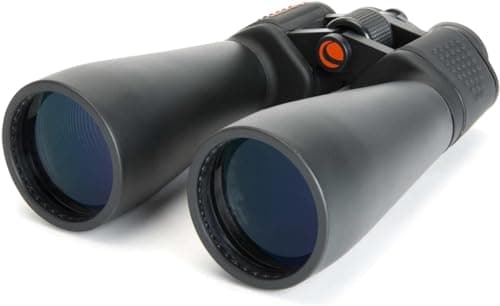 Celestron SkyMaster 15x70 The widest useful exit pupil of any 70mm here, at the bottom of the line's price range. | Most people, and the best balance in the line | |
| 2 | 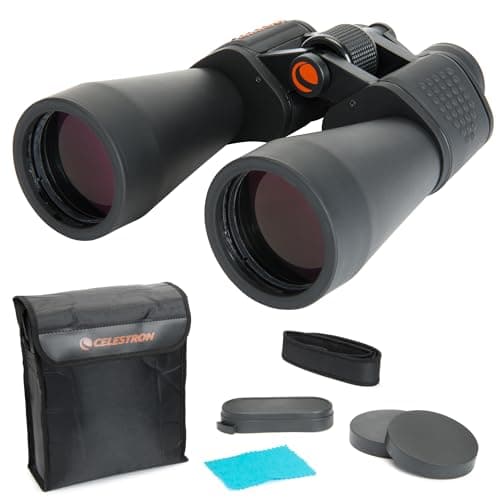 Celestron SkyMaster 12x60 5mm exit pupil and a 5.3 degree field — the brightest and widest SkyMaster, and the only one near handheld. | The widest, brightest view in the line, and the lightest body | $109.95 on Amazon #ad How we’re funded · price as of October 18, 2026 |
| 3 | 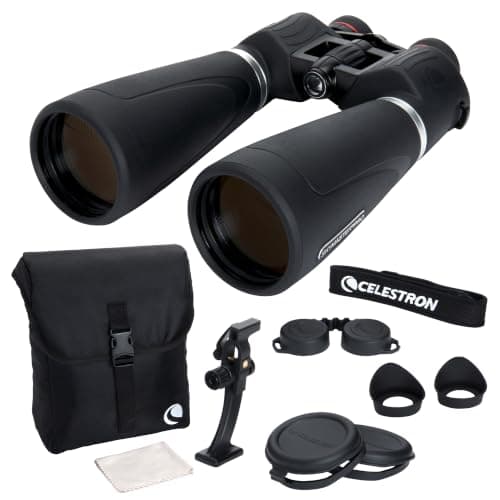 Celestron SkyMaster Pro 15x70 Optically identical to the 15x70 on paper; waterproof, XLT-coated, and it brings the tripod adapter. | The same optics, sealed — for damp climates and gear that lives outside | $279.49 on Amazon #ad How we’re funded · price as of October 18, 2026 |
| 4 | 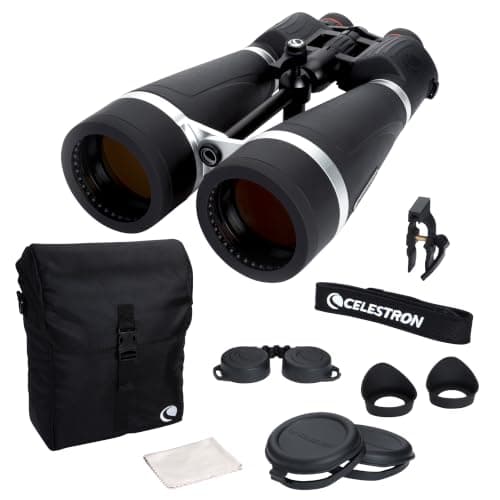 Celestron SkyMaster Pro 20x80 80mm and XLT coatings in a sealed body — the most capable SkyMaster you can still carry in one hand. | Serious deep-sky work, if the tripod is already solved | |
| 5 | 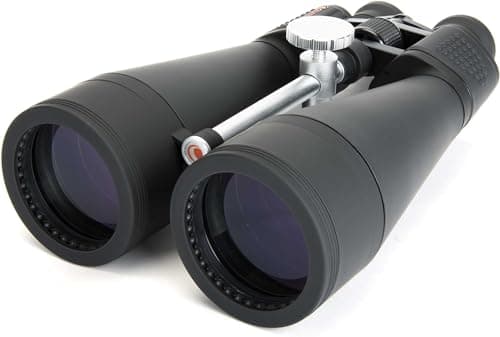 Celestron SkyMaster 20x80 Lighter than the Pro, with a wider published field and longer eye relief — and no weather sealing. | The same 80mm aperture for less, when sealing is not the point | |
| 6 | 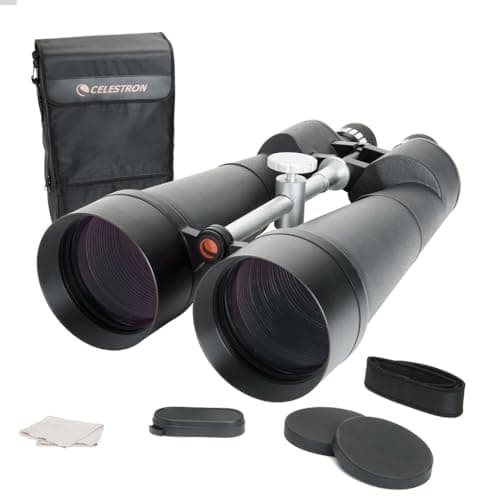 Celestron SkyMaster 25x100 100mm objectives put this in telescope territory — and 8.75 lbs puts it on a pier, not in your hands. | A fixed observing spot, a heavy tripod, and a dark sky | |
| ! | 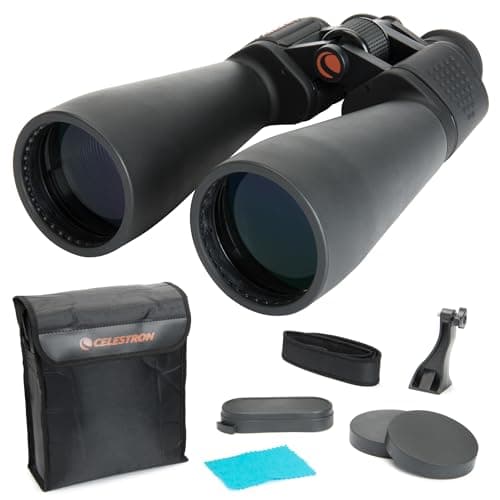 Celestron SkyMaster 25x70 Same 70mm glass as the 15x70, heavier, with the narrowest field, shortest eye relief and smallest exit pupil in the line. Skip this one — see why below | Nobody, on Celestron's own published figures | Not recommended |
Rows link to the full write-up further down this page. Prices come from the live price layer only; where there is no live figure the button reads “Check price” rather than showing a number we remembered.
What the Pro tier actually buys
Both Pro models cost substantially more than their standard counterparts, so it is worth being precise about what moves and what does not.
| 15x70 to Pro 15x70 | 20x80 to Pro 20x80 | |
|---|---|---|
| Optical formula | Unchanged — 4.4 deg, 231 ft at 1000 yds | Changes — field narrows, 3.7 deg to 3.2 deg |
| Coatings | Multi-coated to fully multi-coated XLT | Multi-coated to fully multi-coated XLT |
| Sealing | Water resistant to waterproof, nitrogen filled | Water resistant to waterproof, nitrogen filled |
| Eye relief | 18mm to 17mm | 18mm to 15.5mm |
| Weight | 48 oz to 51 oz | 75 oz to 86.4 oz |
| Tripod adapter in box | No to yes | Not listed either way |
Both Pro models add a reflex sight rail for an optional red dot finder, which is not included. Figures from Celestron's published specifications for all four models.
At 15x70 the Pro upgrade is clean: identical optics, better coatings, a sealed body, and the tripod adapter thrown in. At 20x80 it is a genuine trade — you gain sealing and coatings but give up field of view and 3mm of eye relief, and you carry 11 oz more.
Our rule: pay for Pro when the binocular will be exposed to damp, dew or salt air, because internal fogging and fungus are not repairable faults. If it will be stored indoors and used from a garden, put the difference toward the tripod you are going to need anyway.
Weight, and the tripod you have not budgeted for
Published weights are the most under-read specification in this category, because they decide whether the thing gets used.
| Model | Weight | What that means in practice |
|---|---|---|
| SkyMaster 12x60 | 39.2 oz (2.45 lbs) | Briefly handheld if braced; a light tripod is enough |
| SkyMaster 15x70 | 48 oz (3 lbs) | Tripod needed; most photo tripods cope |
| SkyMaster Pro 15x70 | 51 oz (3.19 lbs) | As above, and the adapter is already in the box |
| SkyMaster 25x70 | 52 oz (3.25 lbs) | Tripod needed, and the view does not repay it |
| SkyMaster 20x80 | 75 oz (4.69 lbs) | A sturdy tripod, not a travel one |
| SkyMaster Pro 20x80 | 86.4 oz (5.4 lbs) | A sturdy tripod with a geared or fluid head |
| SkyMaster 25x100 | 140 oz (8.75 lbs) | A heavy tripod or a pier, and a fixed observing spot |
Ounces as published by Celestron; pounds are those figures divided by 16.
The pattern that catches people out is at the bottom of the table. The 25x100 weighs 3.6 times what the 12x60 does, and the mount it needs costs a multiple of the cheaper binocular. Working out which tripod and adapter you need is the subject of our binocular tripod adapter guide, and it is worth reading before rather than after.
Three questions that decide it
- Do you already own a tripod, and what will it hold? If the answer is none, buy the 12x60 and brace it, or budget for a tripod plus adapter alongside a 15x70. If you own something sturdy, the 80mm models open up. If you own something genuinely heavy, the 25x100 becomes possible.
- How dark is the sky where you will actually use it? Under light pollution the wide-exit-pupil models (12x60, either 15x70) give the better view, because a 4mm exit pupil in a bright sky mostly magnifies the sky glow. At a dark site the aperture models pull ahead sharply.
- Will it live indoors or outdoors? Indoors and used occasionally: standard tier. Outdoors, damp, coastal, or stored in a shed or boat: pay for a Pro, because sealing is the one thing on this list you cannot add later.
Notice what is not on that list: magnification. It is the number on the box and the first thing most buyers compare, and within a single aperture it is the one that most reliably makes the view worse.
What we did and did not do here
We have not handled any of these seven binoculars and we do not say otherwise. Every figure above was read from Celestron's own published specification page for that model, re-checked on the date at the top of this page, and linked in the sources below. The exit-pupil divisions, the surface-brightness percentages, the area ratios and the pound conversions are our arithmetic on those published figures, shown in full so you can redo every one of them. Our standing method is on the methodology page.
One availability note, because it affects what you will find when you click. At the time of writing the 12x60, 25x70 and standard 20x80 are listed out of stock on Celestron's own store while remaining stocked at the major retailers; the Pro 15x70 is in stock at Celestron. All seven carried a live retailer offer when we checked. Where a price appears on a button above it came from the live price feed on the date shown beside it, never from us.
The picks in full
Pick 1
Celestron SkyMaster 15x70
Most people, and the best balance in the line
The arithmetic
The counter-intuitive number: 70 / 15 = 4.7mm exit pupil, against 7.1mm for a 7x50. More objective glass, but spread across more magnification — so into a child's fully dark-adapted 7mm pupil this delivers roughly (4.7 / 7.1) squared, about 44 percent of the light the cheaper 7x50 does. The 70mm advantage is real only for an adult eye that no longer dilates past 5mm, or on a tripod where the extra reach pays. At 48 oz it is 1.76 times the weight of a 7x50 and 15x magnifies hand tremor fifteen times: this is a tripod instrument, not a handheld one.
This is the model the rest of the line has to argue with. 70mm divided by 15x gives a 4.7mm exit pupil, and nothing else in the SkyMaster range pairs that much light per unit of image with that little weight. Its published 4.4 degree field is second only to the 12x60's, and it sits at the bottom of the line's price range alongside the 12x60.
Set against the 25x70 — the same 70mm objective, more magnification, and a meaningfully higher price — the arithmetic is lopsided. Image surface brightness goes with the square of the exit pupil, so dropping from 4.7mm to 2.8mm leaves you looking at roughly a third of the brightness on the same glass. More magnification is not more telescope.
What you are buying is a tripod instrument that happens to be cheap, not a handheld binocular. We say the same thing in the full SkyMaster 15x70 review, and it is the whole reason the tripod adapter guide exists on this site.
The honest limit: for a child, a 7x50 or 10x50 delivers more light to a dark-adapted young eye than this does, because a 7mm pupil can use all of a 7x50's exit pupil and only two thirds of this one's. If the user is under about twelve, start at binoculars for stargazing instead.
Skip it if
You have no tripod and no intention of buying one. 48 oz at 15x magnifies hand tremor fifteen times, and there is no tripod adapter in the box either — so the real cost of this model is the binocular plus an adapter plus a tripod. If that is not the plan, the 12x60 below is the honest choice.
| Magnification | 15x |
|---|---|
| Objective lens | 70mm (2.75") |
| Prism glass | BaK-4 |
| Lens coatings | Multi-coated |
| Angular field of view | 4.4 degrees |
| Linear field at 1000 yds | 231 ft (77 m) |
| Exit pupil | 4.7mm (.18") |
| Eye relief | 18mm (.71") |
| Close focus | 43 ft (13 m) |
| Weight | 48 oz (1361 g) |
| Tripod adaptable | Yes |
| Environmental | Water resistant |
| What the box does not do | No tripod and no tripod adapter in the box, and it genuinely needs both — 48 oz at 15x cannot be held steady by anyone, let alone a child. Water resistant, not waterproof. A 43 ft close focus rules out any daytime use in a garden. |
Specifications from Celestron — SkyMaster 15x70 specifications. We have not handled this one — everything above is the published spec sheet plus our own arithmetic on it.
Pick 2
Celestron SkyMaster 12x60
The widest, brightest view in the line, and the lightest body
The arithmetic
60 divided by 12 gives a 5mm exit pupil — the widest in the SkyMaster line. Image surface brightness scales with the square of the exit pupil, so against the 25x70's published 2.8mm this shows roughly (5 / 2.8) squared, about 3.2 times the image brightness, despite having the smaller objective. Its 5.3 degree field is the widest here too, around ten Moon-widths, which is the single thing that makes a faint target findable without a finder. At 39.2 oz it is the lightest in the line and the only model within sight of handheld use — though 12x still multiplies hand tremor twelve times, so steadied against something is the realistic way to use it.
Every published figure that governs how a night view feels points at this model. 60 divided by 12 is a 5mm exit pupil, the widest in the line; 5.3 degrees is the widest field, roughly ten Moon-widths across; and 39.2 oz is the lightest body, about 2.45 lbs.
That combination is what makes a target findable. A 5.3 degree field means you can sweep along the Milky Way and land on something without a finder, which is the single most common reason a beginner gives up on big binoculars — not that the view is dim, but that they cannot get the object inside it.
It is also the only SkyMaster where handheld is a real, if brief, proposition. 12x still multiplies tremor twelve times, so steadied against a wall, a fence or a car roof is how it actually gets used. Celestron publishes it as tripod adaptable, but no adapter is in the box.
The trade is aperture, and it is a genuine one. 60mm against 70mm is a 27 percent light deficit by area, and against the 25x100's 100mm it is about 36 percent. This is the model for sweeping and for learning the sky, not for chasing faint fuzzies.
Skip it if
You want reach. 60mm is the smallest objective in the line and gathers about 73 percent of what a 70mm does, so on faint galaxies and globular clusters it is the first model here to run out of light. If deep sky is the goal rather than sweeping the Milky Way, go up to 70mm or 80mm.
| Item number | 71007 |
|---|---|
| Magnification | 12x |
| Objective diameter | 60mm (2.36") |
| Prisms | BaK-4 porro |
| Coatings | Multi-coated |
| Angular field of view | 5.3 degrees |
| Linear field of view | 278 ft at 1000 yds (92 m) |
| Exit pupil | 5mm (.2") |
| Eye relief | 17mm (.67") |
| Close focus | 59 ft (18 m) |
| Weight | 39.2 oz (1111 g) |
| Tripod adaptable | Yes |
| Weather sealing | Water resistant |
| Included | Objective lens cap, rainguard, carrying case, neck strap, lens cloth, manual |
| Warranty | Limited lifetime |
| What the box does not do | No tripod and, unlike the 25x70 and the Pro models, no tripod adapter either — so the mount that 12x really wants is two separate purchases. Water resistant, not waterproof. A 59 ft close focus rules out close-range daytime use in a garden. |
Specifications from Celestron — SkyMaster 12x60 specifications. We have not handled this one — everything above is the published spec sheet plus our own arithmetic on it.
#ad How we’re funded · price as of October 18, 2026
Pick 3
Celestron SkyMaster Pro 15x70
The same optics, sealed — for damp climates and gear that lives outside
The arithmetic
Optically this is the standard 15x70: the same 15x on 70mm, the same published 4.4 degree field and the same 231 ft linear field at 1000 yards. Celestron publishes a 4.6mm exit pupil against the standard model's 4.7mm, which is the same number inside rounding. The whole difference is build — waterproof and nitrogen filled against merely water resistant, fully multi-coated XLT against plain multi-coated, and a box that includes the tripod adapter and a reflex sight rail that the standard model leaves out. That costs 3 oz, 51 against 48. The thing to know before paying the Pro premium is what it buys: sealing, coatings and the mount hardware, not reach.
Put the two 15x70 spec sheets side by side and the optics do not move: 15x on 70mm, 4.4 degrees of field, 231 ft at 1000 yards on both. Celestron publishes a 4.6mm exit pupil here against 4.7mm on the standard model, which is the same number inside rounding.
What changes is everything around the glass. Waterproof and nitrogen filled instead of merely water resistant. Fully multi-coated with XLT instead of plain multi-coated. And a box that includes the tripod adapter and a reflex sight rail, both of which the standard model leaves out — so some of the price gap is hardware you would otherwise buy.
Nitrogen filling is the part worth paying for if it applies to you. A sealed, dry-gas-filled body does not fog internally when you carry it from a warm house into cold air, and it does not grow fungus in a humid climate. If the binocular will live in a shed, a boat or a Gulf Coast summer, that is a real durability argument rather than a specification.
The reflex sight rail matters more than it sounds, too: aiming a 4.4 degree field at something faint is genuinely hard, and the rail accepts a red dot finder. The finder itself is not included.
Skip it if
Your binoculars live in a cupboard and come out on clear nights. You would be paying a substantial premium over the standard 15x70 for sealing you will never test and coatings whose benefit Celestron does not quantify. The optical formula is the same — buy the cheaper one and put the difference toward a better tripod.
| Item number | 72030 |
|---|---|
| Magnification | 15x |
| Objective diameter | 70mm (2.75") |
| Prisms | BaK-4 porro |
| Coatings | Fully multi-coated, XLT |
| Angular field of view | 4.4 degrees |
| Linear field of view | 231 ft at 1000 yds (77 m) |
| Exit pupil | 4.6mm (.18") |
| Eye relief | 17mm (.67") |
| Close focus | 49.2 ft (15 m) |
| Weight | 51 oz (1450 g) |
| Tripod adaptable | Yes, tripod adapter included |
| Weather sealing | Waterproof, nitrogen filled |
| Included | Tripod adapter, reflex sight rail, objective lens caps, interchangeable flared eyecups, rainguard, neck strap, lens cloth, manual |
| Warranty | Limited lifetime |
| What the box does not do | No tripod — the adapter is included, the tripod is not, and 15x needs one. No red dot finder either: the reflex sight rail is a mount for an accessory sold separately. A 49.2 ft close focus is the shortest in the line but still rules out close daytime use. |
Specifications from Celestron — SkyMaster Pro 15x70 specifications. We have not handled this one — everything above is the published spec sheet plus our own arithmetic on it.
#ad How we’re funded · price as of October 18, 2026
Pick 4
Celestron SkyMaster Pro 20x80
Serious deep-sky work, if the tripod is already solved
The arithmetic
The interesting comparison is against the 25x100 above rather than against a hand-held binocular. This is 86.4 oz against 140 — 5.4 lbs against 8.75 — for 80mm objectives against 100mm, which by the square of the ratio is about 64 percent of the light. Both land on the same 4mm exit pupil, because dividing 80 by 20 and 100 by 25 gives the same answer. What the Pro adds over the bigger model is sealing and coatings that Celestron publishes as fully multi-coated with XLT, against plain multi-coated on the 25x100, plus a rail for a red dot finder — which matters more than it sounds, because aiming a 3.2 degree field at a faint object is genuinely hard.
80mm gathers about 1.78 times the light of a 60mm objective and about 1.31 times a 70mm, by the ratio of their areas. That is the step up this model exists to sell, and with XLT coatings and a sealed nitrogen-filled body it is the best-built thing in the line on published sealing and coatings — the 25x100 is bigger but only water resistant and plain multi-coated.
Its 4mm exit pupil is narrower than a dark-adapted eye can fill, which means it rewards a genuinely dark site and punishes a suburban one. Under light pollution a 4mm exit pupil shows you a gray sky in more detail; under a dark sky it shows you structure in the Milky Way that a 60mm cannot reach.
There is a detachable reflex sight rail for an optional red dot finder, which on a 3.2 degree field is close to essential rather than a luxury. The finder is sold separately.
Note one oddity in Celestron's own figures before you assume Pro means better in every row: the standard 20x80 publishes a wider field (3.7 degrees against 3.2) and longer eye relief (18mm against 15.5mm) than this model. We work through that trade in the full Pro 20x80 review.
Skip it if
You do not already own a tripod rated well above 5.4 lbs. At 86.4 oz this is the second-heaviest model in the line, and a photo tripod that holds a camera steady will visibly tremble under it. The tripod is not an accessory here, it is half the purchase, and it is not in the box.
| Item number | 72031 |
|---|---|
| Magnification | 20x |
| Objective diameter | 80mm (3.15") |
| Prisms | BaK-4 porro |
| Coatings | Fully multi-coated, XLT |
| Angular field of view | 3.2 degrees |
| Linear field of view | 168 ft at 1000 yds (56 m) |
| Exit pupil | 4mm (.15") |
| Eye relief | 15.5mm (.61") |
| Close focus | 66.2 ft (20.2 m) |
| Tripod adaptable | Yes |
| Weather sealing | Waterproof, nitrogen filled |
| Also included | Detachable reflex sight rail for an optional red dot finder |
| Weight | 86.4 oz (2449 g) |
| Warranty | Limited lifetime |
| What the box does not do | Still too heavy to hold: at 20x and 5.4 lbs this wants a tripod for anything longer than a glance, and no tripod is included. The 4mm exit pupil is narrower than a dark-adapted eye can use, and a 66 ft close focus rules out most daytime use. |
Specifications from Celestron — SkyMaster Pro 20x80 specifications. We have not handled this one — everything above is the published spec sheet plus our own arithmetic on it.
Pick 5
Celestron SkyMaster 20x80
The same 80mm aperture for less, when sealing is not the point
The arithmetic
The comparison that matters is the Pro 20x80: the same 20x on the same 80mm, so the same 4mm exit pupil and the same light collected. What the published specs actually separate is build and bulk. This model is 75 oz against the Pro's 86.4 — 4.7 lbs against 5.4 — and it publishes the WIDER field of the two, 3.7 degrees against 3.2, with longer eye relief at 18mm against 15.5mm. The Pro premium buys waterproof nitrogen-filled sealing and XLT coatings, not reach. For scale on the aperture itself: 80mm gathers about 1.78 times the light of a 60mm objective and about 1.31 times a 70mm, by the ratio of their areas.
This is the value answer to the Pro 20x80, and on two published rows it is actually the better instrument. Its field is 3.7 degrees against the Pro's 3.2, and its eye relief is 18mm against 15.5mm — the longest in the entire line, which matters if you observe wearing glasses.
It is also lighter: 75 oz against 86.4, or 4.69 lbs against 5.4. On a tripod that is 11 oz less to hold steady, and in a bag it is the difference between taking it and leaving it.
You keep the full 80mm aperture and the same 4mm exit pupil, because 80 divided by 20 gives the same answer whichever tier you buy. What you give up is the XLT coating spec and, more importantly, the sealing.
Choose this over the Pro if it will be used from a garden or a car and stored indoors. Choose the Pro if it will live in damp air. That is genuinely the whole decision — the optics are the same size.
Skip it if
The binocular will be out in dew, damp or sea air. This is water resistant, not waterproof and not nitrogen filled, which is the one place the Pro premium buys something you cannot add later. Internal fogging and fungus are not problems you fix on a binocular; they are reasons it gets replaced.
| Item number | 71018 |
|---|---|
| Magnification | 20x |
| Objective diameter | 80mm (3.15") |
| Prisms | BaK-4 porro |
| Coatings | Multi-coated |
| Angular field of view | 3.7 degrees |
| Linear field of view | 195 ft at 1000 yds (65 m) |
| Exit pupil | 4mm (.15") |
| Eye relief | 18mm (.71") |
| Close focus | 108 ft (33 m) |
| Weight | 75 oz (2126 g) |
| Tripod adaptable | Yes |
| Weather sealing | Water resistant |
| Included | Objective lens caps, rainguard, nylon carrying case, neck strap, lens cloth, manual |
| Warranty | Limited lifetime |
| What the box does not do | No tripod and no tripod adapter listed in the box, and 4.7 lbs at 20x cannot be held steady by anyone. Water resistant, not waterproof — the sealing is the main thing you give up against the Pro. A 108 ft close focus is the longest in the line, which makes it useless for anything nearby. |
Specifications from Celestron — SkyMaster 20x80 specifications. We have not handled this one — everything above is the published spec sheet plus our own arithmetic on it.
Pick 6
Celestron SkyMaster 25x100
A fixed observing spot, a heavy tripod, and a dark sky
The arithmetic
100mm objectives put this in telescope territory: each side gathers about the same light as the 102mm refractors we review, and the pair gathers roughly twice what a 70mm telescope does. The arithmetic that decides whether you enjoy it is the weight against the magnification. 140 oz is 8.75 lbs, and at 25x every tremor in your hands is multiplied twenty-five times, so this is a tripod instrument in the same way a telescope is — not as a refinement, as a requirement. Objective divided by magnification gives a 4mm exit pupil, narrower than a dark-adapted adult eye, so it is less forgiving of a bright sky than a 7x50.
Each 100mm side gathers roughly the same light as a 102mm refractor, and the pair gathers about 2.04 times what a 70mm model here does and 2.78 times the 60mm. On a dark night, pointed at the Double Cluster or the Andromeda Galaxy, that is a genuinely different experience from everything above it in this list.
It is last on this ranking anyway, and the reason is not optical. It is 8.75 lbs with a 3 degree field and a 4mm exit pupil, which means it needs a tripod most buyers do not own, a dark sky most buyers do not have, and a fixed spot to observe from. Meet those three conditions and it is the most capable binocular Celestron sells under this name. Miss one and it sits in a cupboard.
Worth noting that its exit pupil is the same 4mm as both 80mm models — 100 divided by 25 and 80 divided by 20 land on the same figure. So extended objects do not look brighter through it than through a Pro 20x80; there is simply more aperture resolving more detail and reaching fainter stars.
The full 25x100 review goes through the mounting problem properly, because that is the part that decides whether anyone enjoys owning one.
Skip it if
You will have to carry it anywhere or mount it on anything ordinary. 140 oz is 8.75 lbs, more than many photo tripods will hold without visible shake at full extension, and the pairing problem is yours to solve. It also uses individual eyepiece focus, so each side is refocused separately.
| Item number | 71017 |
|---|---|
| Magnification | 25x |
| Objective diameter | 100mm (3.94") |
| Prisms | BaK-4 porro |
| Coatings | Multi-coated |
| Angular field of view | 3 degrees |
| Linear field of view | 156 ft at 1000 yds (52 m) |
| Exit pupil | 4mm (.15") |
| Eye relief | 15mm (.59") |
| Close focus | 80 ft (24.4 m) |
| Focus | Individual eyepiece focus |
| Tripod adaptable | Yes, integrated tripod adapter rod |
| Weather sealing | Water resistant |
| Weight | 140 oz (3969 g) |
| Included | Nylon carrying case, rainguard, lens caps, neck strap |
| Warranty | Limited lifetime |
| What the box does not do | No tripod, and the one you own may not be enough — 8.75 lbs at full extension is more than many photo tripods will hold steady. The 80 ft close focus makes it useless for anything terrestrial nearby, individual eyepiece focus means refocusing each side when you change target distance, and water resistant is not waterproof. |
Specifications from Celestron — SkyMaster 25x100 specifications. We have not handled this one — everything above is the published spec sheet plus our own arithmetic on it.
Skip this
Celestron SkyMaster 25x70
Nobody, on Celestron's own published figures
The arithmetic
One number decides this model: 70 divided by 25 gives a 2.8mm exit pupil, the narrowest in the SkyMaster line. Because image surface brightness goes with the square of the exit pupil, against the 15x70 — the same 70mm objective with less magnification — this shows roughly (2.8 / 4.7) squared, about 35 percent of the image brightness. It is also the heavier of the two 70mm models at 52 oz against 48, publishes the narrowest field here at 2.7 degrees, and has the shortest eye relief in the line at 13mm. Same glass, more magnification, and every published figure that governs a night view moves the wrong way.
This is the one model in the line we would tell you not to buy for stargazing, and we are not relying on opinion to say it. Line up Celestron's published figures for the 25x70 against the 15x70 — the same 70mm objective, the same prisms, the same coatings, with the 25x70 the more expensive of the two.
Exit pupil: 2.8mm against 4.7mm. Because image surface brightness goes with the square of the exit pupil, that is roughly 35 percent of the brightness on identical glass. Field of view: 2.7 degrees against 4.4, the narrowest in the line, which makes finding anything materially harder. Eye relief: 13mm against 18mm, the shortest in the line and tight for anyone in glasses. Weight: 52 oz against 48, so it is also the heavier of the two.
Four published rows, four losses, same aperture. The extra magnification spreads the same light over a bigger, dimmer image and narrows the window you have to find things through. It does include a tripod adapter the 15x70 omits, which is the one point in its favor and does not come close to covering the gap.
The pattern is worth carrying into any binocular purchase: on a fixed aperture, magnification is a cost, not a feature. We make the same case across formats on 7x50 vs 10x42.
Skip it if
Always, in our view — and the reason is arithmetic rather than taste. If you specifically want 25x on 70mm for terrestrial long-range use in daylight, where a 2.8mm exit pupil is not a handicap, it becomes defensible. For night sky use there is no column in which it beats the cheaper 15x70.
| Item number | 71008 |
|---|---|
| Magnification | 25x |
| Objective diameter | 70mm (2.75") |
| Prisms | BaK-4 porro |
| Coatings | Multi-coated |
| Angular field of view | 2.7 degrees |
| Linear field of view | 141 ft at 1000 yds (47 m) |
| Exit pupil | 2.8mm (.11") |
| Eye relief | 13mm (.51") |
| Close focus | 75 ft (23 m) |
| Weight | 52 oz (1474 g) |
| Tripod adaptable | Yes, tripod adapter included |
| Weather sealing | Water resistant |
| Included | Objective lens caps, tripod adapter, rainguard, nylon carrying case, neck strap, lens cloth, manual |
| Warranty | Limited lifetime |
| What the box does not do | No tripod, though a tripod adapter is in the box — and at 25x a tripod is a requirement rather than a refinement. Water resistant, not waterproof. 13mm of eye relief is the least in the line and is tight for anyone who observes in glasses. A 75 ft close focus rules out most daytime use. |
Specifications from Celestron — SkyMaster 25x70 specifications. We have not handled this one — everything above is the published spec sheet plus our own arithmetic on it.
Questions people actually ask
- Which Celestron SkyMaster is the best?
- For most buyers the 15x70, because it has the widest useful exit pupil of any 70mm in the line and sits at the bottom of the price range. The 25x100 is the most capable if you have a heavy tripod and a dark sky, and the 12x60 gives the widest, brightest field.
- What is the difference between SkyMaster and SkyMaster Pro?
- Build rather than reach. Pro models are waterproof and nitrogen filled instead of water resistant, and fully multi-coated with XLT coatings instead of plain multi-coated. At 15x70 the optical formula is otherwise identical; at 20x80 the Pro's field is narrower, 3.2 degrees against 3.7.
- Is the Celestron SkyMaster 25x70 any good?
- Not for stargazing, on Celestron's own figures. It uses the same 70mm objective as the 15x70 but publishes a 2.8mm exit pupil against 4.7mm, a 2.7 degree field against 4.4, 13mm of eye relief against 18mm, and it weighs more. The cheaper 15x70 beats it in every one of those rows.
- Can you use SkyMaster binoculars without a tripod?
- Only really the 12x60, and only braced against something solid. The line starts at 12x and a steady handheld view tops out around 10x, so every model is a tripod instrument. Only the 25x70 and the Pro models include a tripod adapter.
- Which SkyMaster is best for a child?
- Usually none of them. These are heavy, tripod-mounted adult instruments, and for a child under about twelve a handheld 7x50 or 10x50 puts more light into a dark-adapted young eye and can be used without a mount. If an adult will set it up and share it, the 12x60 is the lightest way in.
- What does exit pupil mean on binoculars?
- It is the objective diameter divided by the magnification, in millimeters, and it governs how bright extended objects look. Surface brightness scales with its square, so a 2.8mm exit pupil shows roughly a third the brightness of a 5mm one. A dark-adapted young eye can use about 7mm.
- Is the SkyMaster 25x100 worth it?
- Only if you can meet three conditions: a tripod rated well above 8.75 lbs, a dark sky, and a fixed spot to observe from. Each 100mm side gathers about as much light as a 102mm refractor, so when those conditions are met it is a genuinely different experience. Miss one and it goes unused.
Sources
- Celestron — SkyMaster 12x60 specifications
- Celestron — SkyMaster 15x70 specifications
- Celestron — SkyMaster 25x70 specifications
- Celestron — SkyMaster 20x80 specifications
- Celestron — SkyMaster Pro 15x70 specifications
- Celestron — SkyMaster Pro 20x80 specifications
- Celestron — SkyMaster 25x100 specifications
Read next
Where to go from here
- Celestron SkyMaster 15x70 review
The big-binocular option, reviewed honestly: 70mm objectives that deliver less light to a dark-adapted child's eye than a 7x50, and 48 oz that demand a tripod.
- Celestron SkyMaster 25x100 review
100mm per side puts this in telescope territory, and 8.75 lbs at 25x puts it permanently on a tripod. The arithmetic on what that buys, and what it costs.
- Celestron SkyMaster Pro 20x80 review
80mm per side, waterproof and nitrogen filled, with XLT coatings and a detachable finder rail. Two-thirds the light of a 25x100 at 62 percent of the weight.
- Celestron SkyMaster Pro ED 20x80 review
Top of the SkyMaster line. Every published light figure matches the cheaper Pro 20x80 exactly, because it is the same 20x on the same 80mm — so what you are buying is color correction, for 43 percent more weight and no sight rail.
- Celestron SkyMaster Pro ED 7x50 review
7x50 is the format we recommend more than any other, and this is the expensive version of it: 7.8 degrees of field, 20.8mm of eye relief, IPX7 sealing — and 62 percent more weight than the budget pick it has to beat.
- Celestron SkyMaster Pro ED 15x70 review
The last SkyMaster we had not reviewed. It adds ED glass and a published limiting magnitude of 11.73, and it costs about 11 percent more than the non-ED Pro 15x70 while weighing 44 percent more and dropping both the tripod adapter and the reflex sight rail.
- Putting binoculars on a tripod: adapter, tripod, and the height nobody checks
The cheapest fix for the most common binocular disappointment. Which binoculars accept an adapter, what tripod height actually matters for looking up, and what this will not fix.
- The best binoculars for stargazing with kids
The exit pupil calculation that decides which binoculars suit a child, and what a 7x50 actually shows on a first clear night.
- Binoculars for kids, by age
What a child can physically hold at each age, and which published weight and eye-relief figures to check before buying.
- 7x50 versus 10x42: which for a child, and why
The exit pupil arithmetic that settles the classic binocular argument, and why the answer is different for a child than for an adult.
- The best stargazing binoculars under $100
Three pairs under $100, judged on exit pupil, prism glass and steadiness rather than on magnification claims — plus the two corners this budget always cuts.
- What you can actually see with a kids' telescope
The honest target-by-target list for 70mm, 76mm and 114mm telescopes, so nobody is disappointed on night one.
- How much should you spend on a telescope for a child?
Band by band, what the money buys and where it stops helping. The jump from $60 to $150 matters more than the one above it.