Binoculars
Celestron SkyMaster Pro ED 7x50 review
The only SkyMaster you can hold, the widest field in the line, and a spec sheet that argues with itself.

By Scooter M. · published October 13, 2026
I'm not an astronomer and I don't have a lab. I'm someone who's genuinely into this — I read the manuals, compile the published specs, and do the arithmetic the box doesn't do for you. No lab coat. How we pick.
How this is funded. Lens & Lightyear earns a commission when you buy through a link on this page, at no extra cost to you. It does not change which products we pick or what we say about them — every card below carries a real reason to skip it. Prices are pulled live and were last verified October 18, 2026. Full disclosure.
The short answer
For an adult, especially one who wears glasses: yes. It has the widest field and longest eye relief in the SkyMaster line and is the only model in it you can hold. For a child, no — the Cometron 7x50 is the same format, 17 oz lighter, and a fraction of the price.
7x50 is the format we recommend more than any other on this site, so the expensive version of it deserves a proper look. This is also the only SkyMaster that is not a tripod instrument, which makes it the odd one out in its own line in a way the marketing does not mention.
The one SkyMaster you can actually hold
The SkyMaster range runs from 12x to 25x. A steady handheld view tops out at roughly 10x, which means every other model in the line needs a tripod and an adapter before it needs anything else — and on most of them neither is in the box.
At 7x this one sits comfortably under that limit. It is also the only model in the line whose exit pupil approaches what a dark-adapted eye can use: the other six publish between 2.8mm and 5mm, where this one publishes figures in the 6.4mm to 7.14mm range. Those two facts together make it a different instrument from its siblings rather than a smaller one.
The spec sheet contradicts itself, and the arithmetic says which row is wrong
Celestron publishes three figures that describe how much light this binocular delivers. Two of them reconcile perfectly with a plain 7x on 50mm. The third does not reconcile with anything, and because this site publishes the arithmetic rather than the conclusion, here it is in full.
- Twilight factor, published as 18.7. The convention is the square root of magnification times objective: the square root of 7 x 50 = the square root of 350 = 18.708. Match.
- Relative brightness, published as 51.02. The convention is the exit pupil squared: (50 / 7) squared = 51.0204. Match, to four figures.
- Exit pupil, published as 6.4mm. The convention is objective divided by magnification: 50 / 7 = 7.14mm. No match.
Notice what the second line means. A relative brightness of 51.02 is only produced by an exit pupil of 7.14mm, because the square root of 51.02 is 7.14. So Celestron's own relative-brightness figure encodes a 7.14mm exit pupil two rows below a row that says 6.4mm. Going the other way, a genuine 6.4mm exit pupil on a 50mm objective would mean a magnification of 7.8x, and a relative brightness of 40.96 rather than the 51.02 printed on the same page.
What can be said safely is that the disagreement is small in practice and the model wins its own line either way. At 6.4mm it is still the widest exit pupil in the SkyMaster range by a distance — the next widest is the 12x60's 5mm — and at 7.14mm it is the only one that fills a dark-adapted young eye. For contrast, the Pro ED 20x80 publishes all three figures in perfect agreement with each other, so this is not a systematic problem with Celestron's sheets.
Against the 7x50 we normally recommend
The useful comparison is not against the rest of the SkyMaster line, which is tripod-class and aimed elsewhere. It is against the budget 7x50 that leads several pages on this site.
| SkyMaster Pro ED 7x50 | Cometron 7x50 | |
|---|---|---|
| Magnification / objective | 7x, 50mm | 7x, 50mm — identical |
| Angular field of view | 7.8 degrees | 6.6 degrees |
| Linear field at 1000 yds | 409 ft (136 m) | 344 ft (105 m) |
| Eye relief | 20.8mm | 13mm |
| Exit pupil (published) | 6.4mm — contradicts its own sheet | 7.1mm — matches 50 / 7 |
| Prisms | BaK-4 | BK7 |
| Coatings | Fully multi-coated, XLT | Multi-coated |
| Weather sealing | Waterproof IPX7, nitrogen filled | Water resistant |
| Close focus | 26.2 ft (8 m) | 26.2 ft (8 m) — identical |
| Weight | 44.3 oz (2.77 lbs) | 27.3 oz (1.71 lbs) |
| Tripod adapter in box | No | No |
| Price bracket | Middle of the SkyMaster range | Bottom of the market |
Both columns from Celestron's own published specification pages, linked at the foot of this page. Bold marks the better figure for night sky use. The ED glass itself is absent from this table because Celestron publishes no figure for it.
Six rows favor the Pro ED, and they are not trivial: 18 percent more linear field, 60 percent more eye relief, better prism glass, better coatings, and sealing that survives being rained on. If you wear glasses, the eye relief row on its own may decide it — 13mm behind spectacles shows you a keyhole.
Two rows favor the Cometron, and for this site's readers they are the deciding ones: 17 fewer ounces, and an exit pupil figure that is internally consistent. It is also the cheapest real binocular on the site, which is why it leads binoculars for stargazing and appears on binoculars by age.
Quick picks
The Pro ED 7x50 against the 7x50 we usually recommend
| # | Product | Best for | Price |
|---|---|---|---|
| 1 | 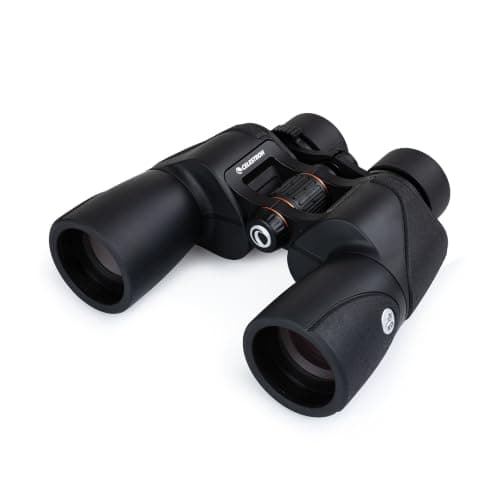 Celestron SkyMaster Pro ED 7x50 The widest field and by far the longest eye relief in the SkyMaster line, in the only format in that line you can hold up to the sky. | An adult who wants the 7x50 format done properly, and wears glasses | |
| 2 | 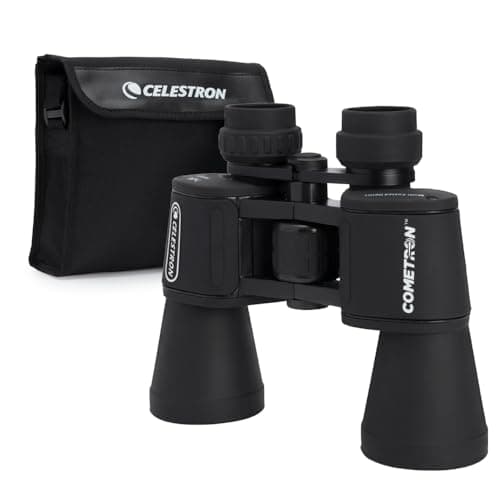 Celestron Cometron 7x50 The same 7x50 format at a fraction of the price and 17 oz lighter — still our most-recommended binocular on this site. | Almost every child, and most first-time buyers | |
| 3 | 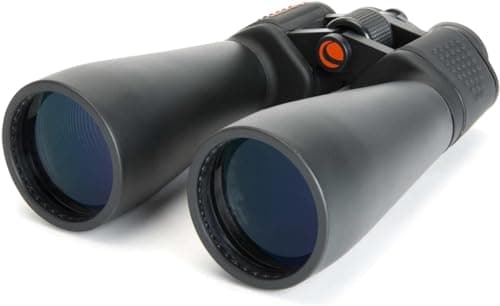 Celestron SkyMaster 15x70 If you are willing to mount it, 70mm and 15x reaches far deeper than any 7x50 — and it costs less than this one. | Anyone whose answer to a tripod is yes |
Rows link to the full write-up further down this page. Prices come from the live price layer only; where there is no live figure the button reads “Check price” rather than showing a number we remembered.
What ED glass does, and does not, do here
Extra-low dispersion glass brings different wavelengths closer to a common focus, which reduces the faint purple or green edge on high-contrast objects — the limb of the Moon, a bright planet, a bright star near the field edge. It is a real optical effect.
What it does not do is make the image brighter or the field wider. On this model the wider field and longer eye relief come from the eyepiece design, not from the ED objective, and the exit pupil is set entirely by 50 divided by 7. If you are weighing the ED premium, weigh it as color correction and build quality — which is how we framed it on the 20x80, where the non-ED sibling publishes identical light figures.
There is no non-ED SkyMaster 7x50 to compare against, so unlike the 20x80 this model has no cheaper twin inside its own line. Its real alternative is the Cometron above, which is a different class of product rather than the same product without ED glass.
Who should buy this
| If this is you | Buy | Why |
|---|---|---|
| An adult who wears glasses and wants a wide, comfortable night-sky view | The Pro ED 7x50 | 20.8mm of eye relief and 7.8 degrees of field are the best figures in the line, and no other SkyMaster can be held at all. |
| Buying for a child, or buying your first binocular | The Cometron 7x50 | Same 7x50 format, 17 oz lighter, a consistent 7.1mm exit pupil, and a fraction of the price. |
| You want to see fainter objects and will accept a tripod | The SkyMaster 15x70 | About 1.96 times the light of a 50mm objective, for less money than this. Needs a tripod and an adapter. |
| It will live in a boat, a shed or a damp climate | The Pro ED 7x50 | IPX7 and nitrogen filling are the one thing on this list you cannot add later. |
The honest summary for the audience this site is written for: the format is right and the instrument is good, but the price and the weight both point at an adult buyer. A parent who has caught the interest themselves is the person this makes sense for — not the eight-year-old who started it.
What we did and did not do
We have not handled or looked through this binocular and we do not say otherwise. Every figure above was read from Celestron's own published specification pages for the Pro ED 7x50 and the Cometron 7x50, re-checked on the date at the top of this page, and linked in the sources below. The twilight-factor and relative-brightness derivations, the exit-pupil contradiction, the weight ratio, the pound conversions and the area-based light ratio are our arithmetic on those published figures, shown in full so you can redo each one.
We have deliberately not resolved the exit-pupil discrepancy, and we have not estimated how much visible improvement the ED glass delivers. Celestron publishes no figure for the latter and two conflicting figures bearing on the former. Our standing method is on the methodology page.
One availability note, because it affects what you will find when you click: at the time of writing this model is listed out of stock on Celestron's own store while carrying a live offer at the major retailer. The price beside our buy button comes from the live feed on the date shown there, never from us.
The picks in full
Pick 1
Celestron SkyMaster Pro ED 7x50
An adult who wants the 7x50 format done properly, and wears glasses
The arithmetic
This spec sheet does not reconcile with itself, and the arithmetic shows which row is the outlier. Two of the three published light figures confirm a plain 7x on 50mm: twilight factor is the square root of 7 x 50 = the square root of 350 = 18.708, published as 18.7; and relative brightness is the exit pupil squared, where (50 / 7) squared = 51.0204, published as 51.02 — an exact match to four figures. Both therefore encode an exit pupil of 50 / 7 = 7.14mm. But the exit pupil row itself is published as 6.4mm, which is not 50 / 7, and which would imply either a magnification of 7.8x or a relative brightness of 40.96 rather than the 51.02 printed two rows above it. We cannot resolve the contradiction from published data and we do not guess: it may be a measured figure reflecting real vignetting, or a transcription error. Either way this is the widest exit pupil in the SkyMaster line by a distance — the next widest is the 12x60's 5mm — and at 7x it is the only SkyMaster inside the roughly 10x limit for a steady handheld view. The cost is mass: 44.3 oz is 2.77 lbs, about 62 percent heavier than the 27.3 oz Cometron 7x50 in the same optical format.
Every other SkyMaster is a tripod instrument. The line starts at 12x and runs to 25x, and a steady handheld view tops out around 10x, so the rest of the range needs a mount before it needs anything else. This is the exception, and that single fact changes what the model is for.
At 7x on 50mm it is also the only SkyMaster whose exit pupil comes near a fully dark-adapted eye. The other six land between 2.8mm and 5mm; this one publishes figures implying somewhere between 6.4mm and 7.14mm, which is the range a young pupil can actually fill. That is why 7x50 is the format we recommend more often than any other on this site, and why an expensive one is worth taking seriously.
Where it clearly earns the premium is field and eye relief. 7.8 degrees is the widest angular field in the line by a wide margin — 409 ft at 1000 yards against 344 for the Cometron and 231 for the 15x70. And 20.8mm of eye relief is enormous: it is 60 percent more than the Cometron's 13mm, which is the difference between an eyeglass wearer seeing the whole field and seeing a keyhole.
The build is the best in the line alongside the ED 20x80: BaK-4 porro prisms rather than BK7, fully multi-coated with XLT rather than plain multi-coated, waterproof to IPX7 and nitrogen filled rather than merely water resistant, and a limited lifetime warranty. For a binocular that will live in a bag or a boat, those are real.
What you do not get is a tripod adapter or a reflex sight rail, neither of which this model really needs, and what you cannot check is the ED glass itself — Celestron says it virtually eliminates chromatic aberration and publishes no figure for it, exactly as on the Pro ED 20x80.
Skip it if
A child is the user, or you want something to carry on a walk. 44.3 oz is 2.77 lbs, about 62 percent heavier than the Cometron 7x50 in the same 7x50 format, and sustained handheld viewing at that weight is tiring for an adult and genuinely not workable for small arms. The format is the right one for a child; this particular body is not.
| Item number | 72033 |
|---|---|
| Magnification | 7x |
| Objective diameter | 50mm (1.97") |
| Prisms | BaK-4 porro |
| Coatings | Fully multi-coated, XLT, with Extra-Low Dispersion (ED) objective glass |
| Angular field of view | 7.8 degrees |
| Linear field of view | 409 ft at 1000 yds (136 m) |
| Exit pupil | 6.4mm (.25") as published — see note below |
| Eye relief | 20.8mm (.82") |
| Close focus | 26.2 ft (8 m) |
| Interpupillary distance | 56mm-72mm (2.20"-2.83") |
| Diopter adjustment | Plus or minus 3 |
| Twilight factor | 18.7 |
| Relative brightness | 51.02 |
| Weight | 44.3 oz (1255 g) |
| Dimensions | 180mm x 198mm x 64mm (7.1" x 7.8" x 2.5") |
| Tripod adaptable | Yes, adapter not included |
| Weather sealing | Waterproof (IPX7), nitrogen filled |
| Included | Objective lens caps, eyepiece covers, rainguard, neck strap, lens cloth, non-silica desiccant, deluxe nylon case, manual |
| Warranty | Limited lifetime |
| What the box does not do | No tripod and no tripod adapter, though at 7x it is the one SkyMaster that does not require either. No reflex sight rail. Celestron describes the ED glass as virtually eliminating chromatic aberration and publishes no figure for it, so the headline benefit is the one row on the sheet that cannot be checked — and the exit pupil row contradicts the other two light figures, so that one cannot be relied on either. At 2.77 lbs, sustained handheld viewing is tiring for an adult and out of the question for a child. |
Specifications from Celestron — SkyMaster Pro ED 7x50 specifications. We have not handled this one — everything above is the published spec sheet plus our own arithmetic on it.
Pick 2
Celestron Cometron 7x50
Almost every child, and most first-time buyers
The arithmetic
Exit pupil is objective divided by magnification: 50 / 7 = 7.1mm, which matches Celestron's published figure. That is the single most useful number here. A fully dark-adapted young pupil opens to around 7mm, so a child uses nearly all of that 7.1mm cone and the view is as bright as the optics can make it. An adult over about forty typically dilates to 5mm or less and simply cannot use the extra — this is one of the rare cases where a child gets more out of the hardware than the grown-up does.
This is the binocular the Pro ED has to beat for this site's readers, and for a child it wins on the two things that decide whether a binocular gets used: weight and exit pupil.
27.3 oz against 44.3 — 1.71 lbs against 2.77. Our Cometron 7x50 review already calls 27.3 oz heavy for small arms held up at the sky. At 44.3 oz the question stops being whether a child will tire and becomes whether they can aim it at all.
Its published exit pupil of 7.1mm matches the formula exactly — 50 divided by 7 is 7.14 — and that is the figure that matters most for a young observer, because a fully dark-adapted young pupil opens to around 7mm and uses almost all of it. An adult over about forty typically dilates to 5mm or less and cannot use the extra, which is one of the few cases in optics where a child gets more from the hardware than the grown-up does.
What the Pro ED genuinely adds over it: 1.2 degrees more field, 7.8mm more eye relief, better prism glass, better coatings, and IPX7 sealing. Those are worth money to an adult. None of them is worth 17 extra ounces to an eight-year-old. The whole format argument is on 7x50 versus 10x42.
Skip it if
You wear glasses, or the binocular will be rained on. 13mm of eye relief is tight behind spectacles and water resistant is not waterproof. Its BK7 prisms also soften slightly toward the field edge where the Pro ED's BaK-4 does not.
| Magnification | 7x |
|---|---|
| Objective lens | 50mm (1.97") |
| Prism glass | BK7 porro |
| Lens coatings | Multi-coated |
| Angular field of view | 6.6 degrees |
| Linear field at 1000 yds | 344 ft (105 m) |
| Exit pupil | 7.1mm (.28") |
| Eye relief | 13mm (.51") |
| Close focus | 26.2 ft (8 m) |
| Weight | 27.3 oz (774 g) |
| Tripod adaptable | Yes |
| Environmental | Water resistant |
| What the box does not do | 27.3 oz is heavy for small arms held up at the sky — plan on leaning against a wall or lying on a blanket, or add the tripod adapter. BK7 prisms are the cheaper glass and show slight softening at the edge of the field. Water resistant is not waterproof. |
Specifications from Celestron — Cometron 7x50mm specifications. We have not handled this one — everything above is the published spec sheet plus our own arithmetic on it.
Pick 3
Celestron SkyMaster 15x70
Anyone whose answer to a tripod is yes
The arithmetic
The counter-intuitive number: 70 / 15 = 4.7mm exit pupil, against 7.1mm for a 7x50. More objective glass, but spread across more magnification — so into a child's fully dark-adapted 7mm pupil this delivers roughly (4.7 / 7.1) squared, about 44 percent of the light the cheaper 7x50 does. The 70mm advantage is real only for an adult eye that no longer dilates past 5mm, or on a tripod where the extra reach pays. At 48 oz it is 1.76 times the weight of a 7x50 and 15x magnifies hand tremor fifteen times: this is a tripod instrument, not a handheld one.
Worth putting on the table because it reframes the money. The SkyMaster 15x70 sits at the bottom of the line's price range and gathers roughly twice the light of a 50mm objective by area — 70 squared over 50 squared is 1.96.
So if the goal is to see fainter things rather than to see comfortably, aperture on a tripod beats optical polish in the hand, and it does so for less. That is the same trade we found at the other end of the line, where the 25x100 gives about 1.56 times the light of an 80mm for only about 14 percent more weight than the ED 20x80.
The catch is the one the whole line shares: 15x magnifies hand tremor fifteen times, so this is a tripod instrument and the tripod is not included. Our binocular tripod adapter guide covers what you actually need.
All seven standard and Pro models are ranked against each other on which SkyMaster should you buy.
Skip it if
You will not buy a tripod and an adapter. 48 oz at 15x cannot be held steady by anyone, there is no adapter in the box, and the real cost of this model is three purchases rather than one.
| Magnification | 15x |
|---|---|
| Objective lens | 70mm (2.75") |
| Prism glass | BaK-4 |
| Lens coatings | Multi-coated |
| Angular field of view | 4.4 degrees |
| Linear field at 1000 yds | 231 ft (77 m) |
| Exit pupil | 4.7mm (.18") |
| Eye relief | 18mm (.71") |
| Close focus | 43 ft (13 m) |
| Weight | 48 oz (1361 g) |
| Tripod adaptable | Yes |
| Environmental | Water resistant |
| What the box does not do | No tripod and no tripod adapter in the box, and it genuinely needs both — 48 oz at 15x cannot be held steady by anyone, let alone a child. Water resistant, not waterproof. A 43 ft close focus rules out any daytime use in a garden. |
Specifications from Celestron — SkyMaster 15x70 specifications. We have not handled this one — everything above is the published spec sheet plus our own arithmetic on it.
Questions people actually ask
- Is the Celestron SkyMaster Pro ED 7x50 worth it?
- For an adult, especially an eyeglass wearer, it has a real case: 7.8 degrees of field and 20.8mm of eye relief are the best figures in the SkyMaster line, and it is the only model in that line you can hold without a tripod. For a child, the far lighter and far cheaper Cometron 7x50 is the better buy in the same format.
- Can you use the SkyMaster Pro ED 7x50 without a tripod?
- Yes, and it is the only SkyMaster that applies to. A steady handheld view tops out around 10x and this is 7x. It is still 2.77 lbs, though, so sustained viewing is tiring and bracing against something helps. No tripod adapter is included.
- What is the exit pupil of the SkyMaster Pro ED 7x50?
- Celestron publishes 6.4mm, but that figure contradicts two others on the same sheet: the published twilight factor of 18.7 and relative brightness of 51.02 both encode an exit pupil of 7.14mm, which is what 50 divided by 7 gives. We cannot resolve which is correct from published data, so we report both.
- SkyMaster Pro ED 7x50 or Cometron 7x50?
- The Cometron for a child or a first buy: same 7x50 format, 27.3 oz against 44.3, a consistent 7.1mm exit pupil, and a fraction of the price. The Pro ED for an adult who wants 60 percent more eye relief, 18 percent more field, BaK-4 prisms and IPX7 sealing.
- Does ED glass make binoculars brighter?
- No. ED glass reduces chromatic aberration — the colored fringe on high-contrast objects. Brightness is set by the exit pupil, which is the objective divided by the magnification, and ED glass does not change either number.
- Why is 7x50 recommended for stargazing?
- Because 50 divided by 7 gives roughly a 7mm exit pupil, and a fully dark-adapted young pupil opens to about 7mm, so the eye can use nearly all the light the binocular delivers. 7x is also under the rough 10x limit for a steady handheld view, so no tripod is needed.
Sources
Read next
Where to go from here
- Celestron Cometron 7x50: the beginner astronomy binocular
Why 7x50 is the standard beginner astronomy specification, what this particular pair publishes, and the one thing to plan around.
- Which Celestron SkyMaster should you buy?
12x60, 15x70, 25x70, 20x80, Pro 15x70, Pro 20x80 or 25x100? Compared on Celestron's own published figures, with the exit-pupil arithmetic that separates them.
- Celestron SkyMaster Pro ED 20x80 review
Top of the SkyMaster line. Every published light figure matches the cheaper Pro 20x80 exactly, because it is the same 20x on the same 80mm — so what you are buying is color correction, for 43 percent more weight and no sight rail.
- 7x50 versus 10x42: which for a child, and why
The exit pupil arithmetic that settles the classic binocular argument, and why the answer is different for a child than for an adult.
- Celestron SkyMaster 15x70 review
The big-binocular option, reviewed honestly: 70mm objectives that deliver less light to a dark-adapted child's eye than a 7x50, and 48 oz that demand a tripod.
- The best binoculars for stargazing with kids
The exit pupil calculation that decides which binoculars suit a child, and what a 7x50 actually shows on a first clear night.
- Binoculars for kids, by age
What a child can physically hold at each age, and which published weight and eye-relief figures to check before buying.
- Putting binoculars on a tripod: adapter, tripod, and the height nobody checks
The cheapest fix for the most common binocular disappointment. Which binoculars accept an adapter, what tripod height actually matters for looking up, and what this will not fix.
- The best stargazing binoculars under $100
Three pairs under $100, judged on exit pupil, prism glass and steadiness rather than on magnification claims — plus the two corners this budget always cuts.