Binoculars
7x50 versus 10x42: which for a child, and why
Two numbers, one calculation, and a clear answer for a young observer.
By Scooter M. · published September 1, 2026
I'm not an astronomer and I don't have a lab. I'm someone who's genuinely into this — I read the manuals, compile the published specs, and do the arithmetic the box doesn't do for you. No lab coat. How we pick.
How this is funded. Lens & Lightyear earns a commission when you buy through a link on this page, at no extra cost to you. It does not change which products we pick or what we say about them — every card below carries a real reason to skip it. Prices are pulled live and were last verified October 18, 2026. Full disclosure.
The short answer
For a child, 7x50 wins clearly. The 7.1mm exit pupil matches a young dark-adapted eye, the wider field makes things easy to find, and 7x is steady enough to hand-hold. 10x42 gives a dimmer 4.2mm exit pupil and magnifies hand shake by 10 instead of 7.
The three numbers that decide it
| 7x50 | 10x42 | 10x50 | |
|---|---|---|---|
| Exit pupil | 7.1mm | 4.2mm | 5.0mm |
| Shake multiplier | 7x | 10x | 10x |
| Typical field of view | Around 6.6 degrees | Around 6.0 degrees | Around 6.8 degrees |
| Typical weight | Around 27 oz | Around 24 oz | Around 27 oz |
| Light collected | Most — 50mm objectives | Least — 42mm objectives | Most — 50mm objectives |
| Best for | Stargazing, especially for children | Birding, all-day carry | Moon detail for a steady adult |
Exit pupils are our arithmetic (objective divided by magnification). Fields of view are typical for the format; the specific figures for the products on this page are in their spec tables below.
Why exit pupil is the deciding number
The exit pupil is the diameter of the cone of light leaving the eyepiece. If it is wider than your own pupil, the surplus lands on your iris and is thrown away. If it is narrower, you are looking through an effectively smaller instrument than you paid for.
Dark-adapted pupil size falls with age. A child's opens to around 7mm; an adult in middle age typically manages around 5mm. So the same pair of binoculars genuinely performs differently depending on who is holding them.
The shake problem, which is worse than it sounds
Magnification multiplies everything, including the movement of your hands. At 7x, a small tremor produces a small wobble. At 10x, the same tremor produces a wobble half again as large.
For most adults the practical hand-held limit sits somewhere around 10x, which is why 10x42 is a popular birding format. For children it is lower, because smaller arms fatigue faster and steadiness improves with age. That puts 7x comfortably inside what a child can manage and 10x right at the edge.
And the consequence of exceeding it is not a slightly worse view — it is a child concluding the binoculars are faulty. A shaking image at 10x looks broken in a way a slightly less magnified steady image does not.
Quick picks
The two sides of the argument
| # | Product | Best for | Price |
|---|---|---|---|
| 1 | 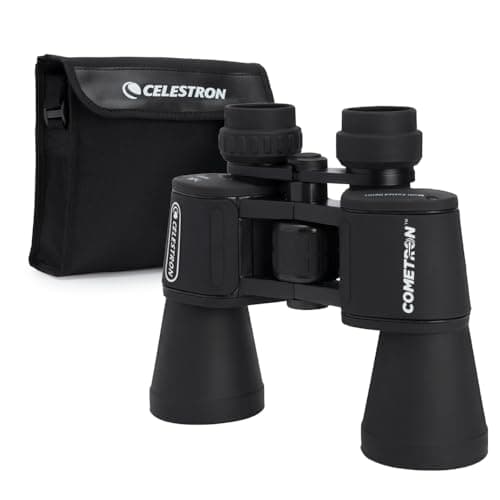 Celestron Cometron 7x50 7.1mm exit pupil, 6.6 degree field, and 7x is steady enough to hand-hold. | The 7x50 case, and the winner for a child | |
| 2 | 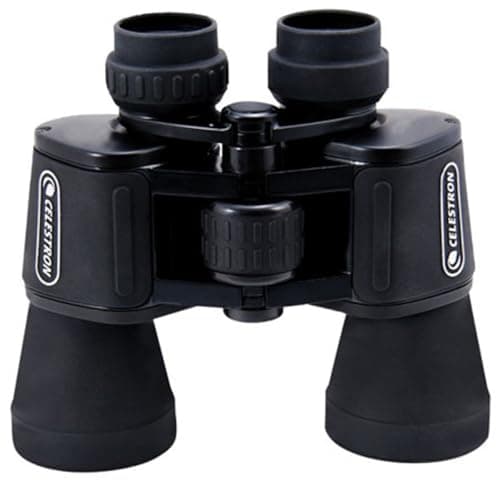 Celestron UpClose G2 10x50 If you want 10x, take it on 50mm objectives rather than 42mm. | The 10x case, without giving up aperture | $64.53 on Amazon #ad How we’re funded · price as of October 18, 2026 |
| 3 | 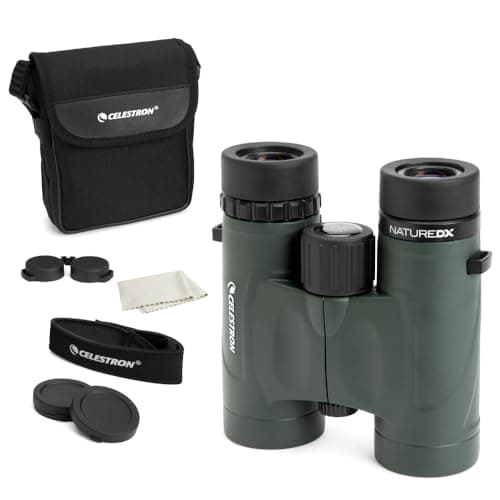 Celestron Nature DX 8x32 8x32 splits the difference on magnification and wins outright on weight. | The compromise, if the pair must do daylight too | $90.97 on Amazon #ad How we’re funded · price as of October 18, 2026 |
Rows link to the full write-up further down this page. Prices come from the live price layer only; where there is no live figure the button reads “Check price” rather than showing a number we remembered.
The verdict, by user
| User | Winner | Why |
|---|---|---|
| A child, for stargazing | 7x50 | Exit pupil matches their eye; 7x is steady in their hands. Not close. |
| A child, for everything | 8x32 | Light enough to actually get used, and long eye relief for glasses. |
| An adult over 40, stargazing | 10x50 | Their pupil cannot use 7.1mm anyway, so the extra magnification is free. |
| Mostly birding, some stars | 10x42 | Compact and reachy in daylight. It is the weakest astronomy choice here. |
| Shared between adult and child | 7x50 on a tripod | Mount it and the shake argument disappears entirely for both of them. |
The option that ends the argument
Put them on a tripod. Almost every astronomy binocular has a threaded socket, including both 50mm pairs here, and an adapter costs very little.
Mounted, the shake penalty for higher magnification disappears, and 10x50 becomes straightforwardly better than 7x50 for a child too. It also removes the weight problem entirely, which is the other reason children put binoculars down.
It is the least glamorous recommendation on this site and it improves the experience more than any upgrade you can buy. See the stargazing night kit for the rest of the cheap things that matter more than the optics.
The picks in full
Pick 1
Celestron Cometron 7x50
The 7x50 case, and the winner for a child
The arithmetic
Exit pupil is objective divided by magnification: 50 / 7 = 7.1mm, which matches Celestron's published figure. That is the single most useful number here. A fully dark-adapted young pupil opens to around 7mm, so a child uses nearly all of that 7.1mm cone and the view is as bright as the optics can make it. An adult over about forty typically dilates to 5mm or less and simply cannot use the extra — this is one of the rare cases where a child gets more out of the hardware than the grown-up does.
For a child, this is the answer, and the arithmetic is why.
50 divided by 7 gives a 7.1mm exit pupil, matching Celestron's published figure and matching a young dark-adapted pupil almost exactly. Every photon the 50mm objectives collect makes it into the eye.
The 6.6 degree field is around thirteen Moon widths, which makes finding things almost effortless. And at 7x, hand tremor is magnified 7 times rather than 10, which sounds like a small difference and is not — the threshold where a hand-held image becomes genuinely unusable sits right between them for most children.
27.3 oz, tripod adaptable, water resistant, BK7 porro prisms with multi-coated optics. Not premium glass, and it does not need to be at the job it is doing.
Skip it if
You are an adult over about forty buying them for yourself. Your pupil probably will not open past 5mm, so you cannot use the 7.1mm exit pupil, and you are carrying 27 oz for light that never reaches your retina.
| Magnification | 7x |
|---|---|
| Objective lens | 50mm (1.97") |
| Prism glass | BK7 porro |
| Lens coatings | Multi-coated |
| Angular field of view | 6.6 degrees |
| Linear field at 1000 yds | 344 ft (105 m) |
| Exit pupil | 7.1mm (.28") |
| Eye relief | 13mm (.51") |
| Close focus | 26.2 ft (8 m) |
| Weight | 27.3 oz (774 g) |
| Tripod adaptable | Yes |
| Environmental | Water resistant |
| What the box does not do | 27.3 oz is heavy for small arms held up at the sky — plan on leaning against a wall or lying on a blanket, or add the tripod adapter. BK7 prisms are the cheaper glass and show slight softening at the edge of the field. Water resistant is not waterproof. |
Specifications from Celestron — Cometron 7x50mm specifications. We have not handled this one — everything above is the published spec sheet plus our own arithmetic on it.
Pick 2
Celestron UpClose G2 10x50
The 10x case, without giving up aperture
The arithmetic
50 / 10 = 5mm exit pupil, against 7.1mm for the 7x50. Same front lens, 30 percent less light reaching the eye, because the extra magnification spreads it over a wider image. The trade you are buying is more detail on the Moon and a shakier view of everything: at 10x, a hand tremor is magnified 10 times too, and children shake more than adults do.
If more magnification is genuinely wanted, this is the sensible way to get it — and it is why our comparison is really 7x50 against 10x50 rather than 10x42.
10x50 gives a 5mm exit pupil, against 4.2mm for a 10x42. Same magnification, more light, because the objectives are bigger. The cost is weight and bulk, which at 27 oz is the same as the 7x50 anyway.
So for astronomy specifically, 10x42 is the weakest of the three combinations: it has the dimmest exit pupil and it shakes as much as a 10x50. Its advantage is compactness, which matters for a birder walking all day and not at all for someone standing in a garden.
6.8 degree field, 23 ft close focus, 12mm eye relief. That eye relief is short, so check for glasses before buying.
Skip it if
The user is a child under about eleven. 10x magnifies every tremor by 10, and children have less steady hands than adults. The extra resolution is invisible if the image is moving.
| Magnification | 10x |
|---|---|
| Objective lens | 50mm (1.96") |
| Prism glass | BK7 porro |
| Lens coatings | Multi-coated |
| Angular field of view | 6.8 degrees |
| Linear field at 1000 yds | 354 ft (118 m) |
| Exit pupil | 5mm (.19") |
| Eye relief | 12mm (.47") |
| Close focus | 23 ft (7 m) |
| Weight | 27 oz (765 g) |
| Tripod adaptable | Yes |
| Environmental | Water resistant |
| What the box does not do | 12mm of eye relief is short. A child who wears glasses will not see the whole field with them on, and taking them off changes the focus. Water resistant, not waterproof. |
Specifications from Celestron — UpClose G2 10x50mm specifications. We have not handled this one — everything above is the published spec sheet plus our own arithmetic on it.
#ad How we’re funded · price as of October 18, 2026
Pick 3
Celestron Nature DX 8x32
The compromise, if the pair must do daylight too
The arithmetic
32 / 8 = 4mm exit pupil — dimmer at night than either 50mm pair above, and that is the honest trade. What you get for it: 18 oz instead of 27, which a seven-year-old can actually hold steady; 17.5mm of eye relief, so a child in glasses sees the full field; 6.5 ft close focus, so it works on a ladybird in the garden as well as the Moon; and genuinely waterproof rather than water resistant. This is the pair that gets used on Tuesday afternoon, not just on a clear Saturday night.
The pair that makes the 7x-versus-10x argument slightly beside the point, if the binoculars are for a child rather than for astronomy specifically.
8x is a genuine middle ground: more reach than 7x, more stable than 10x. The 32mm objectives give a 4mm exit pupil, which is the compromise you are making.
What you get for it is 18 oz instead of 27, 17.5mm of eye relief instead of 12 or 13, 6.5 ft close focus, and genuine waterproofing. Every one of those is a usability win for a child.
For dedicated stargazing, take the 7x50. For a child who will use binoculars on birds, on holidays, and at the sky, take these and accept the dimmer night view.
Skip it if
Faint objects at night are the priority. 4mm exit pupil is the dimmest here, and on the Milky Way or Andromeda that difference is obvious rather than marginal.
| Magnification | 8x |
|---|---|
| Objective lens | 32mm (1.26") |
| Prism glass | BaK-4 roof, phase coated |
| Lens coatings | Fully multi-coated |
| Angular field of view | 7.4 degrees |
| Linear field at 1000 yds | 388 ft (129 m) |
| Exit pupil | 4mm (.157") |
| Eye relief | 17.5mm (.69") |
| Close focus | 6.5 ft (2 m) |
| Weight | 18 oz (510 g) |
| Tripod adaptable | Yes |
| Environmental | Waterproof |
| What the box does not do | A 4mm exit pupil means noticeably dimmer star fields than a 7x50 — the Milky Way will not leap out of it. It costs meaningfully more than the porro pairs above, and none of that money is buying you light. |
Specifications from Celestron — Nature DX 8x32mm specifications. We have not handled this one — everything above is the published spec sheet plus our own arithmetic on it.
#ad How we’re funded · price as of October 18, 2026
Questions people actually ask
- Are 10x42 binoculars good for astronomy?
- They work but they are the weakest of the common formats for it. The 4.2mm exit pupil is dimmer than a 50mm pair and 10x magnifies hand tremor. For a child, 7x50 is clearly better.
- Is 7x50 or 10x50 better for stargazing?
- For a child, 7x50 — the 7.1mm exit pupil matches their dark-adapted eye and 7x is steadier to hold. For an adult over about forty, 10x50, because their pupil cannot use the wider exit pupil anyway.
- What does 7x50 mean on binoculars?
- 7x magnification and 50mm objective lenses. Dividing the second by the first gives the exit pupil — 7.1mm — which is the width of the light beam entering your eye and the number that decides night-time brightness.
- Is more magnification better in binoculars?
- No. Magnification multiplies hand shake as well as image size, and on a fixed objective it reduces the exit pupil and therefore brightness. Past about 10x, hand-held binoculars need a tripod to be useful.
Sources
Read next
Where to go from here
- Celestron SkyMaster 15x70 review
The big-binocular option, reviewed honestly: 70mm objectives that deliver less light to a dark-adapted child's eye than a 7x50, and 48 oz that demand a tripod.
- Celestron UpClose G2 10x50 review
Same 50mm objectives as the Cometron, at 10x instead of 7x. More detail, less light, and a shake that children feel more than adults do.
- Celestron SkyMaster Pro ED 7x50 review
7x50 is the format we recommend more than any other, and this is the expensive version of it: 7.8 degrees of field, 20.8mm of eye relief, IPX7 sealing — and 62 percent more weight than the budget pick it has to beat.
- The best binoculars for stargazing with kids
The exit pupil calculation that decides which binoculars suit a child, and what a 7x50 actually shows on a first clear night.
- Binoculars for kids, by age
What a child can physically hold at each age, and which published weight and eye-relief figures to check before buying.
- Celestron Cometron 7x50: the beginner astronomy binocular
Why 7x50 is the standard beginner astronomy specification, what this particular pair publishes, and the one thing to plan around.
- One pair for birds and stars: what to give up
Birding and astronomy want opposite specifications. What a single pair can honestly do, and which compromise suits a child best.
- The stargazing night kit
A red torch does more for what a child sees than doubling the aperture. The full kit, in order of how much it changes.
- What you can actually see with a kids' telescope
The honest target-by-target list for 70mm, 76mm and 114mm telescopes, so nobody is disappointed on night one.
- Putting binoculars on a tripod: adapter, tripod, and the height nobody checks
The cheapest fix for the most common binocular disappointment. Which binoculars accept an adapter, what tripod height actually matters for looking up, and what this will not fix.
- 8x42 vs 10x42: the same binocular, one number apart
Celestron publishes both versions of the same binocular, so the comparison is unusually clean: 5.25mm exit pupil against 4.2mm, 388 ft of field against 304 ft, 17.5mm of eye relief against 14mm.