Binoculars
8x42 vs 10x42: the same binocular, one number apart
Identical objectives and identical weight. Everything that differs follows from the magnification alone.
By Scooter M. · published September 21, 2026
I'm not an astronomer and I don't have a lab. I'm someone who's genuinely into this — I read the manuals, compile the published specs, and do the arithmetic the box doesn't do for you. No lab coat. How we pick.
How this is funded. Lens & Lightyear earns a commission when you buy through a link on this page, at no extra cost to you. It does not change which products we pick or what we say about them — every card below carries a real reason to skip it. Prices are pulled live and were last verified October 18, 2026. Full disclosure.
The short answer
For stargazing, 8x42. It has a wider 5.25mm exit pupil, 28 percent more field of view and 17.5mm of eye relief against 14mm. Choose 10x42 for daytime detail or if you will brace or mount it — the extra magnification is only usable when the image is steady.
This comparison is unusually clean because Celestron publishes both versions of the same binocular. Same 42mm objective, same BaK-4 phase-coated prisms, same coatings, same waterproof body, same published 22.2 oz. Every difference below follows from the magnification alone.
The published figures, side by side
| Nature DX 8x42 | Nature DX 10x42 | |
|---|---|---|
| Magnification | 8x | 10x |
| Objective | 42mm | 42mm |
| Exit pupil | 5.25mm | 4.2mm |
| Angular field of view | 7.4 degrees | 5.8 degrees |
| Linear field at 1000 yds | 388 ft | 304 ft |
| Eye relief | 17.5mm | 14mm |
| Close focus | 6.5 ft | 6.5 ft |
| Weight | 22.2 oz | 22.2 oz |
| Prisms and coatings | BaK-4, phase coated, fully multi-coated | BaK-4, phase coated, fully multi-coated |
| Tripod adaptable | Yes | Yes |
Celestron's published specifications for items 71332 and 71333, linked below. Bold marks the advantage where there is one.
Exit pupil is the number that matters after dark
Divide the objective by the magnification and you get the width of the light beam reaching your eye. 42 / 8 = 5.25mm. 42 / 10 = 4.2mm. This is the same arithmetic we use on every binocular page, and at night it is the single most useful figure on the sheet.
A dark-adapted adult pupil opens to somewhere around 5 to 7mm, and a child's opens wider still. If the exit pupil is narrower than your pupil, you are simply not using the aperture you paid for — the binocular, not your eye, is the bottleneck. At 4.2mm the 10x42 is that bottleneck on a dark night; at 5.25mm the 8x42 is close to matching an adult eye.
Quick picks
The two of them, and the astronomy-first alternative
| # | Product | Best for | Price |
|---|---|---|---|
| 1 | 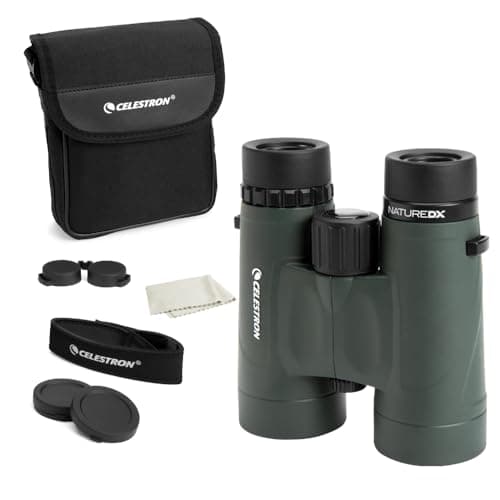 Celestron Nature DX 8x42 5.25mm exit pupil, 388 ft of field at 1000 yards and 17.5mm of eye relief. | Night skies, glasses wearers and anyone who will hold it | |
| 2 | 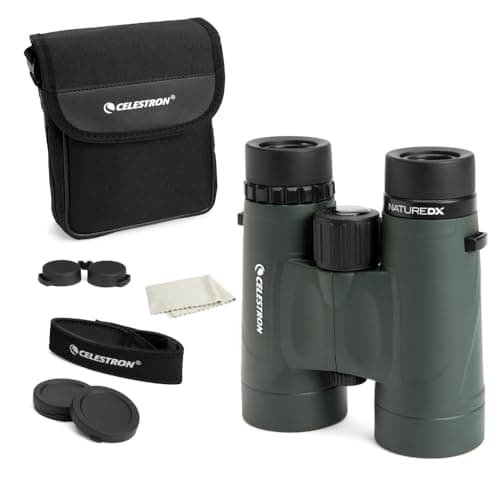 Celestron Nature DX 10x42 25 percent more magnification on the same 42mm objective, at the same published weight. | Daytime detail, and steady hands at night | |
| 3 | 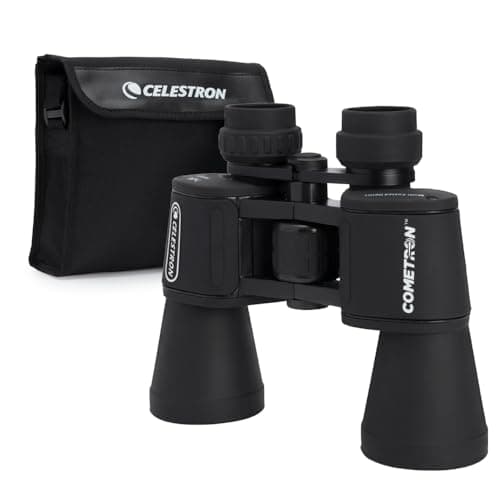 Celestron Cometron 7x50 50mm objectives at 7x — a 7.1mm exit pupil and the steadiest view here. | The night-sky specialist, for less money |
Rows link to the full write-up further down this page. Prices come from the live price layer only; where there is no live figure the button reads “Check price” rather than showing a number we remembered.
Field of view, and why it decides whether you find anything
388 ft against 304 ft at 1000 yards is about 28 percent more sky in the circle. With no finder scope and no app, you locate objects by sweeping — and a wider field is the difference between landing on the Pleiades and hunting for them.
It matters more for a child than for an adult, because a child has no mental map of the sky to navigate by. That is the same reason the age-based picks on binoculars by age lean low-power.
Eye relief, if anyone in the house wears glasses
Eye relief is how far behind the eyepiece the full field is still visible. Spectacle lenses hold your eye roughly 15mm back, so 17.5mm works with glasses on and 14mm generally does not — you get a narrowed, keyhole view.
Both models have twist-up eyecups, which is the correct mechanism: down for glasses, up for bare eyes. The eye relief figure decides whether that adjustment is enough.
Which to buy, by situation
| Situation | Verdict |
|---|---|
| Mostly stargazing | 8x42 — brighter, wider, easier to hold |
| Mostly birds and daytime | 10x42 — the extra reach is usable in good light |
| Someone wears glasses | 8x42 — 17.5mm of eye relief against 14mm |
| A child is the main user | 8x42, or a 7x50 — steadiness beats magnification every time |
| You will use a tripod | 10x42 — mounted, the shake objection disappears |
| Deep-sky sweeping is the goal | Consider 15x70 on a tripod instead of either |
What we did and did not do
We have not handled these binoculars. Every figure above was read from Celestron's own published specification page for that model, linked below and checked on the date at the top of this page. The exit pupil and field comparisons are arithmetic on those figures, shown so you can repeat them.
No price appears in this prose. Live figures come only from our price feed with the date they were checked. Our full method is on the methodology page.
The picks in full
Pick 1
Celestron Nature DX 8x42
Night skies, glasses wearers and anyone who will hold it
The arithmetic
Objective divided by magnification gives the exit pupil: 42 / 8 = 5.25mm, which is what Celestron publishes. That is wider than a dark-adapted adult pupil needs on most nights and far wider than the 4.2mm of the 10x42, which is why this pair looks brighter in the same sky. It also holds 17.5mm of eye relief against the 10x42's 14mm, and shows 388 ft at 1000 yards against 304 ft — 28 percent more sky in the circle.
For stargazing this is the one, and the reason is the exit pupil. 42 divided by 8 is 5.25mm — the width of the beam of light leaving the eyepiece — against 4.2mm for the 10x. A wider beam means a brighter image in the same sky.
The field of view is the second argument: 388 ft at 1000 yards against 304 ft, about 28 percent more sky in the circle. Finding anything without a finder scope is a matter of how much sky you can see at once, which is why sweeping the Milky Way at 8x is easy and at 10x is work.
Third, eye relief: 17.5mm against 14mm. If you observe in glasses, that gap decides whether you see the whole field or a keyhole.
Honest downside: less magnification is less magnification. On the Moon, 10x shows more.
Skip it if
You mainly want detail on distant static subjects — a bird on a far branch, craters at the terminator. 8x simply resolves less than 10x on the same glass.
| Item number | 71332 |
|---|---|
| Magnification | 8x |
| Objective diameter | 42mm (1.65") |
| Prisms | BaK-4 roof, phase coated |
| Coatings | Fully multi-coated |
| Angular field of view | 7.4 degrees |
| Linear field of view | 388 ft at 1000 yds (129 m) |
| Exit pupil | 5.25mm (.20") |
| Eye relief | 17.5mm (.69") |
| Close focus | 6.5 ft (2 m) |
| Weather sealing | Waterproof, nitrogen filled |
| Interpupillary range | 56mm-74mm |
| Tripod adaptable | Yes |
| Weight | 22.2 oz (629 g) |
| Warranty | Limited lifetime |
| What the box does not do | No tripod adapter in the box, though the barrel is threaded for one. 22.2 oz is heavy for small hands, and at 8x it will not pull in as much detail on the Moon as a 10x or 15x pair. There is no image stabilization at any price near this. |
Specifications from Celestron — Nature DX 8x42 specifications. We have not handled this one — everything above is the published spec sheet plus our own arithmetic on it.
Pick 2
Celestron Nature DX 10x42
Daytime detail, and steady hands at night
The arithmetic
Same 42mm objective and the same published 22.2 oz as the 8x42, so everything here is a consequence of the magnification alone: 42 / 10 gives a 4.2mm exit pupil against 5.25mm, the field narrows from 388 ft to 304 ft at 1000 yards, and eye relief drops from 17.5mm to 14mm. The gain is 25 percent more magnification on the same light grasp.
Ten power on a 42mm objective is the most popular binocular specification in the world, and for daylight it is an excellent choice: more detail on birds, more reach across a valley.
At night it gives up three things at once — a dimmer 4.2mm exit pupil, a narrower 304 ft field and shorter eye relief — while gaining resolution you can only use if the image is steady.
If you want the reach, plan for a tripod adapter: 10x is right at the boundary where bracing stops being optional for long looks.
Everything else is identical to the 8x42: the same BaK-4 phase-coated prisms, the same fully multi-coated optics, the same published 22.2 oz, the same waterproof nitrogen-filled body.
Skip it if
You wear glasses or observe for long stretches unbraced. 14mm of eye relief is tight with spectacles, and 10x magnifies hand tremor by 10 as well.
| Item number | 71333 |
|---|---|
| Magnification | 10x |
| Objective diameter | 42mm (1.65") |
| Prisms | BaK-4 roof, phase coated |
| Coatings | Fully multi-coated |
| Angular field of view | 5.8 degrees |
| Linear field of view | 304 ft at 1000 yds (101 m) |
| Exit pupil | 4.2mm (0.16") |
| Eye relief | 14mm (0.55") |
| Close focus | 6.5 ft (2.20 m) |
| Weather sealing | Waterproof, nitrogen filled |
| Interpupillary range | 56mm-74mm |
| Tripod adaptable | Yes |
| Weight | 22.2 oz (629 g) |
| Warranty | Limited lifetime |
| What the box does not do | 14mm of eye relief is tight for anyone observing in glasses. The narrower 4.2mm exit pupil makes it dimmer than the 8x42 under the same sky, and 10x magnifies hand shake as well as the target — the point at which a tripod adapter stops being optional for long looks. |
Specifications from Celestron — Nature DX 10x42 specifications. We have not handled this one — everything above is the published spec sheet plus our own arithmetic on it.
Pick 3
Celestron Cometron 7x50
The night-sky specialist, for less money
The arithmetic
Exit pupil is objective divided by magnification: 50 / 7 = 7.1mm, which matches Celestron's published figure. That is the single most useful number here. A fully dark-adapted young pupil opens to around 7mm, so a child uses nearly all of that 7.1mm cone and the view is as bright as the optics can make it. An adult over about forty typically dilates to 5mm or less and simply cannot use the extra — this is one of the rare cases where a child gets more out of the hardware than the grown-up does.
The honest third option, because the 8x42 versus 10x42 question is usually asked by people who have not been shown the 7x50 alternative.
50 divided by 7 gives a 7.1mm exit pupil, which is wider than most adult eyes can use — but it means the binocular is never the limiting factor on brightness, and at 7x hand shake is at its most forgiving.
The trade is bulk and daylight versatility: this is a big-eyed night instrument, not a hiking companion. Full review.
Skip it if
Daytime use matters. 7x50 is a night specification; it is bulkier than a 42mm roof prism and its wide exit pupil is wasted in daylight, when your pupil closes to 2-3mm.
| Magnification | 7x |
|---|---|
| Objective lens | 50mm (1.97") |
| Prism glass | BK7 porro |
| Lens coatings | Multi-coated |
| Angular field of view | 6.6 degrees |
| Linear field at 1000 yds | 344 ft (105 m) |
| Exit pupil | 7.1mm (.28") |
| Eye relief | 13mm (.51") |
| Close focus | 26.2 ft (8 m) |
| Weight | 27.3 oz (774 g) |
| Tripod adaptable | Yes |
| Environmental | Water resistant |
| What the box does not do | 27.3 oz is heavy for small arms held up at the sky — plan on leaning against a wall or lying on a blanket, or add the tripod adapter. BK7 prisms are the cheaper glass and show slight softening at the edge of the field. Water resistant is not waterproof. |
Specifications from Celestron — Cometron 7x50mm specifications. We have not handled this one — everything above is the published spec sheet plus our own arithmetic on it.
Questions people actually ask
- Is 8x42 or 10x42 better for stargazing?
- 8x42. It has a 5.25mm exit pupil against 4.2mm, so it looks brighter under a dark sky, shows 388 ft of field at 1000 yards against 304 ft, and offers 17.5mm of eye relief against 14mm.
- What is the difference between 8x42 and 10x42 binoculars?
- Only the magnification, and everything that follows from it. On Celestron's Nature DX pair the objective, prisms, coatings, close focus and published 22.2 oz weight are identical; the 10x gives 25 percent more magnification and gives up exit pupil, field of view and eye relief.
- Is 10x42 too shaky to hold?
- For short looks, no. For extended observing it is the point at which bracing or a tripod stops being optional, because hand tremor is magnified ten times along with the image.
- Which is better for glasses wearers?
- The 8x42, with 17.5mm of published eye relief. Glasses hold your eye about 15mm behind the eyepiece, so the 10x42's 14mm usually produces a narrowed, keyhole view even with the eyecups twisted down.
- Do I need 42mm, or is a 50mm better for astronomy?
- A 50mm objective at 7x gives a 7.1mm exit pupil and gathers more light, which is why 7x50 is the classic astronomy specification. A 42mm roof prism is lighter, more compact and far more useful in daylight.
Sources
Read next
Where to go from here
- 7x50 versus 10x42: which for a child, and why
The exit pupil arithmetic that settles the classic binocular argument, and why the answer is different for a child than for an adult.
- Celestron Nature DX ED 10x50 review
A 10x50 with ED glass, phase-coated BaK-4 roof prisms and 17.8mm of eye relief. The exit pupil is identical to a 10x50 costing a quarter as much, so this is a comfort and durability upgrade, not a brightness one.
- The best binoculars for stargazing with kids
The exit pupil calculation that decides which binoculars suit a child, and what a 7x50 actually shows on a first clear night.
- Putting binoculars on a tripod: adapter, tripod, and the height nobody checks
The cheapest fix for the most common binocular disappointment. Which binoculars accept an adapter, what tripod height actually matters for looking up, and what this will not fix.
- The best stargazing binoculars under $100
Three pairs under $100, judged on exit pupil, prism glass and steadiness rather than on magnification claims — plus the two corners this budget always cuts.
- One pair for birds and stars: what to give up
Birding and astronomy want opposite specifications. What a single pair can honestly do, and which compromise suits a child best.
- Binoculars for kids, by age
What a child can physically hold at each age, and which published weight and eye-relief figures to check before buying.
- Celestron Nature DX ED 8x42 review
Every published difference between the ED and standard Nature DX 8x42, laid out — and an honest answer on whether extra-low dispersion glass is worth the premium for stargazing.