Binoculars
Celestron Nature DX 10x42 review
Same body, same glass, same weight as the 8x42. Everything that differs follows from one number.

By Scooter M. · published October 18, 2026
I'm not an astronomer and I don't have a lab. I'm someone who's genuinely into this — I read the manuals, compile the published specs, and do the arithmetic the box doesn't do for you. No lab coat. How we pick.
How this is funded. Lens & Lightyear earns a commission when you buy through a link on this page, at no extra cost to you. It does not change which products we pick or what we say about them — every card below carries a real reason to skip it. Prices are pulled live and were last verified October 18, 2026. Full disclosure.
The short answer
Buy the 10x42 if daylight is the main use — birds, hills, sport, the Moon — and you have steady hands and do not observe in glasses. For stargazing, buy the 8x42 instead: the same objective at 8x gives a 5.25mm exit pupil against 4.2mm, 388 ft of field against 304, and 17.5mm of eye relief against 14mm.
That is an unusually clean decision, because the two models are the same instrument apart from magnification. This page is about what that one change actually costs.
Every published difference, in one table
| Nature DX 10x42 | Nature DX 8x42 | |
|---|---|---|
| Magnification | 10x | 8x |
| Objective diameter | 42mm | 42mm |
| Exit pupil | 4.2mm | 5.25mm |
| Eye relief | 14mm | 17.5mm |
| Angular field of view | 5.8 degrees | 7.4 degrees |
| Linear field at 1000 yds | 304 ft | 388 ft |
| Prisms | BaK-4 roof, phase coated | BaK-4 roof, phase coated |
| Coatings | Fully multi-coated | Fully multi-coated |
| Close focus | 6.5 ft | 6.5 ft |
| Weather sealing | Waterproof, nitrogen filled | Waterproof, nitrogen filled |
| Interpupillary range | 56mm-74mm | 56mm-74mm |
| Weight | 22.2 oz | 22.2 oz |
| Warranty | Limited lifetime | Limited lifetime |
Celestron's published specifications for items 71333 and 71332. Bold marks the advantage. Eight of thirteen rows are identical — the model difference is narrower than the shelf suggests.
Note the weight row especially: both are published at 22.2 oz, so the 10x42 gives you no portability benefit for its narrower field.
What 25 percent more magnification actually buys
- On the Moon: genuinely more. The terminator — the line between light and dark — shows crater relief better at 10x than 8x, and the Moon is bright enough that the dimmer exit pupil costs nothing.
- On birds and distant land: the clearest case. Daylight means your pupil is contracted to 2-3mm anyway, so the 4.2mm exit pupil is not a limit at all, and the extra magnification is pure gain.
- On star fields: a loss more often than a gain. You are spreading the same collected light over a larger, dimmer image, and losing a quarter of the field you would sweep with.
- On hand shake: a straight penalty. 10x magnifies tremor as faithfully as it magnifies the target, and the shake is what most people notice first.
Quick picks
The 10x42, and what to buy instead if the stars come first
| # | Product | Best for | Price |
|---|---|---|---|
| 1 | 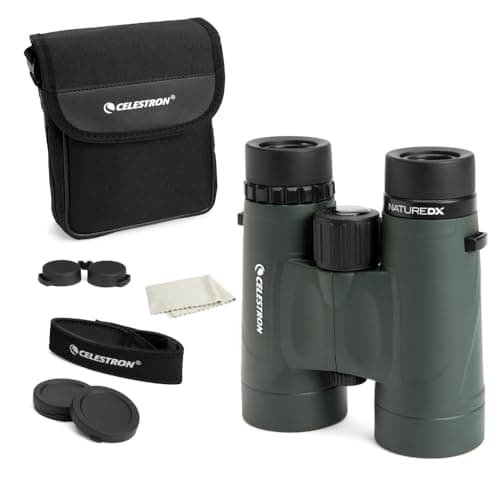 Celestron Nature DX 10x42 10x on a 42mm objective: a 4.2mm exit pupil, 304 ft of field, 14mm of eye relief. | Daylight detail and steady adult hands — birds, hills, the Moon | |
| 2 | 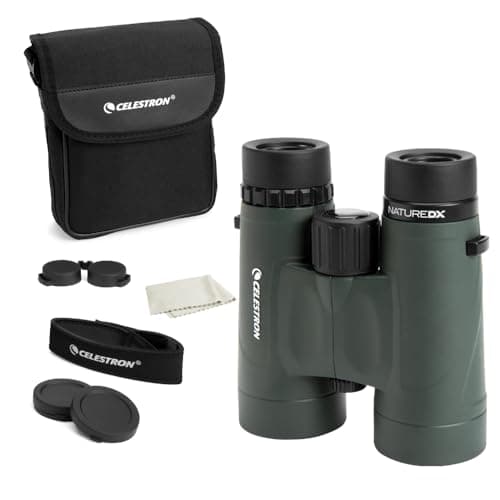 Celestron Nature DX 8x42 5.25mm exit pupil, 388 ft of field, 17.5mm of eye relief — for the same weight. | The same binocular, better after dark | |
| 3 | 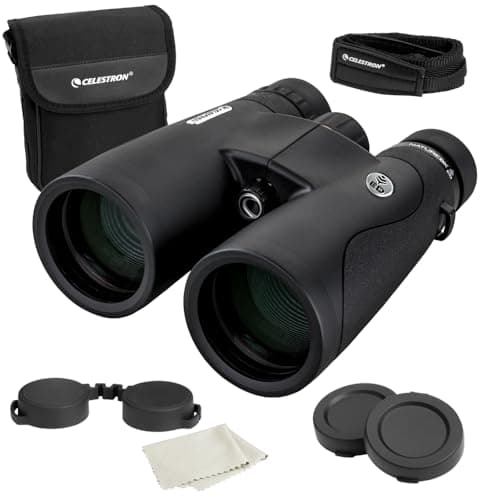 Celestron Nature DX ED 10x50 10x on 50mm objectives — a 5mm exit pupil, ED glass, and more weight. | Wanting 10x without the brightness penalty | $269.95 on Amazon #ad How we’re funded · price as of October 18, 2026 |
Rows link to the full write-up further down this page. Prices come from the live price layer only; where there is no live figure the button reads “Check price” rather than showing a number we remembered.
Who it is genuinely for
| Situation | Verdict |
|---|---|
| Daytime birding and landscape | Yes. This is where 10x earns its field penalty. |
| Lunar observing with steady hands | Yes. Bright target, dimmer exit pupil irrelevant. |
| General stargazing | No. Buy the 8x42. |
| Observing in glasses | No. 14mm of eye relief is too tight. |
| A child's pair | No. 22.2 oz plus 10x shake; see binoculars by age. |
| 10x and brightness both | Step up to 50mm — the ED 10x50. |
The head-to-head in full, with the sweeping-versus-detail argument worked through, is on 8x42 versus 10x42.
The tripod point, stated plainly
At 8x, hand-holding is comfortable for most people for most of a session. At 10x it is not, and the honest consequence is that this pair wants a tripod adapter more than its cheaper sibling does. The barrel is threaded; the bracket is sold separately and costs a small fraction of the binocular. We cover fitting and the common mistakes on binocular tripod adapters.
What we did and did not do
We have not tested these binoculars. Every figure here was read from Celestron's published specification pages for items 71333 and 71332 on the date at the top of this page, both linked below. The exit pupil figures are Celestron's own and match the arithmetic — objective divided by magnification — which a reader can check against the same spec sheets.
No rating or review count appears here, because we have measured nothing. Prices come only from our live feed with the date they were checked. Our full method is on the methodology page.
The picks in full
Pick 1
Celestron Nature DX 10x42
Daylight detail and steady adult hands — birds, hills, the Moon
The arithmetic
Same 42mm objective and the same published 22.2 oz as the 8x42, so everything here is a consequence of the magnification alone: 42 / 10 gives a 4.2mm exit pupil against 5.25mm, the field narrows from 388 ft to 304 ft at 1000 yards, and eye relief drops from 17.5mm to 14mm. The gain is 25 percent more magnification on the same light grasp.
The thing to understand first is that this is not a different binocular from the 8x42. Same 42mm objective, same BaK-4 phase-coated roof prisms, same fully multi-coated optics, same waterproof nitrogen-filled body, same published 22.2 oz, same lifetime warranty. One number changes and everything else is a consequence.
What you gain is 25 percent more magnification on the same light grasp. On a distant bird, a ridge line or the Moon's terminator, that is real resolving advantage and it is the honest reason to buy this one.
What you pay is three-fold. The exit pupil narrows to 4.2mm (42 divided by 10), so under the same sky the view is dimmer than the 8x42's 5.25mm. The field narrows to 304 ft at 1000 yards against 388 — a quarter less sky. And eye relief drops to 14mm, which is tight for anyone observing in glasses.
The fourth cost is not in the specification sheet: 10x magnifies hand shake exactly as efficiently as it magnifies the target. This is the point in the line where a tripod adapter stops being optional for long looks.
Skip it if
Stargazing is the main use, you wear glasses, or a child will hold it. All three are places where the 8x42 is straightforwardly the better instrument.
| Item number | 71333 |
|---|---|
| Magnification | 10x |
| Objective diameter | 42mm (1.65") |
| Prisms | BaK-4 roof, phase coated |
| Coatings | Fully multi-coated |
| Angular field of view | 5.8 degrees |
| Linear field of view | 304 ft at 1000 yds (101 m) |
| Exit pupil | 4.2mm (0.16") |
| Eye relief | 14mm (0.55") |
| Close focus | 6.5 ft (2.20 m) |
| Weather sealing | Waterproof, nitrogen filled |
| Interpupillary range | 56mm-74mm |
| Tripod adaptable | Yes |
| Weight | 22.2 oz (629 g) |
| Warranty | Limited lifetime |
| What the box does not do | 14mm of eye relief is tight for anyone observing in glasses. The narrower 4.2mm exit pupil makes it dimmer than the 8x42 under the same sky, and 10x magnifies hand shake as well as the target — the point at which a tripod adapter stops being optional for long looks. |
Specifications from Celestron — Nature DX 10x42 specifications. We have not handled this one — everything above is the published spec sheet plus our own arithmetic on it.
Pick 2
Celestron Nature DX 8x42
The same binocular, better after dark
The arithmetic
Objective divided by magnification gives the exit pupil: 42 / 8 = 5.25mm, which is what Celestron publishes. That is wider than a dark-adapted adult pupil needs on most nights and far wider than the 4.2mm of the 10x42, which is why this pair looks brighter in the same sky. It also holds 17.5mm of eye relief against the 10x42's 14mm, and shows 388 ft at 1000 yards against 304 ft — 28 percent more sky in the circle.
For a night sky this is the one, and the reasoning is arithmetic rather than taste: a wider exit pupil delivers more of the light the objectives collected.
It also holds 17.5mm of eye relief against 14mm, which decides it for anyone in glasses, and shows 28 percent more sky in the circle.
Everything else — prisms, coatings, sealing, close focus, weight, warranty — is identical. Full review.
Skip it if
You specifically want maximum magnification in daylight, where 10x earns its narrower field.
| Item number | 71332 |
|---|---|
| Magnification | 8x |
| Objective diameter | 42mm (1.65") |
| Prisms | BaK-4 roof, phase coated |
| Coatings | Fully multi-coated |
| Angular field of view | 7.4 degrees |
| Linear field of view | 388 ft at 1000 yds (129 m) |
| Exit pupil | 5.25mm (.20") |
| Eye relief | 17.5mm (.69") |
| Close focus | 6.5 ft (2 m) |
| Weather sealing | Waterproof, nitrogen filled |
| Interpupillary range | 56mm-74mm |
| Tripod adaptable | Yes |
| Weight | 22.2 oz (629 g) |
| Warranty | Limited lifetime |
| What the box does not do | No tripod adapter in the box, though the barrel is threaded for one. 22.2 oz is heavy for small hands, and at 8x it will not pull in as much detail on the Moon as a 10x or 15x pair. There is no image stabilization at any price near this. |
Specifications from Celestron — Nature DX 8x42 specifications. We have not handled this one — everything above is the published spec sheet plus our own arithmetic on it.
Pick 3
Celestron Nature DX ED 10x50
Wanting 10x without the brightness penalty
The arithmetic
All three published light figures reconcile with a plain 10x on 50mm, which is worth confirming because not every Celestron sheet does: exit pupil is 50 / 10 = 5mm, published as 5mm; twilight factor is the square root of 10 x 50 = the square root of 500 = 22.36, published as 22.36; relative brightness is the exit pupil squared, 5 x 5 = 25, published as 25. The more interesting figure is the published limiting stellar magnitude of 10.99 under ideal skies, because it can be cross-checked against the telescopes on this site. Against the 114mm StarSense Explorer LT's published 12.8, the 1.81 magnitude difference implies a light ratio of 10 to the power of (1.81 / 2.5), about 5.3 times. The ratio of the apertures by area is 114 squared over 50 squared, about 5.2 times. Those two numbers agree to within two percent, which is a rare case of a manufacturer's modelled figure matching the physics exactly. Note also that the three sky conditions are published as 10.99, 9.99 and 8.99 — differences of exactly 1.00 magnitude each, so they are a modelled ladder applied to sky quality rather than three separate measurements.
The honest answer to the 10x42's main weakness. Keeping 10x but moving to a 50mm objective restores the exit pupil to 5mm, close to the 8x42's figure.
That is the upgrade path if you want the magnification and the brightness rather than choosing between them.
Honest downside: it is a bigger, heavier, more expensive instrument, and the ED glass is doing less for you at night than in daylight. Full review.
Skip it if
Budget or bulk matter. Stepping up to 50mm objectives costs noticeably more and adds weight to a pair already at the limit for hand-holding.
| Item number | 72335 |
|---|---|
| Magnification | 10x |
| Objective diameter | 50mm (1.97") |
| Prisms | BaK-4 roof, phase coated |
| Coatings | Fully multi-coated, with Extra-Low Dispersion (ED) objective lenses |
| Angular field of view | 5.9 degrees |
| Linear field of view | 309 ft at 1000 yds (103 m) |
| Exit pupil | 5mm (0.20") |
| Eye relief | 17.8mm (0.70") |
| Close focus | 8.2 ft (2.5 m) |
| Interpupillary range | 63mm-74mm (2.48"-2.91") |
| Diopter adjustment | Plus or minus 3 |
| Twilight factor | 22.36 |
| Relative brightness | 25 |
| Limiting stellar magnitude | 10.99 ideal, 9.99 moderate, 8.99 poor |
| Weight | 28.4 oz (806 g) |
| Dimensions | 163mm x 135mm x 61mm (6.4" x 5.3" x 2.4") |
| Tripod adaptable | Yes, adapter not included |
| Weather sealing | Waterproof, nitrogen filled |
| Included | Objective lens caps, rainguard, neck strap, padded nylon canvas case, lens cloth, manual |
| Warranty | Limited lifetime |
| What the box does not do | No tripod adapter, though at 10x it is wanted only for long looks. Celestron describes the ED glass as giving images virtually free of chromatic aberration and publishes no figure for it, so the headline optical claim is the one row here that cannot be checked. The 5.9 degree field is narrower than the far cheaper UpClose G2 10x50's published 6.8 degrees, which is the one row where the budget 10x50 wins outright. |
Specifications from Celestron — Nature DX ED 10x50 specifications. We have not handled this one — everything above is the published spec sheet plus our own arithmetic on it.
#ad How we’re funded · price as of October 18, 2026
Questions people actually ask
- Is the Celestron Nature DX 10x42 good for stargazing?
- It works, but the 8x42 is better. The 10x42's 4.2mm exit pupil delivers less of the light the objectives collect than the 8x42's 5.25mm, it shows 304 ft of field against 388, and 10x magnifies hand shake. Its strength is daylight detail, not night-sky brightness.
- What is the difference between the Nature DX 8x42 and 10x42?
- Only the magnification, and its consequences. Both have 42mm objectives, the same prisms, coatings, sealing and a published 22.2 oz. The 10x42 gives 25 percent more magnification; the 8x42 gives a wider 5.25mm exit pupil, 388 ft of field and 17.5mm of eye relief.
- Can you use the Nature DX 10x42 with glasses?
- It is tight. Celestron publishes 14mm of eye relief, which means fully retracting the eyecups and possibly still losing the field edges. The 8x42, at 17.5mm, is the comfortable choice for spectacle wearers.
- Do you need a tripod for 10x42 binoculars?
- Not strictly, but 10x magnifies hand tremor as much as the target, so long looks at one object are noticeably steadier mounted. The barrels are threaded for an adapter, which is sold separately.
- Is the Nature DX 10x42 heavier than the 8x42?
- No. Celestron publishes 22.2 oz for both, so the narrower field and dimmer exit pupil of the 10x42 do not buy you a lighter instrument.
- What should I buy if I want 10x and a bright image?
- Move up in objective size rather than down in magnification. A 10x50 restores the exit pupil to 5mm, close to the 8x42's figure, at the cost of more bulk, more weight and more money.
Sources
Read next
Where to go from here
- Celestron Nature DX 8x42 review
A 5.25mm exit pupil, 17.5mm of eye relief, 388 ft at 1000 yards and a waterproof nitrogen-filled body. The Nature DX we would actually buy for a night sky, and why.
- 8x42 vs 10x42: the same binocular, one number apart
Celestron publishes both versions of the same binocular, so the comparison is unusually clean: 5.25mm exit pupil against 4.2mm, 388 ft of field against 304 ft, 17.5mm of eye relief against 14mm.
- Celestron Nature DX ED 10x50 review
A 10x50 with ED glass, phase-coated BaK-4 roof prisms and 17.8mm of eye relief. The exit pupil is identical to a 10x50 costing a quarter as much, so this is a comfort and durability upgrade, not a brightness one.
- The best binoculars for stargazing with kids
The exit pupil calculation that decides which binoculars suit a child, and what a 7x50 actually shows on a first clear night.
- Putting binoculars on a tripod: adapter, tripod, and the height nobody checks
The cheapest fix for the most common binocular disappointment. Which binoculars accept an adapter, what tripod height actually matters for looking up, and what this will not fix.
- One pair for birds and stars: what to give up
Birding and astronomy want opposite specifications. What a single pair can honestly do, and which compromise suits a child best.