Binoculars
Celestron Nature DX ED 10x50 review
Identical brightness to a budget 10x50, and a narrower field. What you actually pay for is comfort.

By Scooter M. · published October 15, 2026
I'm not an astronomer and I don't have a lab. I'm someone who's genuinely into this — I read the manuals, compile the published specs, and do the arithmetic the box doesn't do for you. No lab coat. How we pick.
How this is funded. Lens & Lightyear earns a commission when you buy through a link on this page, at no extra cost to you. It does not change which products we pick or what we say about them — every card below carries a real reason to skip it. Prices are pulled live and were last verified October 18, 2026. Full disclosure.
The short answer
Buy it if you want one pair for daylight and night sky and you can spend accordingly. Its 8.2 ft close focus and 17.8mm of eye relief are the best on this site. It is not brighter than a 10x50 costing a quarter as much, and it publishes a narrower field than one.
This is a rare case where a premium binocular and a budget one share every figure that governs brightness. Both are 10x on 50mm. Both publish a 5mm exit pupil. So this review is really about what the rest of the money buys, and the answer is more interesting than the marketing.
The three light figures all reconcile
Worth confirming first, because not every Celestron sheet survives this check. All three published light figures here are reproducible from the two numbers in the name:
- Exit pupil: objective divided by magnification. 50 / 10 = 5mm — published as 5mm.
- Twilight factor: the square root of magnification times objective. The square root of 10 x 50 = the square root of 500 = 22.36 — published as 22.36.
- Relative brightness: the exit pupil squared. 5 x 5 = 25 — published as 25.
Internally consistent, which is not a given: the SkyMaster Pro ED 7x50 publishes an exit pupil that contradicts its own twilight factor and relative brightness. This sheet does not have that problem.
The published limiting magnitude, and why it checks out
The figure that makes this spec sheet unusual for a binocular is a limiting stellar magnitude: 10.99 under ideal skies, 9.99 moderate, 8.99 poor. Celestron publishes that for telescopes routinely and for binoculars rarely, and it is the single most useful number here for an astronomy buyer, because it answers how faint a star you can reach rather than how bright the image looks.
It can also be checked, which is the part we enjoy. Take the 114mm StarSense Explorer LT on this site: Celestron publishes a limiting magnitude of 12.8 for it. The gap to this binocular's 10.99 is 1.81 magnitudes, and the brightness ratio for a magnitude difference is 10 raised to the power of that difference divided by 2.5:
- 10 to the power of (1.81 / 2.5) = about 5.3 times more light for the telescope
- Aperture ratio by area: 114 squared over 50 squared = about 5.2 times
Those agree to within about two percent. The published figure is consistent with the physics, which is a good sign about the sheet in general — and it gives you an honest sense of scale: a 50mm binocular reaches roughly a fifth as deep in light-gathering terms as a beginner 114mm telescope, which is not a criticism of either.
What four times the price actually buys
Here is the comparison that matters, and the surprise is in the field-of-view row.
| Nature DX ED 10x50 | UpClose G2 10x50 | Nature DX 10x42 | |
|---|---|---|---|
| Magnification / objective | 10x, 50mm | 10x, 50mm — identical | 10x, 42mm |
| Exit pupil | 5mm | 5mm — identical | 4.2mm |
| Angular field of view | 5.9 deg | 6.8 deg | 5.8 deg |
| Linear field at 1000 yds | 309 ft (103 m) | 354 ft (118 m) | 304 ft (101 m) |
| Eye relief | 17.8mm | 12mm | 14mm |
| Close focus | 8.2 ft (2.5 m) | 23 ft (7 m) | 6.5 ft (2.2 m) |
| Prisms | BaK-4 roof, phase coated | BK7 porro | BaK-4 roof, phase coated |
| Coatings | Fully multi-coated, ED glass | Multi-coated | Fully multi-coated |
| Weather sealing | Waterproof, nitrogen filled | Water resistant | Waterproof, nitrogen filled |
| Limiting stellar magnitude | 10.99 ideal | Not published | Not published |
| Weight | 28.4 oz | 27 oz | 22.2 oz |
| Price bracket | Top of the Nature DX range | Bottom of the market | Middle |
Every figure from Celestron's own published specification pages, linked at the foot of this page. Bold marks the best figure in each row. The ED glass itself is absent from the comparison because Celestron publishes no figure for it.
Read the first three rows together, because that is the finding. Identical aperture, identical magnification, identical exit pupil — and the cheap one has the wider field. Nothing about the premium pair makes the image brighter, and on raw sky coverage the budget pair is ahead.
What the money does buy is real, just not optical reach: phase-coated BaK-4 prisms instead of BK7, fully multi-coated optics with ED glass, a waterproof nitrogen-filled body instead of water resistant, nearly 6mm more eye relief, and a close focus that drops from 23 ft to 8.2. Those are comfort, durability and versatility. If you wear glasses or want one pair for two jobs, they are worth paying for. If you want the most Milky Way per dollar, they are not.
Why close focus is the underrated row
Most stargazing binoculars cannot focus on anything nearby, and nobody mentions it until the binoculars arrive. The Cometron 7x50 and the UpClose G2 10x50 both stop at 23 to 26 ft. A bird on a feeder twenty feet away is simply out of reach.
8.2 ft changes what the binocular is for. It makes a single pair viable for a child who wants to look at birds on a Saturday and Jupiter on a Saturday night, which is the most common real-world use on a site about space gifts. We built binoculars for birds and stars around exactly this trade, and this is the most capable answer to it we have reviewed — the Nature DX 10x42 goes closer still at 6.5 ft, with less light.
Quick picks
The Nature DX ED 10x50 against the two 10x alternatives on this site
| # | Product | Best for | Price |
|---|---|---|---|
| 1 | 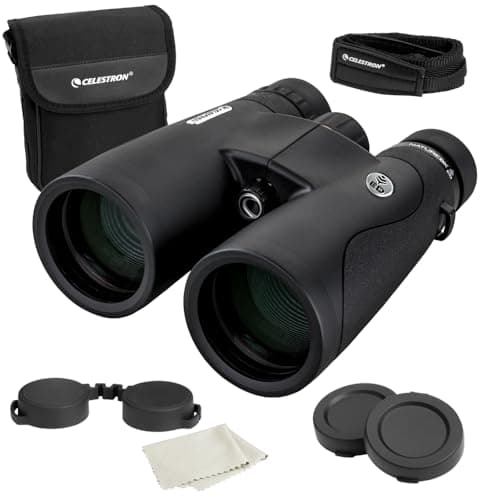 Celestron Nature DX ED 10x50 The only binocular on this site that focuses to 8.2 ft and publishes a limiting stellar magnitude — genuinely dual-purpose, at a price to match. | One pair for birds by day and stars by night, for an adult | $269.95 on Amazon #ad How we’re funded · price as of October 18, 2026 |
| 2 | 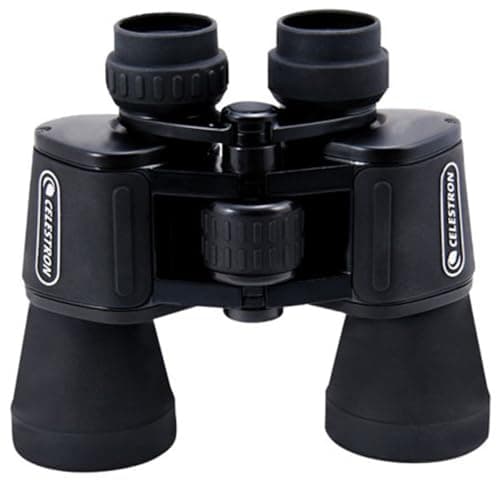 Celestron UpClose G2 10x50 The same 5mm exit pupil and a wider published field, for roughly a quarter of the price — and it loses almost everything else. | Anyone who wants the 10x50 view for a fraction of the money | $64.53 on Amazon #ad How we’re funded · price as of October 18, 2026 |
| 3 | 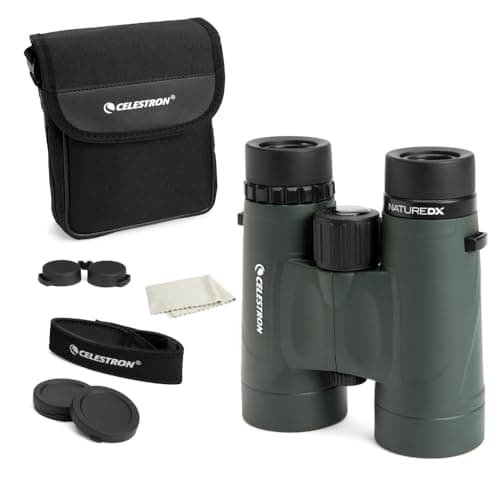 Celestron Nature DX 10x42 Phase-coated BaK-4, waterproof, and 22.2 oz — the Nature DX to buy if weight is the binding constraint. | The same line and the same magnification, 6 oz lighter |
Rows link to the full write-up further down this page. Prices come from the live price layer only; where there is no live figure the button reads “Check price” rather than showing a number we remembered.
The 10x question, briefly
10x magnifies hand tremor ten times as well as the target, and that is the honest limit on all three of these. A steady handheld view tops out around 10x, so this sits right at the edge: fine braced against a fence or a car roof, tiring held free-hand for long. All three are tripod adaptable and none includes an adapter.
Whether 10x is the right choice at all is a separate question from which 10x50 to buy, and we answer it with published arithmetic on 7x50 versus 10x42 — which remains the page to read first if you have not settled on a format. The short version for a young observer is that 7x50 puts more light into a dark-adapted young eye and shakes less.
Who should buy this
| If this is you | Buy | Why |
|---|---|---|
| You want one pair for daylight nature and night sky, and you wear glasses | The Nature DX ED 10x50 | 8.2 ft close focus and 17.8mm eye relief are the best figures on this site, and it is waterproof. |
| You want the most sky for the least money | The UpClose G2 10x50 | Same 5mm exit pupil, a wider published field, a fraction of the price. Night-sky use only. |
| Weight is the binding constraint | The Nature DX 10x42 | 22.2 oz with the same prisms and sealing, for about 71 percent of the image brightness. |
| You are buying for a child under about twelve | None of these — start with a 7x50 | More light into a dark-adapted young eye, less shake, far less money. See binoculars for stargazing and by age. |
That last row matters on a site mostly about children's optics. This is an adult binocular at an adult price. The person it suits is the parent who caught the interest from the child and now wants one good pair for everything — which is a real buyer, just not the one the rest of this hub is written for.
What we did and did not do
We have not handled or looked through this binocular and we do not say otherwise. Every figure above was read from Celestron's own published specification pages for the Nature DX ED 10x50, the UpClose G2 10x50 and the Nature DX 10x42, re-checked on the date at the top of this page, and linked in the sources below. The exit-pupil, twilight-factor and relative-brightness derivations, the magnitude-to-light-ratio conversion, the aperture area ratios and the brightness percentages are our arithmetic on those published figures, shown in full so you can redo each one.
We have not estimated how much the ED glass improves the view. Celestron publishes no figure for it and we have not observed it. Our standing method is on the methodology page.
At the time of writing this model is listed in stock both on Celestron's own store and at the major retailer. The price beside our buy button comes from the live feed on the date shown there, never from us.
The picks in full
Pick 1
Celestron Nature DX ED 10x50
One pair for birds by day and stars by night, for an adult
The arithmetic
All three published light figures reconcile with a plain 10x on 50mm, which is worth confirming because not every Celestron sheet does: exit pupil is 50 / 10 = 5mm, published as 5mm; twilight factor is the square root of 10 x 50 = the square root of 500 = 22.36, published as 22.36; relative brightness is the exit pupil squared, 5 x 5 = 25, published as 25. The more interesting figure is the published limiting stellar magnitude of 10.99 under ideal skies, because it can be cross-checked against the telescopes on this site. Against the 114mm StarSense Explorer LT's published 12.8, the 1.81 magnitude difference implies a light ratio of 10 to the power of (1.81 / 2.5), about 5.3 times. The ratio of the apertures by area is 114 squared over 50 squared, about 5.2 times. Those two numbers agree to within two percent, which is a rare case of a manufacturer's modelled figure matching the physics exactly. Note also that the three sky conditions are published as 10.99, 9.99 and 8.99 — differences of exactly 1.00 magnitude each, so they are a modelled ladder applied to sky quality rather than three separate measurements.
This is the most genuinely dual-purpose binocular we have put on this site, and the figure that earns that description is close focus: 8.2 ft. The 10x50s and 7x50s we normally recommend focus no nearer than 23 to 26 ft, which rules out a bird in the garden, an insect, or anything a child actually points at in daylight. At 8.2 ft this works for both jobs.
The second figure is eye relief: 17.8mm, against 12mm on the budget 10x50 and 13mm on the Cometron 7x50. That is the difference between an eyeglass wearer seeing the whole field and seeing a circle in the middle of it. If anyone in the household observes in glasses, this row alone may decide the purchase.
The build is the best in the Nature DX line: phase-coated BaK-4 roof prisms, fully multi-coated optics with ED objective lenses, waterproof and nitrogen filled, limited lifetime warranty. Phase coating is the thing roof prisms specifically need — without it a roof prism loses contrast that a porro never does — and Celestron publishes it here.
What it does not buy is a brighter image. 50 divided by 10 gives a 5mm exit pupil, exactly as published, and that is identical to the UpClose G2 10x50 below. Same aperture, same magnification, same brightness. The premium is comfort, glass quality, sealing and close focus — which is a perfectly good reason to spend money, but not the one most buyers think they are spending it on.
The honest gap, as on every ED model: Celestron says the ED lenses give images virtually free of chromatic aberration and publishes no figure for it. We have not looked through this binocular, so that claim is the one row on the sheet we can neither check nor confirm.
Skip it if
You want the widest view of the Milky Way, or you are buying for a child. The far cheaper UpClose G2 10x50 publishes a wider field than this (6.8 degrees against 5.9) on the same 50mm objective and the same 5mm exit pupil, so it is not dimmer and it shows more sky. And 28.4 oz at 10x is a lot of binocular for small arms with no tripod.
| Item number | 72335 |
|---|---|
| Magnification | 10x |
| Objective diameter | 50mm (1.97") |
| Prisms | BaK-4 roof, phase coated |
| Coatings | Fully multi-coated, with Extra-Low Dispersion (ED) objective lenses |
| Angular field of view | 5.9 degrees |
| Linear field of view | 309 ft at 1000 yds (103 m) |
| Exit pupil | 5mm (0.20") |
| Eye relief | 17.8mm (0.70") |
| Close focus | 8.2 ft (2.5 m) |
| Interpupillary range | 63mm-74mm (2.48"-2.91") |
| Diopter adjustment | Plus or minus 3 |
| Twilight factor | 22.36 |
| Relative brightness | 25 |
| Limiting stellar magnitude | 10.99 ideal, 9.99 moderate, 8.99 poor |
| Weight | 28.4 oz (806 g) |
| Dimensions | 163mm x 135mm x 61mm (6.4" x 5.3" x 2.4") |
| Tripod adaptable | Yes, adapter not included |
| Weather sealing | Waterproof, nitrogen filled |
| Included | Objective lens caps, rainguard, neck strap, padded nylon canvas case, lens cloth, manual |
| Warranty | Limited lifetime |
| What the box does not do | No tripod adapter, though at 10x it is wanted only for long looks. Celestron describes the ED glass as giving images virtually free of chromatic aberration and publishes no figure for it, so the headline optical claim is the one row here that cannot be checked. The 5.9 degree field is narrower than the far cheaper UpClose G2 10x50's published 6.8 degrees, which is the one row where the budget 10x50 wins outright. |
Specifications from Celestron — Nature DX ED 10x50 specifications. We have not handled this one — everything above is the published spec sheet plus our own arithmetic on it.
#ad How we’re funded · price as of October 18, 2026
Pick 2
Celestron UpClose G2 10x50
Anyone who wants the 10x50 view for a fraction of the money
The arithmetic
50 / 10 = 5mm exit pupil, against 7.1mm for the 7x50. Same front lens, 30 percent less light reaching the eye, because the extra magnification spreads it over a wider image. The trade you are buying is more detail on the Moon and a shakier view of everything: at 10x, a hand tremor is magnified 10 times too, and children shake more than adults do.
The comparison that frames this whole review. Celestron publishes a 6.8 degree field for the UpClose G2 10x50 against 5.9 for the ED — so the cheap pair shows about 15 percent more sky across the diagonal, at the same 5mm exit pupil and the same 10x on 50mm.
It is also marginally lighter at 27 oz against 28.4. For sweeping the Milky Way from a dark garden, those two rows make it the better instrument, and it costs a fraction as much.
What it gives up is everything around the glass: BK7 prisms instead of phase-coated BaK-4, multi-coated instead of fully multi-coated with ED, water resistant instead of waterproof and nitrogen filled, 12mm of eye relief instead of 17.8mm, and a 23 ft close focus instead of 8.2 ft. It is a night-sky-only instrument, and an uncomfortable one behind spectacles.
For this site's usual reader — a gift buyer, often for a child — that trade still often lands on the cheap pair, or on a 7x50 instead. We work the format question through on 7x50 versus 10x42 rather than re-arguing it here.
Skip it if
You wear glasses, you need it to survive rain, or you want to focus on anything closer than 23 ft. 12mm of eye relief is the shortest figure on this site, water resistant is not waterproof, and BK7 prisms soften toward the field edge where BaK-4 does not.
| Magnification | 10x |
|---|---|
| Objective lens | 50mm (1.96") |
| Prism glass | BK7 porro |
| Lens coatings | Multi-coated |
| Angular field of view | 6.8 degrees |
| Linear field at 1000 yds | 354 ft (118 m) |
| Exit pupil | 5mm (.19") |
| Eye relief | 12mm (.47") |
| Close focus | 23 ft (7 m) |
| Weight | 27 oz (765 g) |
| Tripod adaptable | Yes |
| Environmental | Water resistant |
| What the box does not do | 12mm of eye relief is short. A child who wears glasses will not see the whole field with them on, and taking them off changes the focus. Water resistant, not waterproof. |
Specifications from Celestron — UpClose G2 10x50mm specifications. We have not handled this one — everything above is the published spec sheet plus our own arithmetic on it.
#ad How we’re funded · price as of October 18, 2026
Pick 3
Celestron Nature DX 10x42
The same line and the same magnification, 6 oz lighter
The arithmetic
Same 42mm objective and the same published 22.2 oz as the 8x42, so everything here is a consequence of the magnification alone: 42 / 10 gives a 4.2mm exit pupil against 5.25mm, the field narrows from 388 ft to 304 ft at 1000 yards, and eye relief drops from 17.5mm to 14mm. The gain is 25 percent more magnification on the same light grasp.
If the 28.4 oz of the ED 10x50 is the problem rather than the price, this is the answer inside the same line: the Nature DX 10x42 publishes 22.2 oz, about 6 oz lighter, with the same phase-coated BaK-4 roof prisms and the same waterproof nitrogen-filled body.
The cost is light. A 4.2mm exit pupil against 5mm means roughly (4.2 / 5) squared, about 71 percent of the image brightness on a nebula or the Milky Way. Under a suburban sky you will struggle to tell; under a genuinely dark one you will.
It also has the closest focus of the three at 6.5 ft, so as a daytime instrument it is marginally better than the ED 10x50 — the ED's advantage over it is light, eye relief and the ED glass, not versatility.
No ED glass and no 50mm objective, but for a child or a walker this is the more sensible Nature DX, and it is cheaper. The 8x version of the same body is compared against it on 8x42 vs 10x42.
Skip it if
You observe under a dark sky and want the extra light. 42 divided by 10 is a 4.2mm exit pupil against 5mm, which by the square of the ratio is about 30 percent less image brightness on extended objects. Its close focus of 6.5 ft is the best here, but its 14mm eye relief is tighter than the ED's.
| Item number | 71333 |
|---|---|
| Magnification | 10x |
| Objective diameter | 42mm (1.65") |
| Prisms | BaK-4 roof, phase coated |
| Coatings | Fully multi-coated |
| Angular field of view | 5.8 degrees |
| Linear field of view | 304 ft at 1000 yds (101 m) |
| Exit pupil | 4.2mm (0.16") |
| Eye relief | 14mm (0.55") |
| Close focus | 6.5 ft (2.20 m) |
| Weather sealing | Waterproof, nitrogen filled |
| Interpupillary range | 56mm-74mm |
| Tripod adaptable | Yes |
| Weight | 22.2 oz (629 g) |
| Warranty | Limited lifetime |
| What the box does not do | 14mm of eye relief is tight for anyone observing in glasses. The narrower 4.2mm exit pupil makes it dimmer than the 8x42 under the same sky, and 10x magnifies hand shake as well as the target — the point at which a tripod adapter stops being optional for long looks. |
Specifications from Celestron — Nature DX 10x42 specifications. We have not handled this one — everything above is the published spec sheet plus our own arithmetic on it.
Questions people actually ask
- Is the Celestron Nature DX ED 10x50 worth the money?
- If you want one pair for daylight and night sky, yes — its 8.2 ft close focus and 17.8mm eye relief are the best figures on this site and it is waterproof and nitrogen filled. If you only want night sky brightness, no: a 10x50 costing a quarter as much has the same 5mm exit pupil and a wider published field.
- Is the Nature DX ED 10x50 brighter than a cheap 10x50?
- No. Brightness on extended objects is governed by exit pupil, which is objective divided by magnification. Both are 10x on 50mm, so both publish 5mm and both have a published relative brightness of 25. The ED glass improves color correction, not brightness.
- What does a limiting stellar magnitude of 10.99 mean?
- It is the faintest star the binocular should reach under ideal skies. For scale, a 114mm beginner telescope publishes 12.8, and that 1.81 magnitude gap works out to about 5.3 times more light — which matches the 5.2 times you get from comparing the apertures by area.
- Nature DX ED 10x50 or Nature DX 10x42?
- The 10x42 if weight matters: 22.2 oz against 28.4, same phase-coated BaK-4 prisms, same waterproof body, cheaper. The ED 10x50 if light matters: a 5mm exit pupil against 4.2mm is roughly 40 percent more image brightness on faint extended objects.
- Can you use the Nature DX ED 10x50 for birding?
- Yes, and it is one of the few stargazing-capable binoculars on this site that genuinely can. Its 8.2 ft close focus is close enough for garden birds, where the 23 to 26 ft close focus of typical 7x50 and budget 10x50 astronomy pairs is not.
- Is 10x50 good for a child?
- Usually not. 10x magnifies hand tremor ten times, and at 28.4 oz this pair is heavy for small arms with no tripod included. A 7x50 puts more light into a dark-adapted young eye and shakes less, which is why we recommend that format for children.
Sources
Read next
Where to go from here
- Celestron UpClose G2 10x50 review
Same 50mm objectives as the Cometron, at 10x instead of 7x. More detail, less light, and a shake that children feel more than adults do.
- 8x42 vs 10x42: the same binocular, one number apart
Celestron publishes both versions of the same binocular, so the comparison is unusually clean: 5.25mm exit pupil against 4.2mm, 388 ft of field against 304 ft, 17.5mm of eye relief against 14mm.
- Celestron Nature DX ED 8x42 review
Every published difference between the ED and standard Nature DX 8x42, laid out — and an honest answer on whether extra-low dispersion glass is worth the premium for stargazing.
- One pair for birds and stars: what to give up
Birding and astronomy want opposite specifications. What a single pair can honestly do, and which compromise suits a child best.
- 7x50 versus 10x42: which for a child, and why
The exit pupil arithmetic that settles the classic binocular argument, and why the answer is different for a child than for an adult.
- The best binoculars for stargazing with kids
The exit pupil calculation that decides which binoculars suit a child, and what a 7x50 actually shows on a first clear night.
- Binoculars for kids, by age
What a child can physically hold at each age, and which published weight and eye-relief figures to check before buying.
- The best stargazing binoculars under $100
Three pairs under $100, judged on exit pupil, prism glass and steadiness rather than on magnification claims — plus the two corners this budget always cuts.
- Celestron SkyMaster Pro ED 7x50 review
7x50 is the format we recommend more than any other, and this is the expensive version of it: 7.8 degrees of field, 20.8mm of eye relief, IPX7 sealing — and 62 percent more weight than the budget pick it has to beat.