Binoculars
One pair for birds and stars: what to give up
Daylight wants light and reachy. Night wants big and bright. Pick your compromise.

By Scooter M. · published September 1, 2026
I'm not an astronomer and I don't have a lab. I'm someone who's genuinely into this — I read the manuals, compile the published specs, and do the arithmetic the box doesn't do for you. No lab coat. How we pick.
How this is funded. Lens & Lightyear earns a commission when you buy through a link on this page, at no extra cost to you. It does not change which products we pick or what we say about them — every card below carries a real reason to skip it. Prices are pulled live and were last verified October 18, 2026. Full disclosure.
The short answer
An 8x32 is the best single-pair compromise for a child. It focuses close enough for garden birds, is light enough to carry all day, has eye relief that works over glasses, and is waterproof. What you give up is night-sky brightness, and that gap is real rather than marginal.
Why the two jobs want opposite things
| Specification | Birding wants | Astronomy wants |
|---|---|---|
| Objective size | Small — 32mm or 42mm for low weight | Large — 50mm or more for light |
| Close focus | Very close — 6 to 8 ft for garden birds | Irrelevant. Everything is at infinity |
| Weight | Low — worn round the neck for hours | Less critical. You can lie down or mount it |
| Exit pupil | 4mm is plenty in daylight | As close to 7mm as possible at night |
| Weatherproofing | Essential — used in real weather | Useful for dew, rarely critical |
| Field of view | Wide, for following movement | Wide, for finding things |
| Magnification | 8x or 10x for detail at distance | 7x or 8x for a steady bright field |
The only specification the two agree on is a wide field of view. Everything else pulls in opposite directions, which is why one perfect pair does not exist.
The specification that decides it: close focus
This is the one that ends the debate, and it is the one nobody checks.
Astronomy binoculars are built for infinity, so their close focus is terrible. The Cometron 7x50 publishes 26.2 ft — anything within about eight meters cannot be brought into focus at all. A bird on a garden feeder six meters away is simply a blur, permanently.
The Nature DX 8x32 publishes 6.5 ft. That is close enough for a feeder, a butterfly, a beetle on a wall. For a child, that difference is enormous, because most of what they will actually look at in daylight is near rather than far.
Quick picks
One pair for both jobs
| # | Product | Best for | Price |
|---|---|---|---|
| 1 | 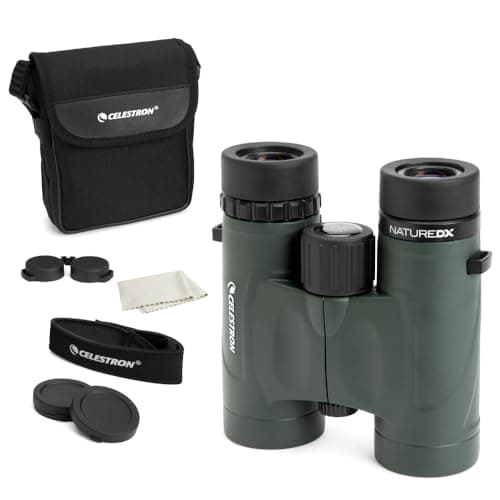 Celestron Nature DX 8x32 18 oz, 6.5 ft close focus, waterproof, 17.5mm eye relief — built for both jobs. | The genuine all-rounder, and the winner here | $90.97 on Amazon #ad How we’re funded · price as of October 18, 2026 |
| 2 | 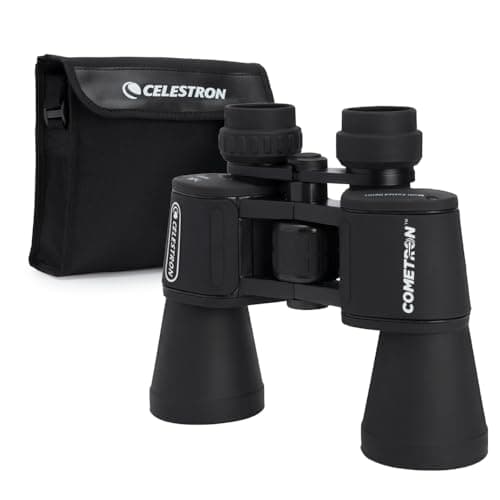 Celestron Cometron 7x50 7.1mm exit pupil for the night, at the cost of everything daylight wants. | If stargazing is the real priority | |
| 3 | 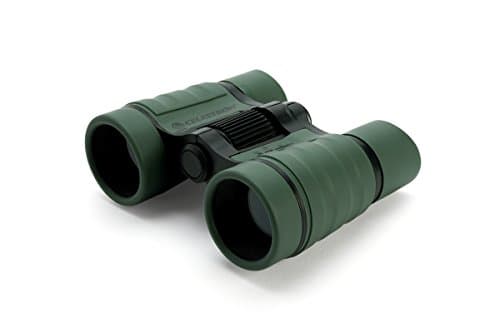 Celestron Celestron Kids 4x30 4.7 oz. Low power, bright, and light enough for a four-year-old to carry all day. | A very young child doing both, badly and happily | $9.95 on Amazon #ad How we’re funded · price as of October 18, 2026 |
Rows link to the full write-up further down this page. Prices come from the live price layer only; where there is no live figure the button reads “Check price” rather than showing a number we remembered.
The honest recommendation
If the budget allows two pairs, buy two. A cheap 7x50 for the sky and a light 8x32 for daylight together cost less than one premium pair, and each does its job properly instead of compromising.
If it has to be one pair, choose based on which job is real and which is aspirational. Most families overestimate how much stargazing will happen and underestimate how much daytime use a pair of binoculars gets. That argues for the 8x32 more often than the exit-pupil arithmetic alone would suggest.
And a child who uses binoculars every week in daylight is a child who will happily take them outside at night when the sky is clear. A child whose binoculars are too heavy and cannot focus on anything nearby will not.
What binoculars show in daylight
Worth listing, because it is the half of the value that gets ignored on an astronomy site: garden birds close enough to see individual feathers; raptors circling, close enough to identify; deer and foxes at the edge of a field; the far bank of a lake; aircraft; the details of buildings and hillsides on a walk.
For a child, that daily-use case is often the difference between a present that is loved and one that is admired once. It is also the reason we would rather sell you the 8x32 and the honest caveat than the 7x50 and a better commission.
The picks in full
Pick 1
Celestron Nature DX 8x32
The genuine all-rounder, and the winner here
The arithmetic
32 / 8 = 4mm exit pupil — dimmer at night than either 50mm pair above, and that is the honest trade. What you get for it: 18 oz instead of 27, which a seven-year-old can actually hold steady; 17.5mm of eye relief, so a child in glasses sees the full field; 6.5 ft close focus, so it works on a ladybird in the garden as well as the Moon; and genuinely waterproof rather than water resistant. This is the pair that gets used on Tuesday afternoon, not just on a clear Saturday night.
If a child is getting one pair of binoculars and it has to do everything, this is it — and the reasons are all daylight reasons.
6.5 ft close focus is the birding specification that matters most and the one astronomy binoculars fail completely. It means a bird on a garden feeder is in focus. A 7x50 with 26.2 ft close focus simply cannot focus on anything that near.
Genuinely waterproof rather than water resistant, which matters for a pair that goes out in daytime weather rather than only on clear nights. Phase-coated BaK-4 roof prisms and fully multi-coated optics give better daylight contrast than the cheaper porro pairs.
18 oz and 17.5mm eye relief make it comfortable for a child, glasses or not. The 4mm exit pupil is the price, and at night that is a noticeably dimmer view than a 50mm pair.
Skip it if
The night sky is genuinely the priority. The 4mm exit pupil is the compromise, and on faint objects it is a real one. If the binoculars are for stargazing and birds are incidental, take a 7x50 instead.
| Magnification | 8x |
|---|---|
| Objective lens | 32mm (1.26") |
| Prism glass | BaK-4 roof, phase coated |
| Lens coatings | Fully multi-coated |
| Angular field of view | 7.4 degrees |
| Linear field at 1000 yds | 388 ft (129 m) |
| Exit pupil | 4mm (.157") |
| Eye relief | 17.5mm (.69") |
| Close focus | 6.5 ft (2 m) |
| Weight | 18 oz (510 g) |
| Tripod adaptable | Yes |
| Environmental | Waterproof |
| What the box does not do | A 4mm exit pupil means noticeably dimmer star fields than a 7x50 — the Milky Way will not leap out of it. It costs meaningfully more than the porro pairs above, and none of that money is buying you light. |
Specifications from Celestron — Nature DX 8x32mm specifications. We have not handled this one — everything above is the published spec sheet plus our own arithmetic on it.
#ad How we’re funded · price as of October 18, 2026
Pick 2
Celestron Cometron 7x50
If stargazing is the real priority
The arithmetic
Exit pupil is objective divided by magnification: 50 / 7 = 7.1mm, which matches Celestron's published figure. That is the single most useful number here. A fully dark-adapted young pupil opens to around 7mm, so a child uses nearly all of that 7.1mm cone and the view is as bright as the optics can make it. An adult over about forty typically dilates to 5mm or less and simply cannot use the extra — this is one of the rare cases where a child gets more out of the hardware than the grown-up does.
The other end of the compromise, and the right choice if you are honest that the birds are a nice-to-have.
7.1mm exit pupil, 6.6 degree field, 50mm objectives. Nothing here matches it after dark, and for a child specifically the exit pupil advantage is larger than it would be for an adult.
For daylight it is workable at distance — hills, waterbirds on a lake, raptors overhead. What it cannot do is close range: 26.2 ft close focus means anything nearer than about eight meters is a blur.
27.3 oz on a walk is also a real consideration. Around the neck all afternoon, that is a lot for a child, and it is why birders gravitate to 42mm and smaller.
Skip it if
Birds are a real use case. 26.2 ft close focus rules out garden birdwatching entirely, and 27.3 oz is a lot to carry on a walk. This is a night instrument that can be used in daylight, not a dual-purpose pair.
| Magnification | 7x |
|---|---|
| Objective lens | 50mm (1.97") |
| Prism glass | BK7 porro |
| Lens coatings | Multi-coated |
| Angular field of view | 6.6 degrees |
| Linear field at 1000 yds | 344 ft (105 m) |
| Exit pupil | 7.1mm (.28") |
| Eye relief | 13mm (.51") |
| Close focus | 26.2 ft (8 m) |
| Weight | 27.3 oz (774 g) |
| Tripod adaptable | Yes |
| Environmental | Water resistant |
| What the box does not do | 27.3 oz is heavy for small arms held up at the sky — plan on leaning against a wall or lying on a blanket, or add the tripod adapter. BK7 prisms are the cheaper glass and show slight softening at the edge of the field. Water resistant is not waterproof. |
Specifications from Celestron — Cometron 7x50mm specifications. We have not handled this one — everything above is the published spec sheet plus our own arithmetic on it.
Pick 3
Celestron Celestron Kids 4x30
A very young child doing both, badly and happily
The arithmetic
4.7 oz is the whole point: about a sixth of the weight of a 7x50, which is the difference between a four-year-old using them and a four-year-old putting them down. 30 / 4 = 7.5mm exit pupil, so the view is bright. But 4x is genuinely low magnification — this is a first pair of real optics for very small hands, not a stargazing instrument.
The honest option for a very small child, where the real question is not which compromise but whether they can hold anything at all.
4.7 oz. That is roughly a sixth of a full-size astronomy pair, and it is the entire reason to buy them. A four-year-old will carry these around a park for an hour.
The exit pupil is 7.5mm, which is bright. The 4.3 degree field is narrower than the 7x50, which is unexpected, and at 4x the magnification is genuinely modest — the Moon looks bigger, not detailed.
5mm of eye relief is very short and awkward over glasses, there is no weather sealing and no tripod thread. Bought for what they are — a first real pair of optics for small hands — they are a good present.
Skip it if
The child is over about six. 4x is genuinely low, and a seven-year-old will find these limiting within an afternoon. This is a first-pair-of-optics purchase, not a serious instrument.
| Magnification | 4x |
|---|---|
| Objective lens | 30mm (1.18") |
| Lens coatings | Coated |
| Angular field of view | 4.3 degrees |
| Linear field at 1000 yds | 225 ft (68.58 m) |
| Exit pupil | 7.5mm (.29") |
| Eye relief | 5mm (.2") |
| Weight | 4.7 oz (133 g) |
| Environmental | Not weather sealed |
| Included | Woven nylon case, attached neck strap, lens cloth |
| What the box does not do | 5mm of eye relief is very short and makes them awkward over glasses. No weather sealing and no tripod thread. At 4x you will see the Moon as a slightly larger Moon; you will not resolve craters the way a 7x50 does. |
Specifications from Celestron — Celestron Kids 4x30mm Roof Binocular. We have not handled this one — everything above is the published spec sheet plus our own arithmetic on it.
#ad How we’re funded · price as of October 18, 2026
Questions people actually ask
- Can you use the same binoculars for birdwatching and stargazing?
- Yes, with a compromise. An 8x32 or 8x42 focuses close enough for garden birds and is light enough to carry, but its smaller objectives give a dimmer night view than a 7x50.
- What binoculars are best for kids bird watching?
- An 8x32 at around 18 oz with close focus under about 8 ft and generous eye relief. Weight and close focus matter far more for birding than magnification does.
- Why can't I focus my astronomy binoculars on nearby things?
- Because they are designed for infinity. Astronomy binoculars commonly publish close focus figures around 25 ft, so anything nearer than about eight meters cannot be brought into focus at all.
- Is 8x32 good for stargazing?
- It works, but the 4mm exit pupil is noticeably dimmer than a 7x50's 7.1mm for a dark-adapted child. The Moon, Jupiter's moons and bright clusters are all fine; faint objects suffer.
Sources
Read next
Where to go from here
- Celestron Nature DX 8x32 review
A third lighter than a 7x50, waterproof, and it focuses down to 6.5 feet. What that buys by day, and exactly what it costs you at night.
- Celestron Nature DX ED 10x50 review
A 10x50 with ED glass, phase-coated BaK-4 roof prisms and 17.8mm of eye relief. The exit pupil is identical to a 10x50 costing a quarter as much, so this is a comfort and durability upgrade, not a brightness one.
- Binoculars for kids, by age
What a child can physically hold at each age, and which published weight and eye-relief figures to check before buying.
- The best binoculars for stargazing with kids
The exit pupil calculation that decides which binoculars suit a child, and what a 7x50 actually shows on a first clear night.
- 7x50 versus 10x42: which for a child, and why
The exit pupil arithmetic that settles the classic binocular argument, and why the answer is different for a child than for an adult.
- Space gifts for kids under $50
Under $50 you can buy genuinely good optics — just not a telescope. What the money actually buys, and the allocation we would make ourselves.
- Astronomy gifts for kids, by age
The whole site re-sorted for someone who knows the child's age and nothing else about telescopes. One pick per band.
- Telescope, binoculars or star projector?
Three completely different gifts sold to the same buyer. Which one fits your child, your sky and your household, with a winner named for each.
- 8x42 vs 10x42: the same binocular, one number apart
Celestron publishes both versions of the same binocular, so the comparison is unusually clean: 5.25mm exit pupil against 4.2mm, 388 ft of field against 304 ft, 17.5mm of eye relief against 14mm.
- Celestron Nature DX ED 8x42 review
Every published difference between the ED and standard Nature DX 8x42, laid out — and an honest answer on whether extra-low dispersion glass is worth the premium for stargazing.
- Celestron Kids 4x30 review
4.7 oz, a 7.5mm exit pupil and a price below almost anything else we list. The right first optic for three to six year olds, and honestly not a stargazing instrument.