Binoculars
Celestron UpClose G2 10x50 review
The same 50mm front lenses as our top pick, magnified harder. That cuts both ways.
By Scooter M. · published September 6, 2026
I'm not an astronomer and I don't have a lab. I'm someone who's genuinely into this — I read the manuals, compile the published specs, and do the arithmetic the box doesn't do for you. No lab coat. How we pick.
How this is funded. Lens & Lightyear earns a commission when you buy through a link on this page, at no extra cost to you. It does not change which products we pick or what we say about them — every card below carries a real reason to skip it. Prices are pulled live and were last verified October 21, 2026. Full disclosure.
The short answer
Buy this as a second pair for the adult, or as the main pair for a child of about ten or older with steady hands. It shows more lunar detail than a 7x50 but delivers roughly half the light and magnifies every tremor. For most children under ten, the 7x50 is the better instrument.
Two pairs of binoculars in one household is not extravagance — it is what stops a session ending early because one pair is being passed back and forth in the cold. This is the pair we would add second.
10x50 against 7x50, on published figures
| UpClose G2 10x50 | Cometron 7x50 | |
|---|---|---|
| Magnification | 10x | 7x |
| Objective lens | 50mm | 50mm |
| Exit pupil | 5mm | 7.1mm |
| Angular field of view | 6.8 degrees | 6.6 degrees |
| Linear field at 1000 yds | 354 ft (118 m) | 344 ft (105 m) |
| Eye relief | 12mm | 13mm |
| Close focus | 23 ft (7 m) | 26.2 ft (8 m) |
| Weight | 27 oz (765 g) | 27.3 oz (774 g) |
| Environmental | Water resistant | Water resistant |
| Light into a dark-adapted eye | Baseline | About 2x |
All rows are Celestron's published figures except the last, which is our arithmetic: the ratio of exit pupil areas, (7.1 / 5) squared. Bold marks the advantage in each row.
Notice how close the two are on everything except exit pupil and magnification. Same glass, same body, same weight to within an ounce. You are choosing a magnification, not a quality tier — which is exactly the framing we use on 7x50 vs 10x42.
Quick picks
The UpClose G2 and its 7x sibling
| # | Product | Best for | Price |
|---|---|---|---|
| 1 | 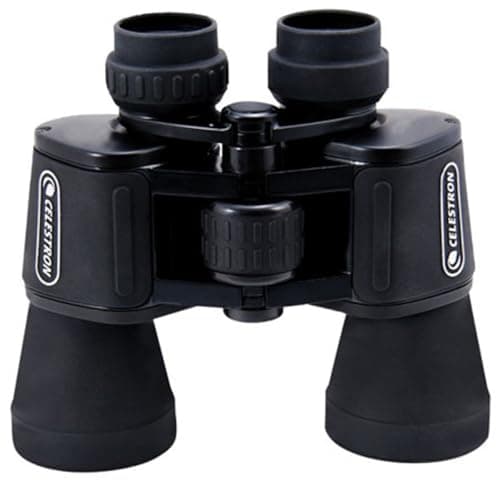 Celestron UpClose G2 10x50 5mm exit pupil, 354 ft field at 1000 yards, and more lunar detail than any 7x. | An adult companion pair, or an older child with steady hands | $64.53 on Amazon #ad How we’re funded · price as of October 21, 2026 |
| 2 | 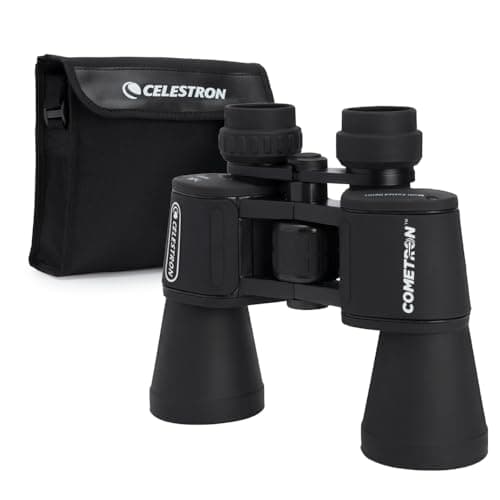 Celestron Cometron 7x50 7.1mm exit pupil, matched to a child's dark-adapted eye, and far easier to hold still. | The child's pair, and the better astronomy buy | |
| 3 | 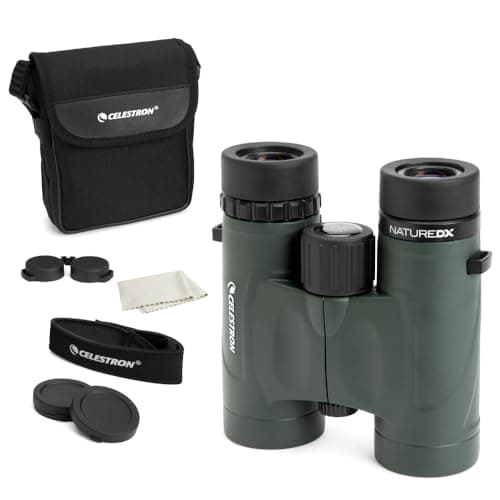 Celestron Nature DX 8x32 18 oz instead of 27, waterproof, and it focuses down to 6.5 feet. | If weight and daylight matter more than light |
Rows link to the full write-up further down this page. Prices come from the live price layer only; where there is no live figure the button reads “Check price” rather than showing a number we remembered.
The shake problem, and how to solve it for free
Magnification multiplies everything, including the movement of your hands. A tremor that is invisible at 7x is obvious at 10x, and children have less steady hands than adults do. This is the single biggest reason we do not recommend 10x as a child's first pair.
It is also almost entirely solvable, and none of the solutions cost anything:
- Lie down on a blanket or a garden lounger. The single most effective fix, and by a distance. Arms braced against the body, head supported, no standing tremor at all.
- Lean against something. A wall, a car, a doorframe, a fence post. Any contact point removes most of the sway.
- Brace your elbows on a wall or a car roof. Turns a handheld view into something close to a tripod view.
- Use the tripod thread. Both pairs have one. A cheap photo tripod plus an inexpensive binocular adapter transforms 10x50s, and it is the upgrade we would make before buying any better binocular.
What 10x50 shows that 7x50 does not
- The Moon: distinctly more crater detail, especially along the terminator. The clearest win.
- Jupiter's moons: better separated from the planet's glare and from each other.
- Double stars: a handful of pairs split at 10x that merge at 7x.
- Distant terrestrial detail: road signs, ships, birds on a far shore.
And what it does not: Saturn's rings resolve at neither magnification — that needs a telescope, which is the honest boundary between the two instruments and one we set out on telescope, binoculars or projector. Wide targets like the Pleiades are also better in the 7x50, because a wider apparent view at lower power is easier to take in.
The eye relief problem for glasses
12mm of published eye relief is short. A child who wears glasses will not see the full field with them on, and taking the glasses off changes where the binoculars need to be focused — which means refocusing every time they swap. If that is the sticking point, the Nature DX ED 10x50 is the same 10x50 format with 17.8mm of eye relief and the same 5mm exit pupil — it costs several times as much and publishes a narrower field.
If glasses are part of the picture, the Nature DX's 17.5mm is the specification that matters more than anything else on this page. We work through the full by-age picture on binoculars by age.
How we reviewed this
We have not handled this pair. Every specification is from Celestron's own published page, linked below and re-checked on the date at the top of this page, and every comparison is arithmetic on those published figures. Our full method is on the methodology page.
The picks in full
Pick 1
Celestron UpClose G2 10x50
An adult companion pair, or an older child with steady hands
The arithmetic
50 / 10 = 5mm exit pupil, against 7.1mm for the 7x50. Same front lens, 30 percent less light reaching the eye, because the extra magnification spreads it over a wider image. The trade you are buying is more detail on the Moon and a shakier view of everything: at 10x, a hand tremor is magnified 10 times too, and children shake more than adults do.
The most useful way to describe this pair is by what it shares rather than what it has: the same 50mm objectives as the Cometron 7x50, in the same porro layout, with the same BK7 prisms and multi-coated lenses. The variable is magnification.
10x buys real detail. The Moon at 10x shows crater fields the 7x renders as texture, and Jupiter's four bright moons are more comfortably separated. On a tripod — and both pairs are tripod adaptable — this is a noticeably more capable instrument.
It also costs you light. 50 / 10 gives a 5mm exit pupil against the 7x50's 7.1mm, and light delivered scales with the area: (7.1 / 5) squared is about 2 times in the 7x50's favor for a fully dark-adapted young eye.
One published oddity worth noting rather than glossing: Celestron states 354 ft at 1000 yards for this 10x50 and 344 ft for the 7x50 — a marginally *wider* true field despite the higher magnification, which comes from a wider apparent field in the eyepiece design. It is unusual, and it is what the manufacturer publishes.
Skip it if
This is the child's only pair, and the child is under about ten. At 10x a hand tremor is magnified ten times as well, and a shaky 10x view genuinely shows less than a steady 7x one.
| Magnification | 10x |
|---|---|
| Objective lens | 50mm (1.96") |
| Prism glass | BK7 porro |
| Lens coatings | Multi-coated |
| Angular field of view | 6.8 degrees |
| Linear field at 1000 yds | 354 ft (118 m) |
| Exit pupil | 5mm (.19") |
| Eye relief | 12mm (.47") |
| Close focus | 23 ft (7 m) |
| Weight | 27 oz (765 g) |
| Tripod adaptable | Yes |
| Environmental | Water resistant |
| What the box does not do | 12mm of eye relief is short. A child who wears glasses will not see the whole field with them on, and taking them off changes the focus. Water resistant, not waterproof. |
Specifications from Celestron — UpClose G2 10x50mm specifications. We have not handled this one — everything above is the published spec sheet plus our own arithmetic on it.
#ad How we’re funded · price as of October 21, 2026
Pick 2
Celestron Cometron 7x50
The child's pair, and the better astronomy buy
The arithmetic
Exit pupil is objective divided by magnification: 50 / 7 = 7.1mm, which matches Celestron's published figure. That is the single most useful number here. A fully dark-adapted young pupil opens to around 7mm, so a child uses nearly all of that 7.1mm cone and the view is as bright as the optics can make it. An adult over about forty typically dilates to 5mm or less and simply cannot use the extra — this is one of the rare cases where a child gets more out of the hardware than the grown-up does.
For a child, this is the one to buy, and the reasons are steadiness and brightness rather than optics.
At 7x a hand tremor is magnified seven times instead of ten. That sounds like a small difference and it is not: it is roughly the boundary between a view a standing child can hold and one they cannot.
The 7.1mm exit pupil matches a fully dark-adapted young pupil almost exactly, which is the single best-matched specification on this site. Full review.
Skip it if
You specifically want lunar detail. 7x is a wide, bright, forgiving view rather than a detailed one, and Saturn's rings do not resolve at either magnification.
| Magnification | 7x |
|---|---|
| Objective lens | 50mm (1.97") |
| Prism glass | BK7 porro |
| Lens coatings | Multi-coated |
| Angular field of view | 6.6 degrees |
| Linear field at 1000 yds | 344 ft (105 m) |
| Exit pupil | 7.1mm (.28") |
| Eye relief | 13mm (.51") |
| Close focus | 26.2 ft (8 m) |
| Weight | 27.3 oz (774 g) |
| Tripod adaptable | Yes |
| Environmental | Water resistant |
| What the box does not do | 27.3 oz is heavy for small arms held up at the sky — plan on leaning against a wall or lying on a blanket, or add the tripod adapter. BK7 prisms are the cheaper glass and show slight softening at the edge of the field. Water resistant is not waterproof. |
Specifications from Celestron — Cometron 7x50mm specifications. We have not handled this one — everything above is the published spec sheet plus our own arithmetic on it.
Pick 3
Celestron Nature DX 8x32
If weight and daylight matter more than light
The arithmetic
32 / 8 = 4mm exit pupil — dimmer at night than either 50mm pair above, and that is the honest trade. What you get for it: 18 oz instead of 27, which a seven-year-old can actually hold steady; 17.5mm of eye relief, so a child in glasses sees the full field; 6.5 ft close focus, so it works on a ladybird in the garden as well as the Moon; and genuinely waterproof rather than water resistant. This is the pair that gets used on Tuesday afternoon, not just on a clear Saturday night.
The third way to spend this money, and the one that gets used most days rather than most clear nights.
A third lighter, genuinely waterproof, 17.5mm of eye relief for a child in glasses, and close focus at 6.5 ft for insects and garden birds.
You pay for all of that in night-time brightness. Full review.
Skip it if
Astronomy is the point. A 4mm exit pupil is the dimmest of the three at night, and no part of its price premium is buying light.
| Magnification | 8x |
|---|---|
| Objective lens | 32mm (1.26") |
| Prism glass | BaK-4 roof, phase coated |
| Lens coatings | Fully multi-coated |
| Angular field of view | 7.4 degrees |
| Linear field at 1000 yds | 388 ft (129 m) |
| Exit pupil | 4mm (.157") |
| Eye relief | 17.5mm (.69") |
| Close focus | 6.5 ft (2 m) |
| Weight | 18 oz (510 g) |
| Tripod adaptable | Yes |
| Environmental | Waterproof |
| What the box does not do | A 4mm exit pupil means noticeably dimmer star fields than a 7x50 — the Milky Way will not leap out of it. It costs meaningfully more than the porro pairs above, and none of that money is buying you light. |
Specifications from Celestron — Nature DX 8x32mm specifications. We have not handled this one — everything above is the published spec sheet plus our own arithmetic on it.
Questions people actually ask
- Are 10x50 binoculars good for stargazing?
- Yes, particularly on a tripod or lying down. They show more lunar detail than a 7x50 but deliver roughly half the light to a dark-adapted eye and magnify hand tremor, so they suit adults and older children better.
- Is the Celestron UpClose G2 10x50 good for a child?
- For a child of about ten or older with steady hands, or with a tripod, yes. Below that the 7x50 is the better instrument — a shaky 10x view genuinely shows less than a steady 7x one.
- What is the difference between 7x50 and 10x50 binoculars?
- Same 50mm front lenses; the 10x magnifies more. That means more detail but a 5mm exit pupil instead of 7.1mm — about half the light into a dark-adapted eye — and every hand tremor magnified ten times instead of seven.
- Can you see Saturn's rings with 10x50 binoculars?
- No. The rings need magnification no handheld binocular provides. Saturn appears as a bright oval-ish point; resolving the rings takes a telescope at about 50x.
- Do these binoculars fit on a tripod?
- Yes, Celestron lists them as tripod adaptable. A cheap photo tripod plus a binocular adapter is the single best upgrade for any 10x pair, and it costs less than a better binocular.
Sources
Read next
Where to go from here
- Celestron Nature DX ED 10x50 review
A 10x50 with ED glass, phase-coated BaK-4 roof prisms and 17.8mm of eye relief. The exit pupil is identical to a 10x50 costing a quarter as much, so this is a comfort and durability upgrade, not a brightness one.
- Celestron SkyMaster 15x70 review
The big-binocular option, reviewed honestly: 70mm objectives that deliver less light to a dark-adapted child's eye than a 7x50, and 48 oz that demand a tripod.
- 7x50 versus 10x42: which for a child, and why
The exit pupil arithmetic that settles the classic binocular argument, and why the answer is different for a child than for an adult.
- Celestron Cometron 7x50: the beginner astronomy binocular
Why 7x50 is the standard beginner astronomy specification, what this particular pair publishes, and the one thing to plan around.
- Celestron Nature DX 8x32 review
A third lighter than a 7x50, waterproof, and it focuses down to 6.5 feet. What that buys by day, and exactly what it costs you at night.
- The best binoculars for stargazing with kids
The exit pupil calculation that decides which binoculars suit a child, and what a 7x50 actually shows on a first clear night.
- Binoculars for kids, by age
What a child can physically hold at each age, and which published weight and eye-relief figures to check before buying.
- The stargazing night kit
A red torch does more for what a child sees than doubling the aperture. The full kit, in order of how much it changes.