Telescopes
Is the Celestron PowerSeeker 50AZ any good?
The telescope this site tells people not to buy, finally explained on a page of its own.
By Scooter M. · published October 18, 2026
I'm not an astronomer and I don't have a lab. I'm someone who's genuinely into this — I read the manuals, compile the published specs, and do the arithmetic the box doesn't do for you. No lab coat. How we pick.
How this is funded. Lens & Lightyear earns a commission when you buy through a link on this page, at no extra cost to you. It does not change which products we pick or what we say about them — every card below carries a real reason to skip it. Prices are pulled live and were last verified October 18, 2026. Full disclosure.
The short answer
No — not for a child. Celestron publishes a highest useful magnification of 118x for this 50mm telescope, then supplies a 4mm eyepiece and a 3x Barlow that together reach about 450x. The 0.96 inch diagonal also blocks any eyepiece upgrade. At a similar price the Celestron FirstScope or Travel Scope 70 are better telescopes.
This site names the PowerSeeker 50AZ on six pages, almost always as the thing not to buy. It has never had a page explaining why in full, which is a gap worth closing — the arithmetic here is the clearest illustration of a pattern that runs through the whole entry-level shelf.
The arithmetic, step by step
| Step | Figure | Source |
|---|---|---|
| Aperture | 50mm | Celestron published |
| Focal length | 600mm | Celestron published |
| Highest useful magnification | 118x | Celestron published |
| Supplied 20mm eyepiece | 600 / 20 = 30x | Our arithmetic |
| Supplied 12mm eyepiece | 600 / 12 = 50x | Our arithmetic |
| Supplied 4mm eyepiece | 600 / 4 = 150x | Our arithmetic — past the ceiling |
| 4mm plus the supplied 3x Barlow | 450x | Our arithmetic — about 4x the ceiling |
| Diagonal size | 0.96" | Celestron published — blocks upgrades |
| Limiting stellar magnitude | 11 | Celestron published |
| Total kit weight | 2.31 lbs (1.05 kg) | Celestron published |
Every published figure is from Celestron's own specification page for this telescope, linked below. Every calculated figure is magnification = focal length divided by eyepiece focal length, which any reader can check.
There is a rough rule that a telescope's useful magnification tops out around twice its aperture in millimeters — about 100x for a 50mm objective. Celestron's own 118x is close to that, and the box exceeds it by a factor of four.
Why too much magnification makes things worse
This is the part that surprises people, because magnification is the number printed largest on the box.
- Magnification does not add detail. Aperture collects light and resolves detail; the eyepiece only enlarges whatever the objective delivered. Past a point you are enlarging the blur along with the image.
- Brightness falls as magnification rises. The same collected light spread across a bigger image makes a dimmer one. At 450x on 50mm, a planet is a faint smudge.
- The field shrinks drastically. At very high power the slice of sky visible is tiny, and without tracking the target drifts out of view in seconds.
- Focus stops being achievable. Atmospheric turbulence alone defeats that power on most nights, so the image never snaps sharp — which a child reads as the telescope being broken.
Quick picks
One to avoid, and two to buy instead
| # | Product | Best for | Price |
|---|---|---|---|
| ! | 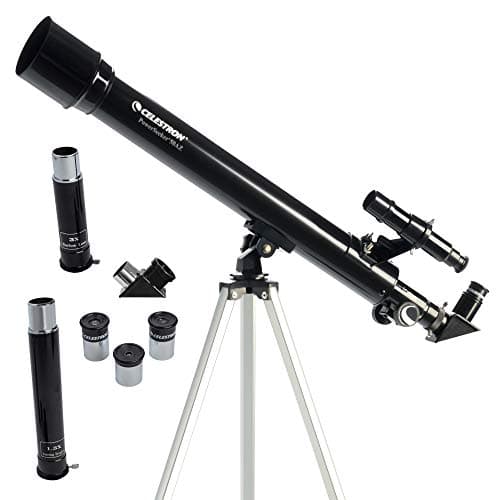 Celestron PowerSeeker 50AZ Published ceiling 118x. The supplied eyepieces and Barlow reach roughly 450x. Skip this one — see why below | Showing exactly how the beginner-telescope trap is built | Not recommended |
| 2 | 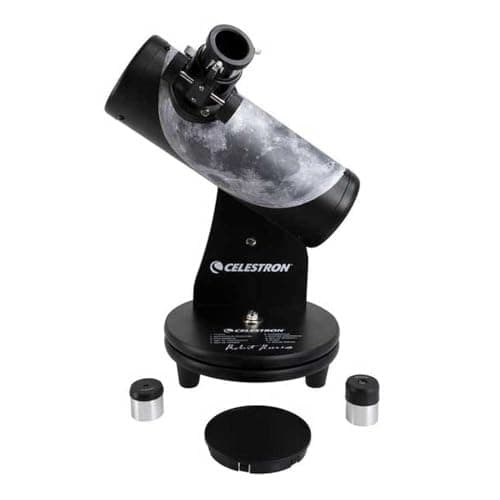 Celestron FirstScope 76mm Tabletop 76mm of aperture, and eyepieces that stay inside the published ceiling. | The same money, spent on aperture instead of on magnification claims | |
| 3 | 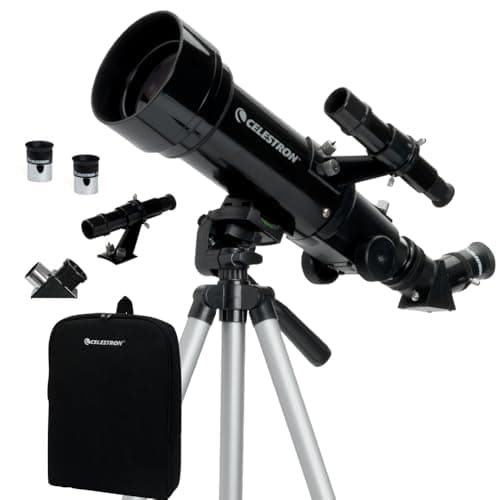 Celestron Travel Scope 70 70mm at f/5.7 with a 45-degree erect-image diagonal and a backpack. | A child who will use it in daylight as much as at night |
Rows link to the full write-up further down this page. Prices come from the live price layer only; where there is no live figure the button reads “Check price” rather than showing a number we remembered.
The 0.96 inch diagonal, and why it is the real problem
A weak eyepiece set is normally a fixable complaint. On most telescopes the barrel is 1.25 inches, the modern standard, and one reasonable eyepiece transforms what the instrument can do.
This telescope uses a 0.96 inch diagonal — a legacy size that the aftermarket has largely abandoned. So the usual repair is unavailable, and what you bought is what you keep. That single specification is why we treat this as a telescope to avoid rather than a cheap telescope with a known fix.
What to buy instead, by what you have
| Your situation | Buy this instead | Why |
|---|---|---|
| A table or flat surface at chest height | FirstScope | 76mm of aperture, eyepieces inside the published ceiling |
| Daylight use matters too | Travel Scope 70 | 70mm, erect-image diagonal, packs into a backpack |
| Child is five or six | Best telescope for a 5 or 6 year old | Age-matched picks rather than a price-matched one |
| You can stretch the budget | Best telescopes under $200 | Where the aperture curve really starts to pay |
| Not sure a telescope is right at all | Binoculars for stargazing | Often the better first instrument for a child |
In fairness to Celestron
Several of this site's recommendations are Celestron telescopes, and the FirstScope directly above is one of them. The problem is not the brand — it is this specific configuration, which exists to hit a price point and a magnification claim on a shelf.
The 50mm objective itself is not the issue either. A 50mm refractor with one sensible eyepiece and a 1.25 inch focuser would be a perfectly reasonable, if modest, first telescope. It is the 4mm eyepiece, the 3x Barlow and the legacy diagonal that make this one a trap.
What we did and did not do
We have not tested this telescope. The aperture, focal length, supplied eyepieces, Barlow, finderscope, diagonal size, published magnification ceiling, limiting magnitude and weight were all read from Celestron's published specification page on the date at the top of this page, linked below.
The magnification figures we call ours are arithmetic on those published numbers — focal length divided by eyepiece focal length — and are reproducible against the same spec sheet. We publish no rating and no review count, because we have measured nothing. Prices come only from our live feed with the date they were checked, and our full method is on the methodology page.
The picks in full
Skip this
Celestron PowerSeeker 50AZ
Showing exactly how the beginner-telescope trap is built
The arithmetic
This is the arithmetic that explains the whole category. Celestron publishes a highest useful magnification of 118x for this 50mm objective. The box also supplies a 4mm eyepiece — 600 / 4 = 150x, already past the ceiling — and a 3x Barlow, which takes that combination to 450x. Roughly four times more magnification than the manufacturer's own spec sheet says the optics can deliver. At 450x you are magnifying a blur.
Start with Celestron's own number. For this 50mm objective they publish a highest useful magnification of 118x. That is the manufacturer saying, in their own specification sheet, what the optics can deliver.
Now look in the box. A 4mm eyepiece on a 600mm focal length gives 600 / 4 = 150x, already past the published ceiling. Add the supplied 3x Barlow and that combination reaches roughly 450x — about four times what Celestron says the telescope can do.
At 450x on 50mm of aperture you are not seeing more. You are magnifying a blur: a dim, shaking, indistinct smear that will not come to focus however carefully a child turns the knob.
The second problem is the one that closes the door. The diagonal is 0.96 inches, a legacy size that almost no aftermarket eyepiece fits. The usual fix for a weak eyepiece set — buy one decent eyepiece — is not available here.
So the honest summary is that the box contains one genuinely usable eyepiece, the 20mm at 30x, and the rest is packaging. At 2.31 lbs for the whole kit, with a 5x24 finderscope, there is no upgrade path and no reason to prefer it to the alternatives below.
Skip it if
Always, for a child. Not because Celestron is a bad brand — several of our picks across the site are theirs — but because this configuration teaches a child that telescopes do not work, and the 0.96 inch diagonal means you cannot fix it later.
| Optical design | Refractor |
|---|---|
| Aperture | 50mm (1.97") |
| Focal length | 600mm (24") |
| Focal ratio | f/12 |
| Eyepieces supplied | 20mm (30x), 12mm (50x), 4mm (150x) |
| Also supplied | 3x Barlow lens, 1.5x erecting eyepiece |
| Finderscope | 5x24 |
| Diagonal | 0.96" |
| Highest useful magnification | 118x |
| Limiting stellar magnitude | 11 |
| Total kit weight | 2.31 lbs (1.05 kg) |
| What the box does not do | The 0.96" diagonal is a legacy size, so almost no aftermarket eyepiece will fit it. The high-power combinations in the box are effectively unusable, which means the "three eyepieces and a Barlow" on the packaging is really one usable eyepiece and some cardboard filler. |
Specifications from Celestron — PowerSeeker 50AZ specifications. We have not handled this one — everything above is the published spec sheet plus our own arithmetic on it.
Pick 2
Celestron FirstScope 76mm Tabletop
The same money, spent on aperture instead of on magnification claims
The arithmetic
The 20mm eyepiece gives 300 / 20 = 15x, and the 4mm gives 300 / 4 = 75x. Celestron's own published ceiling is 180x, so the 4mm sits well inside what the optics support — unusual honesty at this price. There is no tripod: it needs a table, a wall, a car roof or a stack of books at roughly chest height for the child using it.
The direct replacement, and the contrast is instructive. The FirstScope's 76mm mirror collects substantially more light than a 50mm lens, and Celestron publishes a 180x ceiling for it.
The supplied eyepieces give 15x and 75x — both comfortably inside that ceiling. Same brand, honest configuration.
Honest downside: no tripod, no finderscope, and you nudge the tube by hand to track. Full review.
Skip it if
You have no table, wall or flat surface at roughly the child's chest height. This is a tabletop telescope with no tripod.
| Optical design | Newtonian reflector, spherical primary mirror |
|---|---|
| Aperture | 76mm (2.99") |
| Focal length | 300mm (12") |
| Focal ratio | f/3.95 |
| Eyepieces supplied | 20mm (15x) and 4mm (75x) |
| Highest useful magnification | 180x |
| Lowest useful magnification | 11x |
| Limiting stellar magnitude | 11.9 |
| Light gathering vs the eye | 118x |
| Mount | Dobsonian-style tabletop base |
| What the box does not do | No tripod, no finderscope, and no way to track an object as the sky moves — you nudge the tube by hand. The 4mm eyepiece is usable but tight; most children get on better with the 20mm all evening. |
Specifications from Celestron — FirstScope specifications. We have not handled this one — everything above is the published spec sheet plus our own arithmetic on it.
Pick 3
Celestron Travel Scope 70
A child who will use it in daylight as much as at night
The arithmetic
400mm focal length over the two supplied eyepieces gives 20x and 40x. Celestron's published ceiling for a 70mm objective is 168x, so both eyepieces are comfortably inside it — the box is not overselling. The 3.3 lb total is the number that matters for a gift: a child can carry the whole kit themselves, which is most of why it gets used more than once.
The other honest option near this price. 70mm against 50mm is a real aperture gain, and the 20mm and 10mm eyepieces give 20x and 40x against a published 168x ceiling — no inflated numbers.
The 45-degree erect-image diagonal makes it genuinely dual-purpose, so it gets picked up on ordinary afternoons for birds and hills rather than only on clear nights.
Honest downside: the 1.8 lb tripod is the weak part of the package. Full review.
Skip it if
Steadiness matters most. The tripod is light enough to carry and light enough to wobble when a child touches the eyepiece.
| Optical design | Refractor |
|---|---|
| Aperture | 70mm (2.8") |
| Focal length | 400mm (15.74") |
| Focal ratio | f/5.7 |
| Eyepieces supplied | 20mm (20x) and 10mm (40x) |
| Finderscope | 5x24 |
| Diagonal | 45 degree erect image, 1.25" |
| Mount | Manual alt-azimuth on aluminum tripod |
| Highest useful magnification | 168x |
| Limiting stellar magnitude | 11.7 |
| Total kit weight | 3.3 lbs (1.5 kg), tripod 1.8 lbs (0.81 kg) |
| Included | Custom backpack, Starry Night Basic software, SkyPortal app access |
| What the box does not do | The tripod is the weak part. At 1.8 lbs it is light enough to carry and light enough to wobble, and a child nudging the eyepiece will lose the target. The 45 degree erect-image diagonal is built for daytime use and costs you a little light at night. |
Specifications from Celestron — Travel Scope 70 specifications. We have not handled this one — everything above is the published spec sheet plus our own arithmetic on it.
Questions people actually ask
- Is the Celestron PowerSeeker 50AZ good for beginners?
- Not for a child. Celestron publishes a highest useful magnification of 118x for its 50mm objective, but supplies a 4mm eyepiece (150x) and a 3x Barlow that together reach about 450x. Those high-power combinations do not produce a usable image, and the 0.96 inch diagonal prevents upgrading the eyepieces later.
- What magnification can a 50mm telescope actually use?
- Celestron publishes 118x as the highest useful magnification for this telescope, which is close to the common rule of roughly twice the aperture in millimeters. Beyond that you enlarge the image without adding any detail, and it grows dimmer and harder to focus.
- Why does the PowerSeeker 50AZ come with a 4mm eyepiece and a 3x Barlow if they do not work?
- Because the combination produces a large magnification number for the packaging. It is a marketing specification rather than a usable one — the optics cannot deliver a sharp image at 450x on a 50mm objective.
- Can you upgrade the eyepieces on the PowerSeeker 50AZ?
- Barely. It uses a 0.96 inch diagonal, a legacy size that almost no modern eyepiece fits. On telescopes with the standard 1.25 inch fitting, a single better eyepiece is the usual cheap fix; here that route is closed.
- What should I buy instead of the PowerSeeker 50AZ?
- At a similar price the Celestron FirstScope gives 76mm of aperture with eyepieces that stay inside its published 180x ceiling, and the Travel Scope 70 gives 70mm plus daylight use through an erect-image diagonal. Either is a better first telescope for a child.
- Is Celestron a bad telescope brand?
- No. Several telescopes we recommend are Celestron, including the FirstScope. The problem is this particular configuration — the inflated eyepiece and Barlow combination plus the obsolete diagonal size — rather than the manufacturer.
Sources
Read next
Where to go from here
- The space gifts not to buy — and what to buy instead
The four ways the kids astronomy aisle disappoints, each with the arithmetic that exposes it and the honest alternative at the same money.
- Toy telescopes versus real optics: how to tell in thirty seconds
The arithmetic that exposes a 525x claim on a 70mm box, worked through on a real product using its own manufacturer's published numbers.
- Is the Celestron FirstScope any good?
The most-bought first telescope in the category. What its published specs actually mean, and the one household constraint that decides whether it works.
- The best kids' telescopes under $100
The sub-$100 shelf is where the 525x claims live. What that money genuinely buys, and the one telescope here we tell you not to buy.
- The best telescope for a 5 or 6 year old
What a five or six year old can actually do with a telescope, and the two picks built around that rather than around a spec sheet.
- The best beginner telescope
The four things that actually decide whether a first telescope gets used twice, and the picks that satisfy them. Including the case for buying binoculars instead.