Star Projectors
Star projector or telescope? A clear answer either way
One shows a picture of the sky. The other shows the sky.
By Scooter M. · published September 1, 2026
I'm not an astronomer and I don't have a lab. I'm someone who's genuinely into this — I read the manuals, compile the published specs, and do the arithmetic the box doesn't do for you. No lab coat. How we pick.
How this is funded. Lens & Lightyear earns a commission when you buy through a link on this page, at no extra cost to you. It does not change which products we pick or what we say about them — every card below carries a real reason to skip it. Prices are pulled live and were last verified October 18, 2026. Full disclosure.
The short answer
Buy the telescope if there will be clear nights and an adult willing to go outside. Buy the projector if the reality is cloudy weather, early bedtimes and a bedroom. The telescope shows more; the projector gets used more. Match the gift to the household, not to the enthusiasm.
What each one actually does
| Telescope | Star projector | |
|---|---|---|
| What it shows | Real objects, live — the Moon, planets, clusters | A representation of the sky, indoors |
| Works when it is cloudy | No | Yes, every night |
| Works at bedtime in summer | No — it is not dark until very late | Yes |
| Requires going outside | Yes, in whatever the weather is doing | No |
| Requires an adult | Usually, for younger children | No |
| Teaches constellations | Poorly — the field of view is tiny | Very well |
| Shows planets | Yes — Jupiter's moons, Saturn's rings | No |
| Sense of wonder | Very high, and hard-won | High, and immediate |
| Risk of disappointment | High if expectations are not managed | Low |
| Setup | Assembly, alignment, learning to find things | Plug in, point at ceiling |
Quick picks
One of each, and the case for both
| # | Product | Best for | Price |
|---|---|---|---|
| 1 | 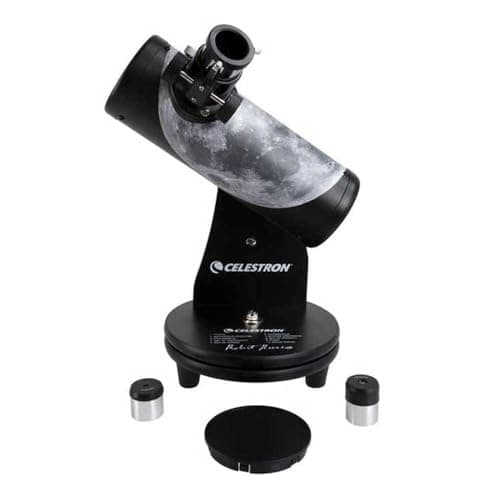 Celestron FirstScope 76mm Tabletop 76mm of aperture showing the actual Moon, actual Jupiter and actual Saturn. | The telescope case: real light, tonight | |
| 2 | No image National Geographic Astro Planetarium 8,000 real stars and 61 constellations, adjustable to tonight's actual sky. | The projector case: the sky, indoors, every night | |
| 3 | 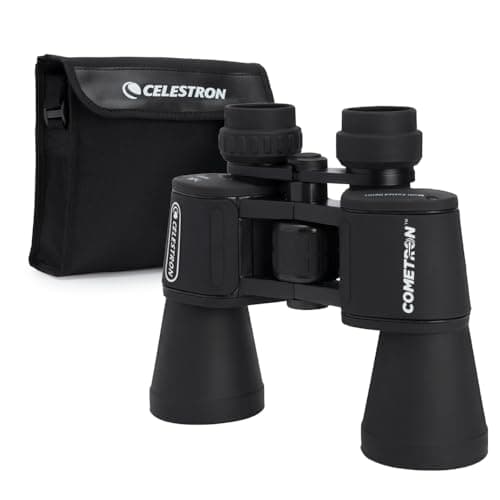 Celestron Cometron 7x50 Costs less than either, works instantly, and shows real objects. | The third option nobody suggests |
Rows link to the full write-up further down this page. Prices come from the live price layer only; where there is no live figure the button reads “Check price” rather than showing a number we remembered.
The verdict, by scenario
A comparison that refuses to pick a winner is not useful, so here are five specific situations with a specific answer for each.
| Situation | Winner | Why |
|---|---|---|
| Child is 3-5, bedtime is 7pm | Projector | It will not be dark before bedtime for half the year. A telescope simply cannot be used. |
| Child is 8, an adult is keen too | Telescope | Real objects with a willing adult is the best version of this hobby. Nothing beats it. |
| Child is 8, no adult will go outside | Projector, or binoculars | A telescope needs a partner at that age. Without one it goes in a cupboard. |
| Child is 11 and genuinely into it | Telescope | They can operate it alone, and at that age the projector will feel like a toy. |
| You have no idea and want it to land | Binoculars | Cheapest, works instantly, works in daylight too. The lowest-risk option by a distance. |
| Child already has a telescope | Projector | It is how you learn the sky on cloudy nights. Genuinely complementary rather than redundant. |
The mistake this comparison usually hides
People compare a $150 telescope with a $40 decorative projector, conclude the projector is better value, and buy something that has nothing to do with astronomy.
That is not a fair comparison. The honest one is a $150 telescope against a $150 optical planetarium, both of which are real instruments that do their jobs well. A decorative galaxy projector is a lovely bedroom light and it is not in this comparison at all — see accurate versus decorative for that distinction.
The expectation problem, which applies to both
Both gifts fail the same way: the child expects the photographs. A telescope shows a small sharp Saturn, not a poster. A projector shows white points, not a swirling nebula — unless it is the decorative kind, in which case it shows a swirling nebula that means nothing.
Say what each will actually look like before it is unwrapped. It costs one sentence and it is the single highest-value thing you can do. Our honest per-object list is on what you can actually see.
The picks in full
Pick 1
Celestron FirstScope 76mm Tabletop
The telescope case: real light, tonight
The arithmetic
The 20mm eyepiece gives 300 / 20 = 15x, and the 4mm gives 300 / 4 = 75x. Celestron's own published ceiling is 180x, so the 4mm sits well inside what the optics support — unusual honesty at this price. There is no tripod: it needs a table, a wall, a car roof or a stack of books at roughly chest height for the child using it.
The thing a telescope does that nothing else can: it shows a child real light from a real object, arriving in real time.
76mm of aperture, a published 180x ceiling, and eyepieces giving 15x and 75x. What that shows: lunar craters and mountain shadows, Jupiter as a disc with up to four moons beside it, Saturn's rings as a distinct oval.
The moment that matters is when a child understands that the light hitting their eye left Jupiter about forty minutes ago. That is not something a projector can deliver at any price, and children get it immediately.
The cost is that it only works outdoors, on a clear night, with someone willing to go out. In a lot of households that is a genuine constraint rather than a detail.
Skip it if
Clear nights are rare where you live, or nobody will go outside in the cold. A telescope used four times a year loses to a projector used four times a week, whatever the optics say.
| Optical design | Newtonian reflector, spherical primary mirror |
|---|---|
| Aperture | 76mm (2.99") |
| Focal length | 300mm (12") |
| Focal ratio | f/3.95 |
| Eyepieces supplied | 20mm (15x) and 4mm (75x) |
| Highest useful magnification | 180x |
| Lowest useful magnification | 11x |
| Limiting stellar magnitude | 11.9 |
| Light gathering vs the eye | 118x |
| Mount | Dobsonian-style tabletop base |
| What the box does not do | No tripod, no finderscope, and no way to track an object as the sky moves — you nudge the tube by hand. The 4mm eyepiece is usable but tight; most children get on better with the 20mm all evening. |
Specifications from Celestron — FirstScope specifications. We have not handled this one — everything above is the published spec sheet plus our own arithmetic on it.
Pick 2
National Geographic Astro Planetarium
The projector case: the sky, indoors, every night
The arithmetic
8,000 real stars and 61 named constellations, adjustable to a specific date and time — so you can set it to the sky outside tonight and then go and find the same thing. That is the useful trick. Note the manufacturer's own age guidance of 14 and up: this is a mechanism with small parts and fiddly discs, not a nursery night light, whatever the shelf it sits on suggests.
The thing a projector does that a telescope cannot: work on a Tuesday in November when it is raining and everyone is in pajamas.
8,000 cataloged stars, 61 named constellations, and a date-and-time setting so the ceiling matches the sky outside. That last feature is what makes it educational rather than decorative.
Used well, a projector is a training tool. A child learns to recognize Orion on their ceiling in five minutes, and then finds it outdoors in thirty seconds instead of ten frustrating minutes. That transfer is real and it is why serious observers own planetariums.
Auto shut-off at 30, 60 or 120 minutes, dual motors with six speeds, a shooting-star function, and a 3 m maximum throw. Bresser's age guidance is 14 and up for handling the discs.
Skip it if
The child specifically wants to see planets. No projector shows Saturn's rings. If that is the ask, only a telescope answers it.
| Stars projected | Over 8,000 |
|---|---|
| Constellations | 61 named |
| Discs | 2 projection discs included |
| Projection area | 1.6 x 2.1 m at 2 m distance |
| Maximum projection distance | 3 m |
| Motion | Dual motors, 6 speeds |
| Timer | Auto shut-off at 30, 60 or 120 minutes |
| Power | 3 x AA (supplied) or 5 V DC cable (not supplied) |
| Manufacturer age guidance | 14 and up |
| Included | 2 projection discs, 3 AA batteries, instruction manual |
| What the box does not do | The 3 m maximum throw means it needs a reasonably close ceiling. The DC cable is not supplied, so on batteries alone it is an occasional-use device. No app, no speaker, no color. |
Specifications from Bresser — National Geographic Astro Planetarium; Space.com — National Geographic Astro Planetarium review. We have not handled this one — everything above is the published spec sheet plus our own arithmetic on it.
Pick 3
Celestron Cometron 7x50
The third option nobody suggests
The arithmetic
Exit pupil is objective divided by magnification: 50 / 7 = 7.1mm, which matches Celestron's published figure. That is the single most useful number here. A fully dark-adapted young pupil opens to around 7mm, so a child uses nearly all of that 7.1mm cone and the view is as bright as the optics can make it. An adult over about forty typically dilates to 5mm or less and simply cannot use the extra — this is one of the rare cases where a child gets more out of the hardware than the grown-up does.
The comparison on this page is usually presented as a binary and it should not be, because the third option beats both for a lot of children.
A 7x50 binocular costs less than either a usable telescope or an accurate planetarium. It shows real objects — the Moon, Jupiter's moons, the Pleiades, Andromeda — and it requires no setup, no assembly and no learning.
The 7.1mm exit pupil matches a dark-adapted child's eye, and the 6.6 degree field makes finding things trivial in a way a telescope never is.
It also works in daylight, on birds and hills, which means it gets picked up on ordinary afternoons rather than only on clear nights. That usage rate is the hidden argument for it.
Skip it if
The gift needs to feel substantial. Binoculars are the optically sensible answer and they are also the least impressive thing to unwrap of the three.
| Magnification | 7x |
|---|---|
| Objective lens | 50mm (1.97") |
| Prism glass | BK7 porro |
| Lens coatings | Multi-coated |
| Angular field of view | 6.6 degrees |
| Linear field at 1000 yds | 344 ft (105 m) |
| Exit pupil | 7.1mm (.28") |
| Eye relief | 13mm (.51") |
| Close focus | 26.2 ft (8 m) |
| Weight | 27.3 oz (774 g) |
| Tripod adaptable | Yes |
| Environmental | Water resistant |
| What the box does not do | 27.3 oz is heavy for small arms held up at the sky — plan on leaning against a wall or lying on a blanket, or add the tripod adapter. BK7 prisms are the cheaper glass and show slight softening at the edge of the field. Water resistant is not waterproof. |
Specifications from Celestron — Cometron 7x50mm specifications. We have not handled this one — everything above is the published spec sheet plus our own arithmetic on it.
Questions people actually ask
- Is a star projector better than a telescope for a child?
- For a very young child, on cloudy nights, or where nobody will go outside — yes. For a child who wants to see planets, no. They do genuinely different jobs and the right answer depends on your household rather than on the child's enthusiasm.
- Can a star projector replace a telescope?
- No. A projector shows a representation of the sky indoors; a telescope shows real light from real objects. Children notice the difference immediately, and the difference is the point.
- Should I buy both a telescope and a star projector?
- If budget allows, they work well together — the projector teaches constellations on cloudy nights, and the telescope shows the real thing when it clears. That combination teaches faster than either alone.
- What is a better first astronomy gift?
- Honestly, often binoculars. They cost less than either, work instantly, show real objects, and work in daylight too. See telescope versus binoculars versus projector.
Sources
Read next
Where to go from here
- Telescope, binoculars or star projector?
Three completely different gifts sold to the same buyer. Which one fits your child, your sky and your household, with a winner named for each.
- Accurate or decorative? The star projector split nobody explains
The single distinction that decides whether a star projector supports a child's interest in astronomy or is simply a very nice bedroom light.
- The best telescope for a 7 or 8 year old
Seven and eight is where independence starts. The picks here are chosen on carry weight and how easy it is to find something, not on aperture.
- Binoculars
Cheaper, easier, and they work on night one. The case for starting here.
- What you can actually see with a kids' telescope
The honest target-by-target list for 70mm, 76mm and 114mm telescopes, so nobody is disappointed on night one.
- The best first telescope for a kid
A first telescope has one job: produce a good first night. Which specifications serve that, and which are irrelevant to it.