Star Projectors
The best star projector for kids, by age
The same device is a night light at four, a teaching tool at eight, and outgrown at twelve.

By Scooter M. · published September 22, 2026
I'm not an astronomer and I don't have a lab. I'm someone who's genuinely into this — I read the manuals, compile the published specs, and do the arithmetic the box doesn't do for you. No lab coat. How we pick.
How this is funded. Lens & Lightyear earns a commission when you buy through a link on this page, at no extra cost to you. It does not change which products we pick or what we say about them — every card below carries a real reason to skip it. Prices are pulled live and were last verified October 18, 2026. Full disclosure.
The short answer
Under about seven, buy the quietest decorative projector you can and treat it as a night light. From seven to nine, buy one with real star discs, because that is the age a child can match a ceiling pattern to the window. From ten, buy an accurate planetarium or skip to binoculars.
This site organizes telescopes, binoculars and gifts by the age of the child, and projectors deserve the same treatment — because the honest answer changes completely between a four-year-old and a twelve-year-old, while the products are sold as though it does not.
How we judged, before any ranking
- Who operates it. A projector a child cannot turn on themselves becomes an adult's chore. Under seven that is fine and app control by a parent is right; over seven it is a reason to prefer physical buttons.
- Noise, published rather than claimed. Govee states 25 dB. Most brands state nothing, and a motorized unit that hums is the most common reason one ends up unplugged.
- Accuracy, but only where it is useful. A real star field matters from about seven. Before that it is a specification you pay for and the child cannot use.
- A timer. Anything that runs all night in a child's room is a problem for the adults. This is the single most useful feature in the category and it is not on every unit.
- How it ages. The question is not whether it impresses on night one — they all do — but whether it is still on in month six.
What changes at each age
| Age | What it really is | What to prioritize | What to ignore |
|---|---|---|---|
| 4-6 | A night light with a space theme | Quiet, dimmable, parent-controlled, timer | Star accuracy, constellation counts |
| 7-9 | The teaching window | Real star discs, child-operable controls | App features, music sync |
| 10-12 | Either the real sky, or outgrown | Accuracy, or spend the money on optics instead | Color effects — they will notice these are fake |
| 13+ | Decor, or nothing | Whatever they actually asked for | Any claim that it teaches astronomy |
Our framing, from the same age-first principle behind telescopes by age and binoculars by age. Under four, see star projectors for toddlers, where safety and cable placement matter more than anything on this page.
Quick picks
Four projectors, matched to the age of the child
| # | Product | Best for | Price |
|---|---|---|---|
| 1 | 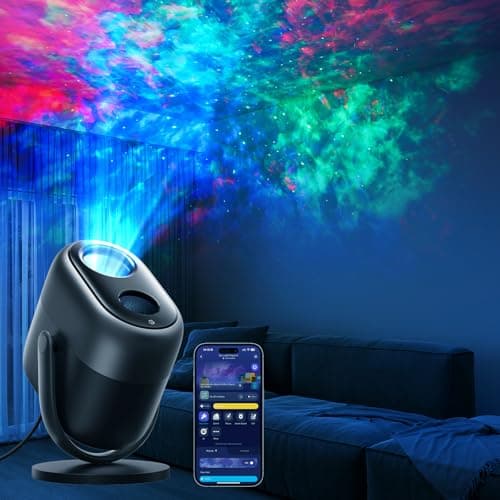 Govee Star Light Projector with Nebula Effect A quiet, app-controlled nebula projector at the bottom of the price range. | Ages 4-6, where it is a night light with good manners | |
| 2 | 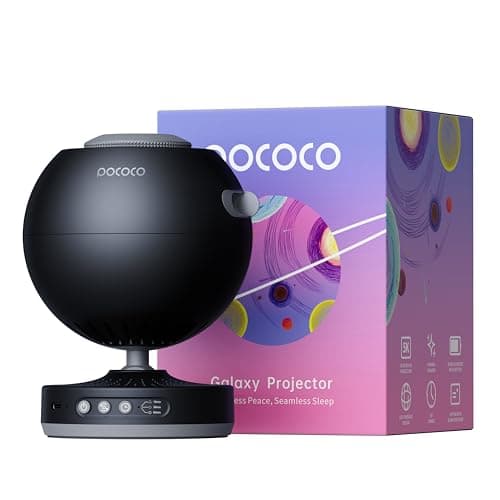 Pococo Galaxy Projector Disc-based projection with real star fields as well as space imagery, and a battery so it goes where the child goes. | Ages 7-9, the years when it can genuinely teach something | $104.99 on Amazon #ad How we’re funded · price as of October 18, 2026 |
| 3 | 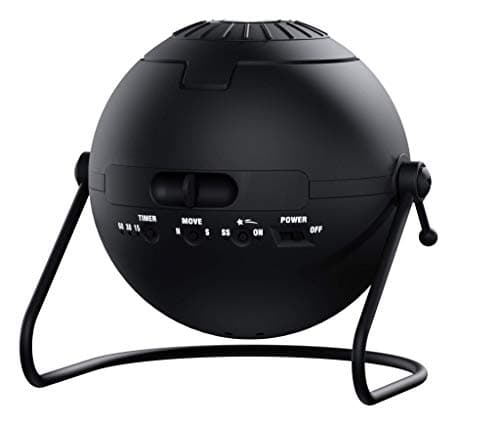 Sega Toys Homestar Flux An optical planetarium projecting a genuine star field from a glass disc, focusable and on a timer. | Ages 10-12, when the real sky is the point | $259.00 on Amazon #ad How we’re funded · price as of October 18, 2026 |
| 4 | 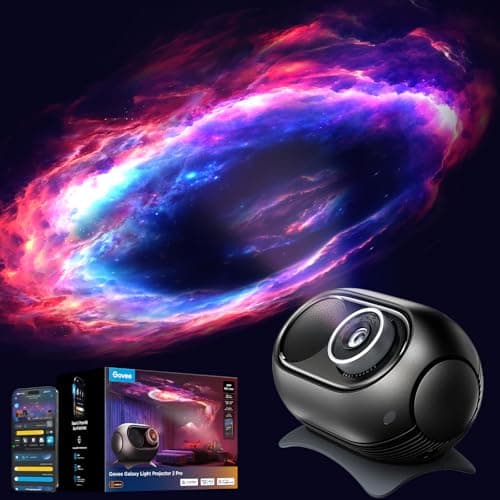 Govee Galaxy Light Projector 2 Pro The best-controlled decorative projector here, with scheduling, brightness control and music sync. | Any age where the request is explicitly for the light show |
Rows link to the full write-up further down this page. Prices come from the live price layer only; where there is no live figure the button reads “Check price” rather than showing a number we remembered.
The seven-year-old test
There is one moment that decides whether a star projector was a good present or a light fitting, and it happens somewhere around seven: the child looks at a shape on the ceiling, goes to the window, and finds the same shape in the sky.
Before that age the two things are unrelated in their head, so an accurate projector is money spent on a feature that does not land. After it, an accurate projector becomes the cheapest astronomy teaching tool there is — cheaper than any telescope, usable on cloudy nights, and repeatable every evening until the pattern sticks.
Accurate or decorative, in one paragraph
Two entirely different products share this name. One projects real stars in real positions from an optical disc; the other projects laser dots and drifting colored cloud. Both are legitimate purchases and only one of them teaches anything. If you are choosing between them, accurate versus decorative is the full argument, and what to check in a bedroom covers where it has to physically sit.
When a projector stops being the right gift
Worth saying on a page whose job is to sell one: for some children, at some ages, this is the wrong present, and the honest recommendation is elsewhere.
- They keep asking to see planets. No projector shows Saturn's rings. That is a telescope request wearing a projector's clothes, and our projector versus telescope page compares them directly.
- They are already naming constellations. A child who can find Cassiopeia outside has finished with the ceiling. Binoculars are the next real step, and they cost less than the accurate projectors here.
- The room is bright. A streetlight through thin curtains beats every projector in this category. Fix that first or buy something else.
- They are under four. The requirements are genuinely different — small parts, cable routing, nothing near the cot. That is the toddler page, not this one.
A note on the accurate option we did not rank here
The National Geographic Astro Planetarium is the affordable accurate projector in this category, and it is the obvious middle option for a seven-to-ten-year-old. We have left it unranked on this page for one reason: Bresser publishes a manufacturer age guidance of 14 and up for it, which is largely a small-parts rating on the projection discs rather than a judgment about usability.
We are not going to quietly ignore a maker's own age guidance on a page about children. If an adult is handling the discs, it is a fine choice for this age group and we say so on accurate versus decorative; we simply will not rank it as a pick for a child below the age its maker states.
What we did and did not do
We have not tested these projectors. Govee publishes full specifications and we read them from its own pages; Sega Toys and Pococo publish very little, so the figures we rely on for those two come from the independent hands-on reviews linked below. Where nobody publishes a number — brightness in lumens, for most of this category — we do not state one.
The age bands are our framing, not a manufacturer's, and they are an argument rather than a measurement. No price appears in this prose; live figures come only from our price feed with the date they were checked. Our full method is on the methodology page.
The picks in full
Pick 1
Govee Star Light Projector with Nebula Effect
Ages 4-6, where it is a night light with good manners
The arithmetic
25 dB is the specification that matters in a child's bedroom and the one nobody checks — roughly the level of a quiet library, which is quiet enough to fall asleep next to. 540 sq ft of coverage will fill an ordinary bedroom ceiling with room to spare, and is in fact 79 percent more area than the far more expensive Galaxy 2 Pro covers.
At four to six, be honest about what you are buying: atmosphere at bedtime. A child this age is not going to match a ceiling pattern to the real sky, and a projector that tries to teach them will mostly be wasted.
What matters instead is that it does not keep anyone awake. Govee publishes a 25 dB noise figure, which is the specification to look for and one most brands never state — a projector that hums is one that gets switched off for good.
Parent-side app control is the right arrangement at this age. The adult sets brightness and turns it off from the doorway rather than negotiating with a six-year-old about it.
Honest downsides: it is decorative by design, it needs mains power near the bed, and the cheapest tier of this category ages fastest — the effect that thrills at four is wallpaper by seven.
Skip it if
You want the child to learn anything astronomical from it. This projects a decorative nebula and laser dots, not a star map, and no amount of use will teach a constellation.
| Model | H6095 |
|---|---|
| Nebula rendering | 7 independent light zones, 7 RGBW lamp beads with 7 independent IC chips |
| Coverage area | 540 square feet |
| Noise level | Less than 25 dB |
| Scene modes | 50+ |
| White noise options | 18 |
| Control | Function button, Govee Home app, voice, Matter |
| Connectivity | 2.4GHz Wi-Fi and Bluetooth |
| Voice assistants | Alexa and Google Assistant |
| Power | 10 W; 5 V DC 3 A input, 100-240 V adapter |
| Dimensions | 5.51 x 6.18 x 8.94" |
| Weight | 1.6 kg |
| What the box does not do | Decorative only: the star field is a pattern, not a sky. No optical discs, so what you see on night one is what you see on night two hundred. Needs the app for most of its features. |
Specifications from Govee — Star Light Projector with Nebula Effect. We have not handled this one — everything above is the published spec sheet plus our own arithmetic on it.
Pick 2
Pococo Galaxy Projector
Ages 7-9, the years when it can genuinely teach something
The arithmetic
A middle path between an accurate planetarium and a decorative light. The disc system means you can run a real star field one night and a nebula the next, and the focus wheel is large enough for a child to work themselves — which matters more than it sounds, because a projector nobody can focus gets switched off. No speaker and no app is a feature in a bedroom, not a gap.
Seven to nine is the age this category actually earns its place. A child can now hold two ideas together — *that shape on the ceiling* and *that shape out of the window* — and that is the only thing that turns a projector from decoration into astronomy.
Swappable discs are what makes that work: a real star field one night, a nebula the next, with the child choosing. No app, no account, nothing to configure — at this age, physical controls beat a phone in a parent's pocket.
Rechargeable battery power matters more than it sounds. It means the projector can go into a blanket fort, a tent or a grandparent's spare room, and it removes the cable that limits where it can sit.
Honest downsides: the disc library is the product, and extra discs are further purchases; and like every projector here it needs a dark room to look like the photographs. Full review.
Skip it if
You expect the discs to be a sky map of tonight's sky. They are images projected large — impressive, but not a rendering of the stars above your house.
| Projection type | Optical disc projection, LED (no laser) |
|---|---|
| Disc resolution | 5K discs through a 2 megapixel lens |
| Stars projected | Around 40,326 on the star disc |
| Projection area | Approximately 12 square meters |
| Dimensions | 157 x 120 x 120 mm |
| Weight | 1.63 lb |
| Power | 5 V USB-C, internal battery, about 1.5 W |
| Controls | Focus wheel, on-body rotation, sleep timer, 60 degree tilt |
| Discs | Two included; further sets sold separately |
| What the box does not do | No speaker, no app control, no aurora effects. Extra discs are an ongoing cost. The battery is convenient but it is one more thing to charge. |
Specifications from Space.com — Pococo Galaxy star projector review; Live Science — Pococo Galaxy star projector review. We have not handled this one — everything above is the published spec sheet plus our own arithmetic on it.
#ad How we’re funded · price as of October 18, 2026
Pick 3
Sega Toys Homestar Flux
Ages 10-12, when the real sky is the point
The arithmetic
The number that separates this from every colorful nebula projector is 60,000 — because those are cataloged stars in their real positions, not a decorative pattern. It means a child can find Orion on their ceiling and then find the same Orion out of the window, which is the only thing a projector can do that genuinely helps with a telescope.
By ten to twelve, a child who is interested in space can tell the difference between a light show and a sky, and they will lose interest in the light show.
This projects a genuine star field with correct relative brightnesses from a glass disc, focusable to sharp points for your ceiling distance. A child of this age can be shown Orion on the ceiling in January and then find the same Orion outside — which is the bridge our telescope, binoculars or projector page is built around.
The timer is the underrated feature for this age group: it runs while they fall asleep and shuts itself off.
Honest downsides: it is the priciest option here by a distance, a bright room ruins it completely, and a child expecting Instagram nebulae will be underwhelmed on night one. Full review.
Skip it if
The budget is anything but generous, or the child wants color and motion. This is the most expensive thing in the category and it projects white stars — nothing drifts, nothing changes color.
| Projection type | Optical disc projection through a glass lens |
|---|---|
| Stars projected | Over 60,000 |
| Projection diameter | Approximately 290 cm |
| Projection distance | 140 to 270 cm |
| Light source | 5 W LED |
| Dimensions | 160 x 160 x 150 mm |
| Features | Rotation, sleep timer, interchangeable discs |
| What the box does not do | It projects white stars on a dark ceiling and nothing else — no color washes, no aurora, no speaker, no app. Children expecting the swirling purple galaxy they have seen on social media are sometimes disappointed by how quiet and accurate it is. It also costs several times what those projectors do. |
Specifications from Space.com — Sega Toys Homestar Flux review (star count, projection figures); Live Science — Sega Toys Homestar Flux review. We have not handled this one — everything above is the published spec sheet plus our own arithmetic on it.
#ad How we’re funded · price as of October 18, 2026
Pick 4
Govee Galaxy Light Projector 2 Pro
Any age where the request is explicitly for the light show
The arithmetic
This is a lighting product, not an astronomy one, and judging it as an astronomy one is the mistake most gift buyers make. 230 lux across a 90 degree throw is genuinely bright and genuinely impressive on a ceiling; none of the star positions mean anything. Buy it for the room, not for the sky.
Sometimes the child has seen one on a screen and wants exactly that, and pretending otherwise produces a disappointed birthday. Bought knowingly, this is the good version of that purchase.
For a child's room the app is a genuine advantage rather than a gimmick: scheduling means it goes off after bedtime without anyone going back in, and brightness control stops a small room being flooded.
It is a laser device, so treat it as one — never look into the aperture, and site it where nobody walks through the beam. That applies at every age and is worth saying to the child directly.
Honest downside, stated as plainly as we can: nothing on the ceiling corresponds to the real sky. Our best galaxy projector page is where we set out what this tier is and is not.
Skip it if
It is being bought as a science present. It is mood lighting with a space theme, and a child told it is astronomy will work that out quickly.
| Model | H609D |
|---|---|
| Lens | Ultra 4MP HD lens |
| Projection angle | 90 degrees wide |
| Projection area | Up to 301 square feet |
| Brightness | 230 lux |
| Film discs | 8 included |
| Scene modes | 20+ presets, 3,200+ scene combinations |
| Starlight motion modes | 2 |
| White noise options | 21 |
| Control | Govee Home app over Wi-Fi and Bluetooth, Matter |
| Voice | Alexa and Google Assistant |
| Scheduling | Timer, wake-up and sleep routines in-app |
| Power | 15 W, 5 V input |
| Dimensions | 9.37 x 6.41 x 5.82" |
| What the box does not do | The stars are decorative — they do not correspond to real constellations, so it teaches nothing about the actual night sky. Wi-Fi setup needs a parent's phone and an account. Not a substitute for a telescope or a real planetarium, and we would not pair it with a stargazing gift and call the job done. |
Specifications from Govee — Galaxy Light Projector 2 Pro. We have not handled this one — everything above is the published spec sheet plus our own arithmetic on it.
Questions people actually ask
- What is the best star projector for kids?
- It depends on age. Under seven, a quiet decorative projector used as a night light. From seven to nine, one with real star discs, because that is when a child can match the ceiling to the window. From ten, an accurate planetarium — or binoculars instead.
- What age is a star projector good for?
- Four to about twelve is the useful span. Below four the requirements change to safety and cable placement, and above twelve most children either want the real sky through optics or treat it as room decor.
- Do star projectors teach kids about astronomy?
- Only the accurate ones, and only from about age seven. A projector that shows real constellations can teach a child to recognize them outside; a laser-and-nebula projector shows patterns that correspond to nothing in the sky.
- Are star projectors safe in a child's room?
- The laser-based decorative units should never be looked into directly and should be placed away from where anyone walks. Beyond that, the practical risks are cables near a bed and small removable discs, which is why makers such as Bresser publish age guidance on disc-based units.
- Is a star projector better than a telescope for a child?
- For a child under about seven, usually yes — it works indoors, on cloudy nights, with no setup. For a child asking to see planets, no: a projector shows a picture of a sky, and no projector shows Saturn's rings.
- What should you look for in a kids' star projector?
- A timer, quiet operation (Govee publishes 25 dB; most brands publish nothing), brightness control, and controls the child can work at their age. Star accuracy matters from about seven and is wasted money before that.
Sources
Read next
Where to go from here
- The best star projector for a toddler's room
For a very young child the useful specifications are noise level, dimming and cable placement. Star count barely matters. What to actually look for.
- Accurate or decorative? The star projector split nobody explains
The single distinction that decides whether a star projector supports a child's interest in astronomy or is simply a very nice bedroom light.
- The best star projector for a bedroom
Throw distance, real darkness and a sleep timer decide whether a projector runs nightly or twice. The three that fit an actual bedroom, and what each gives up.
- Star projector or telescope? A clear answer either way
The two gifts overlap in price and are completely different in what they do. Which one is right for a given child, with a winner named for each scenario.
- Astronomy gifts for kids, by age
The whole site re-sorted for someone who knows the child's age and nothing else about telescopes. One pick per band.
- The best galaxy projector
What actually separates a good galaxy projector from a cheap one — coverage, layering and control — plus the honest line about what none of them teach.
- Are star projectors worth it?
Worth it as room atmosphere and a bedtime ritual; not worth it as astronomy teaching. The honest answer on boredom, plus four picks matched to what you actually want from it.