Star Projectors
The best galaxy projector
Bought knowingly, these are terrific. Bought as astronomy, they disappoint every time.

By Scooter M. · published September 13, 2026
I'm not an astronomer and I don't have a lab. I'm someone who's genuinely into this — I read the manuals, compile the published specs, and do the arithmetic the box doesn't do for you. No lab coat. How we pick.
How this is funded. Lens & Lightyear earns a commission when you buy through a link on this page, at no extra cost to you. It does not change which products we pick or what we say about them — every card below carries a real reason to skip it. Prices are pulled live and were last verified October 18, 2026. Full disclosure.
The short answer
Galaxy projectors are mood lighting and they are genuinely good at it. Judge them on coverage, how convincingly the layers move, and whether a child can operate one alone. Do not judge them on astronomy — none of them teaches the sky, and no amount of money in this category changes that.
We say that up front because this site's whole argument is about not overselling. A galaxy projector bought as ambience is a lovely thing. The same device bought for a child who asked to learn the constellations is a disappointment with a bow on it.
What separates a good one from a cheap one
Four things, and the marketing usually leads with none of them.
- Layering. A convincing nebula has depth — several translucent layers drifting at different rates. A cheap unit projects one moving pattern, and the eye reads it as a pattern within about a minute. Zone counts and multi-plane rendering are describing this.
- Lens quality. The difference between defined internal edges and a diffuse smear. Published megapixel figures are a proxy for it; the visible result is whether the nebula has structure or is just a colored cloud.
- Coverage versus definition. Laser-and-diffuser units wash a whole ceiling. Optical disc units project a sharp bounded image. Neither is better — they are different looks, and people are usually shopping for one without knowing the other exists.
- Who can operate it. App-only control is convenient for adults and a barrier for children. In a child's bedroom this often matters more than every optical consideration above.
The line this site will not blur
A galaxy projector shows an artistic impression of deep space. An optical planetarium shows the actual sky, with stars in their real positions, and can be set to the date and time outside your window.
| Galaxy projector | Optical planetarium | |
|---|---|---|
| Star positions | Decorative pattern | Real and dated |
| Nebula color | Yes, that is the point | Rarely |
| Ceiling coverage | Usually whole-room | A defined disc |
| Teaches the sky | No | Yes |
| Works with ambient light | Better | Needs real darkness |
| Price | Low to mid | Mid to high |
The full breakdown of how to tell them apart on a product listing is on accurate vs decorative star projectors.
Quick picks
Galaxy projectors worth buying
| # | Product | Best for | Price |
|---|---|---|---|
| 1 | 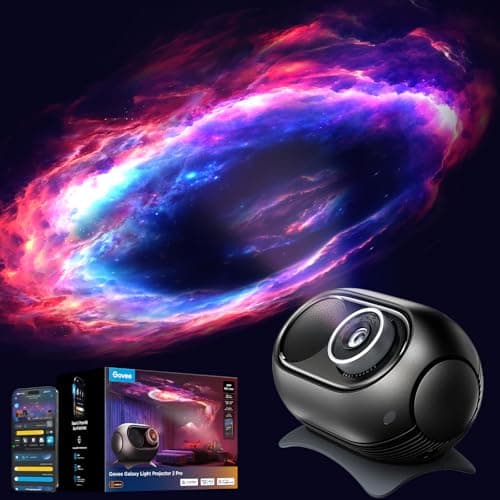 Govee Galaxy Light Projector 2 Pro A 4 megapixel HD lens with app and voice control over the layering. | The best-controlled nebula effect here | |
| 2 | 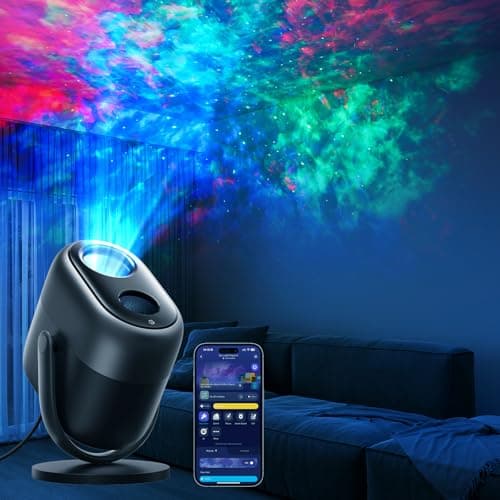 Govee Star Light Projector with Nebula Effect A 7-zone nebula effect at a fraction of the price of the Pro. | The value pick, and the one most people should buy | |
| 3 | 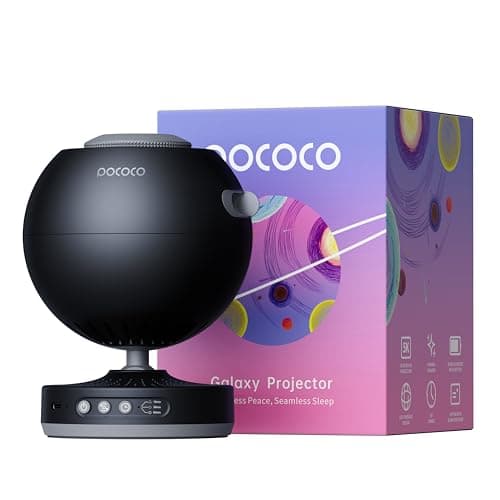 Pococo Galaxy Projector Swappable optical discs — nebula one night, a real star field the next. | If you want the galaxy look AND real star fields | $104.99 on Amazon #ad How we’re funded · price as of October 18, 2026 |
Rows link to the full write-up further down this page. Prices come from the live price layer only; where there is no live figure the button reads “Check price” rather than showing a number we remembered.
Buying knowingly — the three honest use cases
- Ambience in a bedroom or a teenager's room. The core use, and these do it very well. Buy on layering and control.
- A young child who loves space but is too small for optics. A galaxy projector delivers the feeling now; the astronomy can follow in a couple of years. Pair it with a free planetarium app so somebody can point at the real thing too.
- Bad-weather and city fallback. Works every night regardless of cloud or streetlights, which is more than any telescope on this site can say.
The four effects, and which ones age well
Every galaxy projector is some combination of four elements, and they do not wear equally over months of nightly use.
| Effect | What it is | How it ages |
|---|---|---|
| Nebula wash | Drifting translucent color, usually from a rotating film | Well — slow and ambient, the reason to own one |
| Laser starfield | Hundreds of sharp green or red points | Mixed — striking at first, static and obviously artificial later |
| Ocean or aurora ripple | Wave-like moving light | Poorly for space fans; it reads as a different product entirely |
| Color cycling | Automatic shifts through the spectrum | Badly — the first setting people turn off, and the first that feels like a toy |
The pattern: slower and subtler ages better. Anything that announces itself is the thing you will be switching off in a month.
If a unit lets you run the nebula alone with the lasers off, try that configuration before deciding you dislike it. A great many disappointing galaxy projectors are simply being run with every effect on at once.
Getting more out of a cheap one
- Kill the ambient light. A blackout blind improves any projector in this category more than doubling the budget does.
- Project across the room, not straight up. A longer throw at an angle gives a larger, more even field and hides the bright central hotspot.
- Turn the brightness down. Most units ship far brighter than a dark bedroom needs, which flattens the layering that makes the effect convincing.
- Run one effect at a time. Nebula alone usually looks better than nebula plus lasers plus color cycling.
What none of them do
- Show real constellations in real positions. That is a planetarium, a different product.
- Replace a telescope. They are not the same purchase and the comparison is set out on projector vs a telescope.
- Work well in a lit room. Better than optical planetariums, but ambient light still flattens them.
- Stay interesting without variety. A single fixed effect fades in weeks. Variety — discs, zones, modes — is what keeps one switched on.
We have not handled these projectors. Manufacturer figures are linked on each product card, and where a figure comes from a published third-party review rather than a maker's spec sheet we say so on that product's page. Our method is on the methodology page.
Questions people actually ask
- What is the best galaxy projector?
- Judge on layering, lens definition, ceiling coverage and whether a child can operate it. The most controllable units use an app; the most child-friendly have physical controls and no phone dependency.
- Are galaxy projectors worth it?
- As mood lighting, yes — they do exactly what they promise and cost little. As astronomy, no: none of them shows real star positions or teaches a constellation.
- What is the difference between a galaxy projector and a star projector?
- A galaxy projector shows an artistic nebula wash. An optical star projector or planetarium shows real stars in real positions, often settable to tonight's date. They share a shelf and do different jobs.
- Do galaxy projectors work in a lit room?
- Better than optical planetariums, but ambient light still flattens the effect. A blackout blind improves any of them more than spending more on the projector would.
- Why does my galaxy projector look washed out?
- Almost always ambient light, and second most often the ceiling distance. A blackout blind improves any projector in this category more than spending more on the projector would, and angling it across the room rather than straight up spreads the image more evenly.
- Should you run all the effects at once?
- No — that is the most common reason a decent projector looks cheap. Nebula alone usually looks better than nebula plus lasers plus color cycling, and turning the brightness down restores the layering that makes the effect convincing.
- Do galaxy projectors show real constellations?
- No. The star patterns are decorative rather than mapped, so there is no version of this that ends with a child finding Orion out of the window. That takes an optical planetarium or a free star app.
- Are galaxy projectors good for kids?
- Yes for atmosphere and for children too young for optics. Just buy it knowing it is decoration — a child who asked to learn the sky needs an accurate planetarium or a pair of binoculars instead.
Sources
Read next
Where to go from here
- Accurate or decorative? The star projector split nobody explains
The single distinction that decides whether a star projector supports a child's interest in astronomy or is simply a very nice bedroom light.
- Smart star projectors: what the app actually adds
App control, voice assistants and scene modes are what the money buys in the decorative half of the category. What that is genuinely worth in a child's room.
- The best star projector for a bedroom
Throw distance, real darkness and a sleep timer decide whether a projector runs nightly or twice. The three that fit an actual bedroom, and what each gives up.
- The best star projector under $50
The sub-$50 shelf is where most of this category lives and where the specifications get least reliable. What to check and what to ignore.
- Star projector or telescope? A clear answer either way
The two gifts overlap in price and are completely different in what they do. Which one is right for a given child, with a winner named for each scenario.
- Pococo Galaxy Projector review
Swappable optical discs, a focus wheel small hands can use, and deliberately no app. The middle option between an accurate planetarium and a light show.
- The best star projector for adults
An accurate home planetarium and a colored nebula lamp are not the same purchase. The split explained, with three picks judged on what an adult room actually needs.
- The best star projector for kids, by age
Age decides this purchase more than any specification. What changes between four, eight and twelve, four picks matched to those bands, and the point where a telescope is the better gift.
- Govee Galaxy Light Projector 2 Pro review
A 4 MP lens, a published 230 lux and eight physical film discs — the sharpest decorative projector on this site. It covers less ceiling than the cheaper Govee, and projects no real stars.