Star Projectors
The best star projector for adults
Two entirely different products share this name. Decide which one you actually want first.
By Scooter M. · published September 21, 2026
I'm not an astronomer and I don't have a lab. I'm someone who's genuinely into this — I read the manuals, compile the published specs, and do the arithmetic the box doesn't do for you. No lab coat. How we pick.
How this is funded. Lens & Lightyear earns a commission when you buy through a link on this page, at no extra cost to you. It does not change which products we pick or what we say about them — every card below carries a real reason to skip it. Prices are pulled live and were last verified October 18, 2026. Full disclosure.
The short answer
Decide which product you want before you shop. An optical planetarium like the Homestar Flux puts a genuine star field on the ceiling; a laser nebula projector puts colored atmosphere there. Both are legitimate for an adult room, and no product does both well.
Most of this site is written for people buying for a child. This page is not: it is for the adult who wants one in their own bedroom, living room or home office, where the requirements are genuinely different.
What an adult room needs that a child's room does not
- No cartoon shapes. Rotating unicorns and smiling moons are a hard no in a grown-up room, and they are the default in the kids' aisle.
- A real off switch or timer. Something that runs all night is a nuisance rather than a feature. A timer, a schedule or a plain physical switch matters more here.
- Brightness control. An adult room is usually darker and smaller than a nursery, and a projector at full output on a low ceiling is glaring rather than atmospheric.
- Quiet. Motorized rotation with a cheap motor hums. In a nursery it is masked by white noise; in a bedroom at midnight it is not.
- A finish you do not mind seeing in daylight. It sits in a room you look at all day. Most children's units do not survive that test.
The split nobody explains before you buy
| Optical planetarium | Laser or LED nebula projector | |
|---|---|---|
| What it projects | A real star field from a glass disc | Laser dots plus drifting colored cloud |
| Astronomical accuracy | Genuine, with correct star brightnesses | None — the pattern is decorative |
| Color | White stars only | Full color, usually adjustable |
| Control | Focus, timer | App, scheduling, music sync |
| Best room | Dark bedroom, smooth pale ceiling | Any dark room; textured ceilings are fine |
| Teaches you anything | Yes — constellations are real | No |
| Typical price bracket | Highest on this site | Low to middle |
The full version of this argument, with what each design physically does, is on accurate versus decorative.
Quick picks
Three projectors for a grown-up room
| # | Product | Best for | Price |
|---|---|---|---|
| 1 | 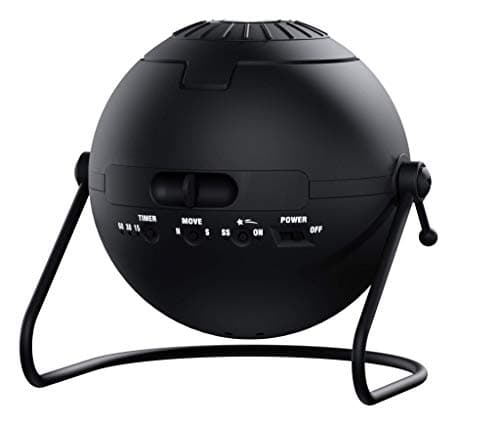 Sega Toys Homestar Flux An optical planetarium projecting a genuine star field from a glass disc, with focus and a timer. | Adults who want the real sky on the ceiling | $259.00 on Amazon #ad How we’re funded · price as of October 18, 2026 |
| 2 | 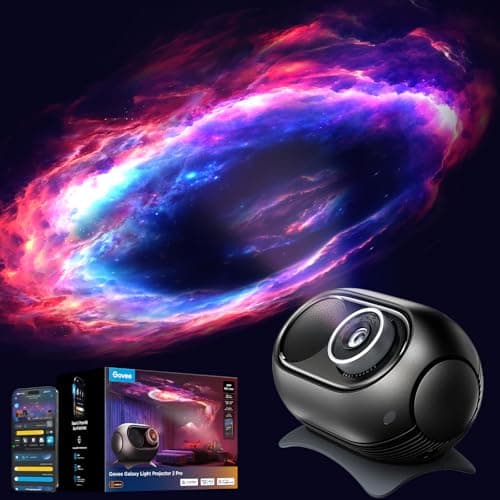 Govee Galaxy Light Projector 2 Pro Laser-and-nebula projection with app scenes, scheduling and music sync. | Atmosphere, music and app control | |
| 3 | 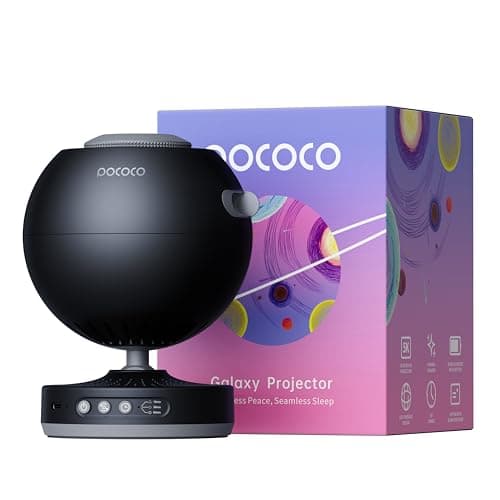 Pococo Galaxy Projector Disc-based projection of photographic space images, quieter and simpler than app-driven units. | The middle ground, with real images on the discs | $104.99 on Amazon #ad How we’re funded · price as of October 18, 2026 |
Rows link to the full write-up further down this page. Prices come from the live price layer only; where there is no live figure the button reads “Check price” rather than showing a number we remembered.
Ceiling height, room size and the thing that ruins it
Three practical constraints decide whether a projector looks impressive or disappointing in a particular room, and none of them appear on the box.
- Throw distance. The further the projector sits from the ceiling, the larger and dimmer the image. A standard 8-foot ceiling with the unit on a bedside table is close to ideal for most of these; a high vaulted ceiling will wash out.
- Ceiling texture and color. A smooth white ceiling is a screen. Heavy texture scatters fine star points, which hurts an optical planetarium far more than it hurts a nebula projector.
- Stray light. A streetlight through thin curtains will beat any projector in this category. This is the most common reason a unit disappoints, and it costs nothing to fix.
A projector is not a telescope
Worth saying on a page aimed at adults, because the marketing blurs it: a star projector shows you a picture of a sky, and a telescope shows you the actual sky. One is decoration or teaching; the other is observation.
If what you want is to look at Saturn's rings rather than at an image of them, the answer is a telescope, and our planets and galaxies page is the place to start. We compare the two directly on star projector versus telescope.
What we did and did not do
We have not tested these projectors. Govee publishes full specifications and we read them from its own page; Sega Toys and Pococo publish little, so the Homestar and Pococo figures we rely on come from the independent hands-on reviews linked below. Where nobody publishes a figure — as nobody does for lumens on several of these — we do not state one.
No price appears in this prose. Live figures come only from our price feed with the date they were checked. Our full method is on the methodology page.
The picks in full
Pick 1
Sega Toys Homestar Flux
Adults who want the real sky on the ceiling
The arithmetic
The number that separates this from every colorful nebula projector is 60,000 — because those are cataloged stars in their real positions, not a decorative pattern. It means a child can find Orion on their ceiling and then find the same Orion out of the window, which is the only thing a projector can do that genuinely helps with a telescope.
This is the one that answers the question most adults are actually asking: can I have the real night sky indoors?
It uses an optical system and a glass projection disc rather than the LED-and-laser trick, so what lands on the ceiling is a star field with true relative brightnesses, focusable to a sharp point. Discs can be swapped to change the sky.
For a bedroom it also has the practical things: a focus adjustment for your ceiling distance, and a timer so it does not run all night.
Honest downsides: it is the most expensive projector on this site, it shows no color, and a bright room ruins it completely. Full review.
Skip it if
You want color and motion. This is a field of white stars, and next to a nebula projector in a shop demonstration it can look austere — which is exactly the point.
| Projection type | Optical disc projection through a glass lens |
|---|---|
| Stars projected | Over 60,000 |
| Projection diameter | Approximately 290 cm |
| Projection distance | 140 to 270 cm |
| Light source | 5 W LED |
| Dimensions | 160 x 160 x 150 mm |
| Features | Rotation, sleep timer, interchangeable discs |
| What the box does not do | It projects white stars on a dark ceiling and nothing else — no color washes, no aurora, no speaker, no app. Children expecting the swirling purple galaxy they have seen on social media are sometimes disappointed by how quiet and accurate it is. It also costs several times what those projectors do. |
Specifications from Space.com — Sega Toys Homestar Flux review (star count, projection figures); Live Science — Sega Toys Homestar Flux review. We have not handled this one — everything above is the published spec sheet plus our own arithmetic on it.
#ad How we’re funded · price as of October 18, 2026
Pick 2
Govee Galaxy Light Projector 2 Pro
Atmosphere, music and app control
The arithmetic
This is a lighting product, not an astronomy one, and judging it as an astronomy one is the mistake most gift buyers make. 230 lux across a 90 degree throw is genuinely bright and genuinely impressive on a ceiling; none of the star positions mean anything. Buy it for the room, not for the sky.
The other half of the category, and there is no shame in wanting it: colored cloud effects drifting over a ceiling, controlled from a phone, scheduled to come on and go off.
For adults the app is the feature that matters most. Scheduling and brightness control turn it from a novelty into something that fits an evening routine rather than interrupting it.
The honest framing, which we apply across the accurate versus decorative split: this is mood lighting that happens to be space-themed. It will not teach anyone a constellation.
Laser devices also need the usual care — never look into the aperture, and place it where nobody will walk into the beam.
Full review — the 4 MP lens and 230 lux are what you are paying for.
Skip it if
You want anything astronomically real. The nebula clouds are an effect, not a sky, and the stars are laser dots rather than a star map.
| Model | H609D |
|---|---|
| Lens | Ultra 4MP HD lens |
| Projection angle | 90 degrees wide |
| Projection area | Up to 301 square feet |
| Brightness | 230 lux |
| Film discs | 8 included |
| Scene modes | 20+ presets, 3,200+ scene combinations |
| Starlight motion modes | 2 |
| White noise options | 21 |
| Control | Govee Home app over Wi-Fi and Bluetooth, Matter |
| Voice | Alexa and Google Assistant |
| Scheduling | Timer, wake-up and sleep routines in-app |
| Power | 15 W, 5 V input |
| Dimensions | 9.37 x 6.41 x 5.82" |
| What the box does not do | The stars are decorative — they do not correspond to real constellations, so it teaches nothing about the actual night sky. Wi-Fi setup needs a parent's phone and an account. Not a substitute for a telescope or a real planetarium, and we would not pair it with a stargazing gift and call the job done. |
Specifications from Govee — Galaxy Light Projector 2 Pro. We have not handled this one — everything above is the published spec sheet plus our own arithmetic on it.
Pick 3
Pococo Galaxy Projector
The middle ground, with real images on the discs
The arithmetic
A middle path between an accurate planetarium and a decorative light. The disc system means you can run a real star field one night and a nebula the next, and the focus wheel is large enough for a child to work themselves — which matters more than it sounds, because a projector nobody can focus gets switched off. No speaker and no app is a feature in a bedroom, not a gap.
A reasonable compromise for a grown-up room: physical discs carrying real photographic imagery, swapped by hand, with no app to configure.
It reads as more considered than a laser nebula unit and less austere than a true planetarium, which for a living room is often the right register.
The catch is the same one the best galaxy projector page makes: disc systems are only as good as the disc library, and each extra disc is a further purchase.
Skip it if
You expect the discs to be a sky map. They are images — nebulae, planets, the aurora — projected large, not an accurate rendering of the sky above your house.
| Projection type | Optical disc projection, LED (no laser) |
|---|---|
| Disc resolution | 5K discs through a 2 megapixel lens |
| Stars projected | Around 40,326 on the star disc |
| Projection area | Approximately 12 square meters |
| Dimensions | 157 x 120 x 120 mm |
| Weight | 1.63 lb |
| Power | 5 V USB-C, internal battery, about 1.5 W |
| Controls | Focus wheel, on-body rotation, sleep timer, 60 degree tilt |
| Discs | Two included; further sets sold separately |
| What the box does not do | No speaker, no app control, no aurora effects. Extra discs are an ongoing cost. The battery is convenient but it is one more thing to charge. |
Specifications from Space.com — Pococo Galaxy star projector review; Live Science — Pococo Galaxy star projector review. We have not handled this one — everything above is the published spec sheet plus our own arithmetic on it.
#ad How we’re funded · price as of October 18, 2026
Questions people actually ask
- What is the best star projector for adults?
- It depends which of two products you want. For a genuine star field on the ceiling, an optical planetarium like the Sega Homestar Flux. For colored atmosphere with app control and scheduling, a laser nebula projector such as the Govee Galaxy Light Projector 2 Pro.
- Are star projectors just for kids?
- No. The accurate optical planetariums are aimed squarely at adults, and the decorative nebula projectors are widely bought for living rooms and bedrooms. What differs in an adult room is the need for a timer, brightness control, quiet operation and no cartoon shapes.
- Do star projectors show real constellations?
- Optical planetarium models do — they project a genuine star field with correct relative brightnesses from a glass disc. Laser and LED nebula projectors do not; their star patterns are decorative and their clouds are an effect.
- What ceiling works best for a star projector?
- A smooth, pale ceiling around standard height. Heavy texture scatters fine star points and hurts an optical planetarium most, while a very high ceiling enlarges the image and dims it. Stray light from a window ruins any of them.
- Is a star projector a substitute for a telescope?
- No. A projector shows a picture of a sky; a telescope shows the sky itself, including planets a projector cannot represent. They serve different purposes, and we compare them directly on our star projector versus telescope page.
Sources
Read next
Where to go from here
- Accurate or decorative? The star projector split nobody explains
The single distinction that decides whether a star projector supports a child's interest in astronomy or is simply a very nice bedroom light.
- Sega Toys Homestar Flux: the serious one
The flagship optical planetarium. What over 60,000 cataloged stars looks like on a ceiling, and why some children find it disappointing.
- The best galaxy projector
What actually separates a good galaxy projector from a cheap one — coverage, layering and control — plus the honest line about what none of them teach.
- Star projector or telescope? A clear answer either way
The two gifts overlap in price and are completely different in what they do. Which one is right for a given child, with a winner named for each scenario.
- The best star projector for a bedroom
Throw distance, real darkness and a sleep timer decide whether a projector runs nightly or twice. The three that fit an actual bedroom, and what each gives up.
- The best gifts for space lovers
Space gifts sorted by recipient rather than budget — the small child, the serious kid, the teenager, the adult who never got one. With the honest downside on each.