Guides
Headlamp or flashlight? Choosing a red light for stargazing
The cheapest thing on this site is also the one that most often decides whether a first night works. Two versions of it, and a real difference between them.
By Scooter M. · published November 7, 2026
I'm not an astronomer and I don't have a lab. I'm someone who's genuinely into this — I read the manuals, compile the published specs, and do the arithmetic the box doesn't do for you. No lab coat. How we pick.
How this is funded. Lens & Lightyear earns a commission when you buy through a link on this page, at no extra cost to you. It does not change which products we pick or what we say about them — every card below carries a real reason to skip it. Prices are pulled live and were last verified November 7, 2026. Full disclosure.
The short answer
Buy the headlamp if one light has to serve the whole session, because astronomy needs both hands. Buy the flashlight if you want to dim it precisely, or if a child is holding their own light. The headlamp publishes its numbers and needs batteries you must supply; the flashlight publishes almost none and arrives with its battery fitted.
This site recommends a red light on seven pages and makes it the first pick on three of them, and has never explained the choice between the two Celestron sells. This page does that.
Why any of this matters: dark adaptation
A human eye takes roughly twenty to thirty minutes to reach useful dark adaptation, and the change is large — a fully adapted eye sees vastly fainter objects than one that has just come out of a lit kitchen. That adaptation is also fragile: one glance at a white phone screen or a porch light resets much of it, and the clock starts again.
This is the quiet reason so many first nights fail. The telescope is fine, the sky is fine, and nobody has waited long enough or has been reading a chart by white light the whole time. We rank it alongside the other causes on why can't I see anything.
The two, side by side
| Night Vision Headlamp (93581) | Night Vision Flashlight (93588) | |
|---|---|---|
| Hands free | Yes | No — occupies a hand |
| Brightness control | Two fixed levels | Thumbwheel, continuously variable |
| Published output | 1 lumen low, 4 lumens high | Not published |
| Published battery life | 100 h low, 25 h high | Not published |
| Battery | 2 x AAA — not included | 9 V — included |
| Light source | Red LED | Two red LEDs |
| Published weight | 62 g (2.15 oz) | Not published |
| Beam adjustment | 45 degree tilt | Aim by hand |
| Extras | Headband, quick setup guide | Attached lanyard |
| Warranty | 2 years | 2 years |
Celestron's own published specifications for items 93581 and 93588. Bold marks the advantage where there is one. The pattern of blanks is itself informative: Celestron documents the headlamp thoroughly and the flashlight barely at all, so on paper the headlamp is the one you can actually evaluate.
Quick picks
Two red lights, one real difference
| # | Product | Best for | Price |
|---|---|---|---|
| 1 | 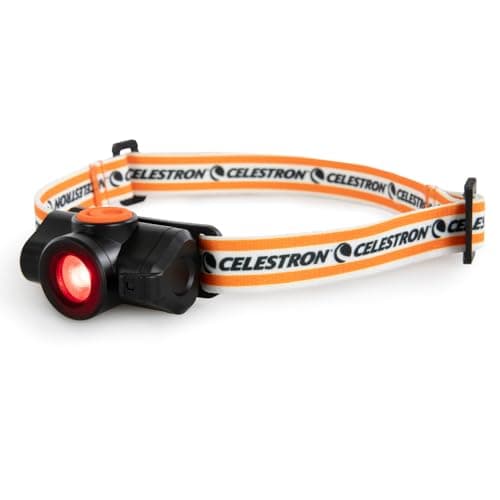 Celestron Night Vision Red Headlamp 1 lumen on low, 100 hours on that setting, 62 g, and both hands free. | Most families — anyone whose hands will be on a focuser, a star chart and a child | |
| 2 | 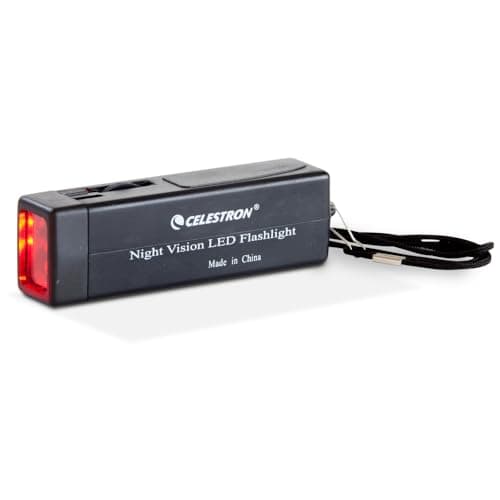 Celestron Night Vision Flashlight Two red LEDs on a thumbwheel that dims continuously, with the 9 V battery already in it. | Anyone who wants to dial the brightness down, and for a child to hold their own light |
Rows link to the full write-up further down this page. Prices come from the live price layer only; where there is no live figure the button reads “Check price” rather than showing a number we remembered.
Which one, by household
| Situation | Buy | Why |
|---|---|---|
| One light for the whole family | Headlamp | Both hands stay free for the telescope |
| A child wants their own light | Flashlight | Easier to hand over, and it cannot be shone in a face by a turning head |
| You read paper star charts | Flashlight | Dim it to the exact level the chart needs |
| Setting up in the dark alone | Headlamp | Assembly takes two hands; see the setup checklist |
| It is a gift and may be opened at night | Flashlight | The battery is already in it |
| Observing with other people | Flashlight | A headlamp points wherever its wearer looks |
| You want published specifications | Headlamp | It is the only one Celestron documents |
The free version, which genuinely works
Before spending anything, two things cost nothing and solve most of the problem. We would rather say so than sell you a torch you did not need.
- Red cellophane or a red balloon over a flashlight you own, held on with an elastic band. This is the original amateur-astronomy solution and it works. Use two layers if it still looks bright — remember that dimmest-that-works is the target.
- Your phone's red or night mode, turned to minimum brightness. Most phones have a color filter in accessibility settings that produces a genuinely red screen. The catch is discipline: a notification, a map, or a sibling grabbing the phone undoes it instantly.
- The honest caveat: both are worse than a proper red light in one specific way — brightness control. A phone at minimum is often still brighter than 1 lumen, and cellophane transmits whatever the torch underneath puts out.
The phone is worth a separate warning, because it is the single biggest destroyer of dark adaptation on a family observing session. We cover using one properly, including the red-mode setting, on stargazing apps for kids.
How to use a red light so it actually helps
- Turn it on before you go outside, and turn the white lights off behind you. Starting adapted is easier than recovering.
- Use the lowest setting that works, and resist stepping up. If you can read the chart, you are done.
- Point it down. At the ground, at the chart, at the eyepiece tray — never at a face, and never at the sky.
- Give it twenty minutes before judging the sky. Most people decide a telescope is disappointing in the first five, which is before their eyes have done anything.
- Keep the phone in a pocket, or in red mode at minimum brightness. One white screen undoes the whole group's adaptation.
Is it worth buying at all?
For around the price of a couple of cinema tickets, this is the cheapest purchase on this site and the one with the largest effect on whether a first night works — which is why it is our first pick on three separate pages. It is also the rare accessory that improves every instrument equally: it does the same job beside binoculars as beside a telescope.
If the budget is genuinely tight, use the cellophane method and put the money into aperture instead. Nothing on this page changes what a telescope can show; it changes whether the person at the eyepiece is in a state to see it. The rest of the evening kit is on the stargazing night kit.
What we did and did not do
We have not tested either light. The item numbers, lumen outputs, battery lives, battery types, LED counts, the thumbwheel control, the 45 degree tilt, the weight and the two-year warranties are all read from Celestron's own published product pages, linked below. Where Celestron publishes nothing — the flashlight's output, runtime, weight and dimensions — the table says so rather than estimating, and that absence is reported as a finding rather than smoothed over.
The twenty-to-thirty-minute dark adaptation figure and the reason red is used are the standard account of how night vision works, not a measurement we made. We publish no rating and no review count. No price appears in this prose; live figures come only from our price feed with the date they were checked, and our full method is on the methodology page.
The picks in full
Pick 1
Celestron Night Vision Red Headlamp
Most families — anyone whose hands will be on a focuser, a star chart and a child
The arithmetic
The cheapest thing on this site and the one that changes the most. Human eyes take 20 to 30 minutes to dark-adapt, and one glance at a white phone screen resets the clock — which is why so many first nights end with a child seeing almost nothing. Red light preserves that adaptation, and the number that matters here is the low setting: 1 lumen. Most red lights sold for astronomy are far brighter than the job needs, and a red light that is too bright is only a slower way of destroying dark adaptation. The second number is 100 hours on that low beam, which is more clear nights than most families will use in a year.
The practical case is simply that astronomy uses both hands. You are turning a focuser, holding a chart, steadying a tripod leg or handing an eyepiece to a child, and a light that lives on your forehead is the one that is actually on when you need it.
Celestron publishes the numbers that matter, which is rarer than it should be in this category: 1 lumen on low and 4 on high, 100 hours of battery life on low and 25 on high, a 45 degree adjustable tilt, and 62 g on the head. One lumen is the specification to notice — it is far dimmer than most lights sold for this job, and dim is the point.
100 hours on the low beam is more clear nights than most families will get through in a year, so this is not a thing you will be feeding batteries.
Honest downsides: the 2 AAA cells are not included, so buy them in the same order or the gift fails on the first evening; there is no continuous dimmer, only two steps; the blinking and SOS modes are camping features that do nothing here; and being head-mounted it points wherever the wearer looks, which takes a little discipline around other people's dark adaptation.
Skip it if
You want to fine-tune the brightness. This has two fixed levels rather than a dimmer, and if even the low setting is brighter than you want on a dark night, there is nothing you can do about it.
| Item number | 93581 |
|---|---|
| Light source | Red LED |
| Output | 1 lumen on low, 4 lumens on high |
| Modes | Low beam, high beam, blinking, SOS |
| Battery life | 100 hours on low, 25 hours on high |
| Power | 2 x AAA alkaline or lithium, user supplied |
| Beam angle | 45 degree adjustable tilt |
| Weight | 62 g (2.15 oz) |
| Dimensions | 58 x 35 x 30mm (2.28" x 1.42" x 1.18") |
| Included | Headlamp, elastic headband with adjusting clips, quick setup guide |
| Warranty | 2 year |
| What the box does not do | Batteries. Celestron supplies the headband and the quick setup guide but not the 2 AAA cells, so buy them in the same order. There is no continuous dimmer — brightness is two fixed steps rather than a wheel you can creep down — and the blinking and SOS modes are camping features that do nothing for astronomy. Being head-mounted it also points wherever the wearer looks, which takes a little discipline around other observers. |
Specifications from Celestron — Night Vision Red Headlamp. We have not handled this one — everything above is the published spec sheet plus our own arithmetic on it.
Pick 2
Celestron Night Vision Flashlight
Anyone who wants to dial the brightness down, and for a child to hold their own light
The arithmetic
The thumbwheel is the entire argument for this over the headlamp, and it is a better argument than it looks. Dark adaptation is destroyed by brightness, not by color alone, so the ability to creep a red light down to the dimmest setting that still shows a star chart beats any fixed step. The headlamp gives two fixed levels; this gives a continuum, and it arrives with its battery fitted rather than needing two AAAs you forgot to buy. The honest counterweight is that Celestron publishes almost nothing about it — no lumen figure, no runtime, no weight — where the headlamp's numbers are all on the page.
The thumbwheel is the whole argument, and it is a better one than it first appears. Dark adaptation is destroyed by brightness, not by color alone, so being able to creep a light down to the dimmest level that still shows a star chart beats any fixed step a maker chose for you.
It also arrives working — Celestron includes the 9 V battery and an attached lanyard — which quietly solves the most common way a cheap astronomy gift fails on the night it is opened.
Two red LEDs rather than one gives more even illumination across a chart, which is the use it is actually designed around.
Honest downsides: Celestron publishes no output, no runtime and no dimensions for it, so there is nothing to compare on paper; it occupies a hand, which is exactly the problem the headlamp solves; and a 9 V cell is a less convenient spare to keep than AAAs.
Skip it if
You want published numbers. Celestron lists no lumen output, no battery life and no weight for this one — you are buying a control, not a specification.
| Item number | 93588 |
|---|---|
| Light source | Two red LEDs, for even illumination |
| Brightness control | Thumbwheel, continuously variable |
| Power | 9 V battery, included |
| Included | 9 V battery, attached lanyard |
| Output in lumens | Not published by Celestron |
| Battery life | Not published by Celestron |
| Weight and dimensions | Not published by Celestron |
| Warranty | 2 years |
| What the box does not do | A published specification worth the name: no output, no battery life, no dimensions. It also occupies a hand, which matters more than it sounds when the other hand is on a focuser and a child is asking for a turn. A 9 V battery is a less common cell to keep spares of than AAA, and the lanyard is the only thing stopping it being put down in wet grass and lost. |
Specifications from Celestron — Night Vision Flashlight (item 93588): two red LEDs, thumbwheel variable brightness, included 9 V battery and lanyard, 2-year warranty. We have not handled this one — everything above is the published spec sheet plus our own arithmetic on it.
Questions people actually ask
- Do you really need a red flashlight for stargazing?
- You need something that is not white light, and a proper red light is the cheapest thing that most improves a night. Red cellophane taped over a torch you already own genuinely works, so the purchase is optional — but at this price it is the accessory we recommend before any other, and it helps binoculars as much as telescopes.
- Why does red light preserve night vision?
- Dark-adapted vision is least disturbed by the red end of the spectrum, so a dim red light lets you read a chart without resetting the twenty to thirty minutes your eyes spent adapting. The important word is dim: a red light that is too bright still destroys dark adaptation, just more slowly than a white one.
- Headlamp or flashlight — which is better for astronomy?
- The headlamp if one light serves the whole session, because astronomy needs both hands for focusing, charts and eyepieces. The flashlight if you want to dim it precisely, or if a child is holding their own, since a thumbwheel beats two fixed levels and it will not be shone in someone's face by a turning head.
- How long does it take for your eyes to adjust to the dark?
- Roughly twenty to thirty minutes for useful dark adaptation, and it keeps improving beyond that. One glance at a white phone screen or a porch light undoes much of it. This is why so many first nights disappoint — people judge the sky within five minutes of walking outside.
- Does the Celestron red headlamp come with batteries?
- No. It takes two AAA cells, alkaline or lithium, which Celestron does not supply — buy them at the same time if it is a gift. The handheld Night Vision Flashlight does include its 9 V battery, which makes it the safer choice for something being opened at night.
- How bright should an astronomy red light be?
- As dim as you can manage while still reading what you need to read. Celestron publishes 1 lumen for the headlamp's low beam, which is far dimmer than most lights sold for the job and is the right order of magnitude. If a red light feels comfortably bright outdoors, it is almost certainly too bright.
Sources
Read next
Where to go from here
- The stargazing night kit
A red torch does more for what a child sees than doubling the aperture. The full kit, in order of how much it changes.
- Why can't I see anything through my telescope?
The ranked causes of a telescope that shows nothing, most common first, each with a fix you can do tonight without tools.
- Stargazing apps for kids, used properly
A planetarium app closes the biggest skill gap in stargazing and wrecks dark adaptation doing it. How to get one without the other.
- Your first night with a telescope
Do these eight things in this order and night one works. Most first nights fail on sequence, not on equipment.
- What to buy a kid who already has a telescope
A telescope's real problems are dark adaptation, steadiness and knowing where to point it. None of them cost much to fix.
- The telescope setup checklist
The indoor, daylight pre-flight that removes the common first-night failures before anyone goes outside.