Guides
Do you need to collimate a kids' telescope?
The word that appears in every reflector review on this site, finally explained — and the free check that settles it in two minutes.
By Scooter M. · published October 24, 2026
I'm not an astronomer and I don't have a lab. I'm someone who's genuinely into this — I read the manuals, compile the published specs, and do the arithmetic the box doesn't do for you. No lab coat. How we pick.
How this is funded. Lens & Lightyear earns a commission when you buy through a link on this page, at no extra cost to you. It does not change which products we pick or what we say about them — every card below carries a real reason to skip it. Prices are pulled live and were last verified November 2, 2026. Full disclosure.
The short answer
Probably not, and you should not buy anything until you have checked. Refractors never need collimation. Small tabletop reflectors usually hold it for months and often arrive fine. Do the free star test below first; if it passes, you are done. If it fails, the Celestron Cheshire Collimation Eyepiece is the tool to buy.
The word collimation appears on two dozen pages of this site, because almost every telescope worth buying for a child under $300 is a reflector and every reflector review has to mention it. This page is the one that explains it, so the others do not have to.
What collimation actually is
A reflecting telescope works by bouncing light off a big curved mirror at the bottom of the tube, onto a small flat mirror near the top, and out through the focuser into your eye. Collimation is the word for those two mirrors pointing at each other correctly.
When they drift out of line — and transport, temperature and being knocked all do it — the telescope still produces an image, but the image is soft in a way no amount of focusing fixes. That is the symptom that matters: a star that will not come to a clean point however carefully you turn the focuser.
Which telescopes need it, and which never do
| Telescope type | Needs collimation? | In practice |
|---|---|---|
| Refractor (lens at the front) | Never | Sealed at the factory. Nothing for an owner to adjust. |
| Tabletop Dobsonian (130mm, 150mm) | Occasionally | Usually holds for months; check after a knock or a long car journey |
| Collapsible tabletop (Heritage, Virtuoso) | More often | The tube is extended and retracted every session, which is what moves things |
| Newtonian on an equatorial mount | Occasionally | Same mirrors, more handling during setup |
| Schmidt-Cassegrain | Rarely | A Cheshire helps align one, but these are not kids' telescopes |
| Star projector or binoculars | Never | Not applicable — no user-adjustable optics |
The practical rule for this site's audience: if the telescope has a lens at the front, you will never do this. If it has a mirror at the bottom, you might, occasionally.
The free check, before you spend anything
This costs nothing, takes two minutes and settles the question for most families. Do it on a clear night on any bright star.
- Let the telescope cool outside for twenty minutes. A warm mirror produces a wobbling image that looks exactly like a collimation fault and is not one.
- Center a bright star and focus it as sharply as you can with a medium-power eyepiece.
- Now deliberately defocus it until the star becomes a small doughnut — a disc with a dark hole in the middle.
- Look at where the hole sits. Centered in the disc means your collimation is fine and you need nothing. Pushed noticeably to one side, consistently, means the mirrors are out.
- Check it is not the sky. Turbulent air makes the doughnut boil and shift. If it is dancing rather than sitting off-center, that is the atmosphere, not your telescope — try again another night before buying anything.
Quick picks
Two tools, and the way to avoid needing either
| # | Product | Best for | Price |
|---|---|---|---|
| 1 | 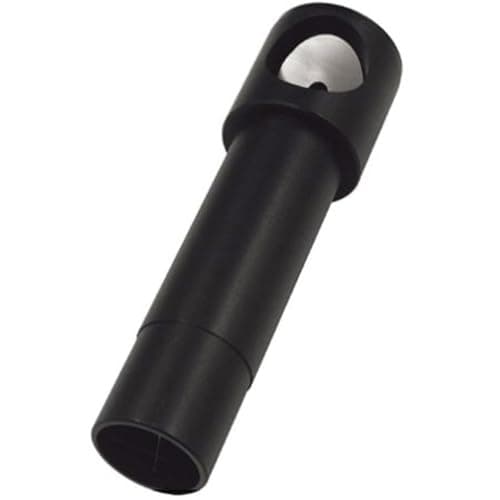 Celestron Cheshire Collimation Eyepiece A 1.25 inch Cheshire eyepiece with no batteries and nothing inside it that can drift. | Almost everyone who owns a reflector and has decided they need a tool | $34.95 on Amazon #ad How we’re funded · price as of November 2, 2026 |
| 2 | 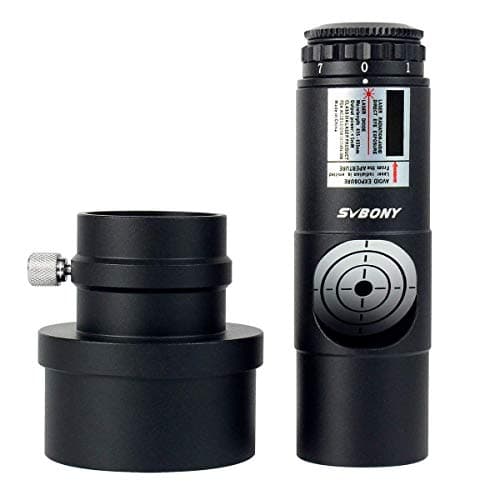 SVBONY Laser Collimator F9123A 635-655nm red laser, 7 brightness levels, 1.25 inch with a removable 2 inch adapter, CR2032 included. | A larger reflector that gets collapsed, carried and re-set often | $25.99 on Amazon #ad How we’re funded · price as of November 2, 2026 |
| 3 | 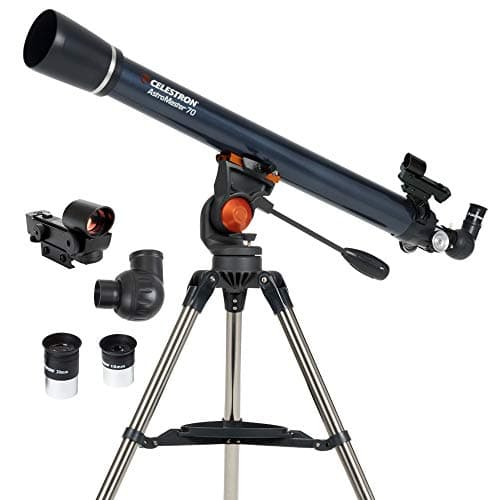 Celestron AstroMaster 70AZ A 70mm f/13 refractor — a sealed lens telescope with no mirrors to align, ever. | A household deciding before they buy, who does not want maintenance at all |
Rows link to the full write-up further down this page. Prices come from the live price layer only; where there is no live figure the button reads “Check price” rather than showing a number we remembered.
Cheshire or laser, in one table
| Cheshire eyepiece | Laser collimator | |
|---|---|---|
| Can be wrong itself | No — nothing inside to drift | Yes, if the laser is not square in its barrel |
| Works in the dark | No — needs light behind you | Yes |
| Speed | A few minutes | Around thirty seconds |
| Batteries | None | CR2032 (included) |
| Safety with children | Entirely safe | A laser — adult job |
| Needs verifying before use | No | Yes — roll it in the focuser first |
| Best suited to | Occasional checks on a small reflector | Frequent checks on a collapsible or larger tube |
Both are published specifications and manufacturer positioning, linked below; the speed figures are the ordinary experience of using each type rather than a measurement we made.
For the telescopes this site recommends, the Cheshire is the better default. The laser earns its place on a collapsible tube that is extended and collapsed every single session, where the thirty seconds genuinely changes whether the check gets done at all.
How often, realistically
- On arrival: worth one check. Telescopes are shipped by courier and some arrive out, which is a far more common cause of a disappointing first night than most people realize.
- After a car journey on anything other than smooth roads, or after the tube has been knocked over.
- Every session, briefly, on a collapsible tube — extending and retracting is the single biggest source of drift.
- Otherwise, twice a year is plenty for a solid-tube tabletop reflector that lives indoors and goes out on the patio.
- Never, on a refractor, a pair of binoculars or a star projector.
If you are buying rather than fixing
For a gift buyer, this is a question to answer before the purchase rather than after it. The honest summary is that collimation is a small, occasional, learnable job, not a reason to avoid reflectors — and avoiding them costs real aperture, which is the thing that decides what a child actually sees.
If nobody in the house will ever enjoy a fiddly job, buy a refractor and accept the smaller aperture. If the idea of adjusting two screws twice a year is fine, a 130mm tabletop reflector shows substantially more for the same money. Our full treatment of that trade is on refractor versus reflector, and the age question is on what age is a telescope right for.
What we did and did not do
We have not tested these tools. The Cheshire's item number, barrel size, telescope compatibility, method of use, accuracy positioning and two-year warranty were read from Celestron's published product page. The laser's wavelength, output power, brightness levels, fit, body material and included battery were read from the published specification for model F9123A. Both pages are linked below.
The star test described above is the standard defocused-star method, not a procedure we invented. We publish no rating and no review count, because we have measured nothing. No price appears in this prose; live figures come only from our price feed with the date they were checked, and our full method is on the methodology page.
The picks in full
Pick 1
Celestron Cheshire Collimation Eyepiece
Almost everyone who owns a reflector and has decided they need a tool
The arithmetic
The reason to prefer this over a laser on a small telescope is that it cannot lie to you. A Cheshire is a tube with a hole and a crosshair — there is nothing inside it that can drift out of alignment, so what it shows is the state of your mirrors and nothing else. A laser collimator can itself be out of collimation in the box, and when it is, it reports a confident wrong answer that sends you adjusting a mirror that was already fine.
The argument for a Cheshire over a laser is that it cannot lie to you. It is a metal tube with a small viewing opening at one end and thin crosshairs at the other. There is nothing inside it to fall out of alignment, so what you see is the state of your mirrors and nothing else.
Celestron's own published positioning is that it is ideal for precise collimation of Newtonians and helpful for aligning Schmidt-Cassegrains, and that it is more accurate than the simple collimation tool they also sell.
For the telescopes this site recommends — the Heritage 130, the Heritage 150, the StarSense 114mm, the FirstScope — this is the tool we would buy, on the simple grounds that a family collimating twice a year wants the answer to be right rather than fast.
Honest downsides beyond the light requirement: it costs more than a basic laser, the crosshairs are small enough to be fiddly for a child to use unaided, and it does nothing about the actual adjustment, which on some tabletop bases means a screwdriver and a patient adult.
Skip it if
You will only ever collimate outdoors after dark. A Cheshire needs light behind you to read the crosshairs, so it is a kitchen-table tool. It also fits 1.25 inch focusers only — the 0.96 inch focusers on the cheapest department-store telescopes are excluded.
| Item number | 94182 |
|---|---|
| Barrel size | 1.25" — fits 1 1/4" focusers or diagonals |
| Telescope types | Newtonians (precise collimation); Schmidt-Cassegrains (alignment aid) |
| How it works | A small viewing opening at one end, thin cross hairs at the other |
| Power | None — no batteries, nothing to charge |
| Accuracy | Celestron: more accurate than the simple Collimation Tool |
| Warranty | 2 years |
| What the box does not do | No batteries needed, but also no light: you need daylight or a bright lamp behind you to see the crosshairs, so this is a kitchen-table tool rather than a dark-garden one. It fits 1.25" focusers only, so the 0.96" focusers on the cheapest department-store telescopes are out. Collimating at all requires reaching the mirror adjustment screws, which on some tabletop models means a screwdriver and a patient adult. |
Specifications from Celestron — Collimation Eyepiece 1.25 inch (item 94182). We have not handled this one — everything above is the published spec sheet plus our own arithmetic on it.
#ad How we’re funded · price as of November 2, 2026
Pick 2
SVBONY Laser Collimator F9123A
A larger reflector that gets collapsed, carried and re-set often
The arithmetic
Speed is the whole argument: a laser turns collimation into a thirty-second job you can do in the dark, where a Cheshire needs daylight. The catch is that the tool has to be trustworthy to be useful, and an inexpensive laser is not guaranteed to be square in its own barrel. Roll it in the focuser before you trust it — if the dot traces a circle instead of staying put, the collimator is the thing out of alignment, not your telescope.
The case for a laser is speed. It turns collimation into a thirty-second job you can do in the dark, which genuinely matters on a collapsible tube that gets taken down and re-extended every session.
The published specification is modest and honest: 635-655nm red laser at less than 5mW, 7 brightness levels, a metal body, and a CR2032 cell included so it works on arrival.
Roll it in the focuser before you trust it. Rotate the collimator in place and watch the dot: if it traces a circle rather than staying put, the laser is the thing out of alignment, not your telescope. Skipping this step is the single most common way a laser makes collimation worse instead of better.
Honest downsides: it is genuinely overkill for a short tabletop reflector that holds collimation for months, it is a laser and should not be the child's job to hold, and you must never look into the telescope's aperture while it is on.
Skip it if
It is your only tool and you will not check it. An inexpensive laser can be out of alignment in its own barrel out of the box, and a miscollimated laser gives a confident wrong answer — sending you to adjust a mirror that was already fine.
| Model | F9123A |
|---|---|
| Laser wavelength | 635-655nm, red |
| Output power | Less than 5mW |
| Brightness levels | 7 |
| Barrel size | 1.25", plus a removable 2" adapter |
| Telescope types | Newtonian reflectors and SCTs |
| Power | CR2032 lithium cell, included |
| Body | Metal |
| What the box does not do | No way to verify itself out of the box — checking the laser's own alignment is a step most buyers skip and the step that decides whether the readings mean anything. Overkill for a short tabletop reflector that holds collimation for months. Never look into the aperture, and never point it at anyone: it is a laser, and a child should not be the one holding it. |
Specifications from SVBONY — Laser Collimator F9123A specifications (wavelength, output, brightness levels, battery). We have not handled this one — everything above is the published spec sheet plus our own arithmetic on it.
#ad How we’re funded · price as of November 2, 2026
Pick 3
Celestron AstroMaster 70AZ
A household deciding before they buy, who does not want maintenance at all
The arithmetic
The number that separates this from every other 70mm on the site is the focal length: 900mm, where the AstroMaster LT 70AZ is 700mm and the Travel Scope 70 is 400mm. That makes it f/13 — the slowest, most color-corrected refractor we list. The supplied 20mm and 10mm give 45x and 90x, both inside Celestron's published 165x ceiling, so the box reaches about 55 percent of the telescope with no Barlow needed. The cost is carried in pounds: 10.8 lbs for 70mm of aperture works out to roughly 6.5mm per pound, the lowest ratio on this site.
The honest third option on a page like this is not a third tool. If collimation is the thing putting you off, buy a refractor and the question disappears permanently — the lens is sealed in the tube at the factory and there is nothing for an owner to adjust.
This one is f/13, which is slow and long. That matters here because a slow focal ratio is also the most forgiving of any small optical imperfection, so it stays sharp with no attention at all.
The trade is stated plainly: at a similar price a 130mm mirror gathers roughly three and a half times the light of a 70mm lens. You are buying freedom from maintenance with aperture, and on a telescope for a child that is a defensible trade — but it is a trade.
We work the whole comparison through on refractor versus reflector.
Skip it if
You want aperture for the money. 70mm of lens collects far less light than 130mm of mirror at a similar price, and that is the real cost of never collimating.
| Item number | 21061 |
|---|---|
| Optical design | Refractor |
| Aperture | 70mm (2.76") |
| Focal length | 900mm (35") |
| Focal ratio | f/13 |
| Optical tube length | 685mm (27") |
| Optical coatings | Fully coated |
| Eyepieces supplied | 20mm (45x) and 10mm (90x) |
| Barlow | Not included |
| Diagonal | Erect image 90 degree, 1.25" |
| Finderscope | StarPointer red dot |
| Mount | Manual alt-azimuth, panning handle with clutch |
| Tripod | 812.8mm-1295.4mm (32"-51") height range, 1.25" steel legs |
| Highest useful magnification | 165x |
| Lowest useful magnification | 10x |
| Limiting stellar magnitude | 11.7 |
| Light gathering power | 100x the human eye |
| Total kit weight | 10.8 lbs (4.9 kg) |
| What the box does not do | No Barlow, and the optics are "fully coated" rather than fully multi-coated — a single-layer coating that passes slightly less light than the multi-coated glass on Celestron's dearer models. The long 685mm tube catches wind and swings the eyepiece through a wide range of heights as it tilts, which a short child will feel. Being a refractor there is nothing to collimate, ever. |
Specifications from Celestron — AstroMaster 70AZ specifications. We have not handled this one — everything above is the published spec sheet plus our own arithmetic on it.
Questions people actually ask
- Do you need to collimate a telescope?
- Only if it is a reflector. Refractors have a sealed lens and never need it. Small tabletop reflectors usually hold collimation for months, so the sensible order is to do the free defocused-star test first and only buy a tool if that test fails.
- How do you know if a telescope needs collimating?
- Center a bright star, focus it sharply, then deliberately defocus until it becomes a small doughnut shape. If the dark hole sits centered in the disc, collimation is fine. If it is consistently pushed to one side, the mirrors are out. If the shape boils and dances, that is unsteady air rather than your telescope.
- Is a laser collimator better than a Cheshire?
- Faster, not better. A Cheshire has nothing inside it that can drift, so it cannot give a wrong answer; an inexpensive laser can be out of alignment in its own barrel and then reports confident nonsense. Roll any laser in the focuser first and watch whether the dot stays put. For an occasional check on a small reflector, the Cheshire is the safer default.
- How often should you collimate a kids' telescope?
- Once when it arrives, after any knock or rough car journey, and roughly twice a year otherwise. A collapsible tube that gets extended and retracted every session is worth a quick check each time. A refractor never needs it.
- Can collimation fix a blurry telescope?
- Sometimes, but it is rarely the first cause. A warm mirror that has not cooled, too much magnification, unsteady air and an unaligned finderscope all produce soft views far more often. Collimation is the answer when a star will not come to a clean point however carefully you focus.
- Can a child collimate a telescope themselves?
- The checking part, yes — the defocused-star test is a good job for a child and teaches them what a sharp image looks like. The adjustment usually means small screws on the mirror cell and sometimes a screwdriver, which is an adult job. A laser collimator should always be handled by an adult.
Sources
Read next
Where to go from here
- Why can't I see anything through my telescope?
The ranked causes of a telescope that shows nothing, most common first, each with a fix you can do tonight without tools.
- Refractor or reflector for a child?
Mirrors are cheaper per millimeter of aperture; lenses never need aligning. Which trade suits which child, with the arithmetic on both.
- The telescope setup checklist
The indoor, daylight pre-flight that removes the common first-night failures before anyone goes outside.
- Sky-Watcher Heritage 130 review
130mm of parabolic mirror that collapses for storage. The biggest single jump in what a child can see, and the planning problem that comes with it.
- Your first night with a telescope
Do these eight things in this order and night one works. Most first nights fail on sequence, not on equipment.
- Tabletop or tripod? The choice your garden makes for you
A tabletop reflector buys more aperture for the money and needs a solid surface. A tripod telescope stands anywhere and costs you glass. Which one your garden allows.