Telescopes
Is the Gskyer telescope any good?
The one telescope this site had never covered, judged by the same arithmetic as everything else — with a result we did not expect.

By Scooter M. · published October 30, 2026
I'm not an astronomer and I don't have a lab. I'm someone who's genuinely into this — I read the manuals, compile the published specs, and do the arithmetic the box doesn't do for you. No lab coat. How we pick.
How this is funded. Lens & Lightyear earns a commission when you buy through a link on this page, at no extra cost to you. It does not change which products we pick or what we say about them — every card below carries a real reason to skip it. Prices are pulled live and were last verified November 2, 2026. Full disclosure.
The short answer
It is better than the shelf around it and still not the one we would buy. The Gskyer AZ 70400 passes our magnification test — 120x maximum against an honest ceiling near 140x — which most cheap telescopes fail badly. But the Celestron Travel Scope 70 gives the same 70mm aperture for less money, with a published specification sheet and a real manual. Buy that instead.
This is one of the best-selling beginner telescopes on Amazon and, until now, the most conspicuous gap in this site's coverage. We review twenty-odd telescopes and had never looked at the one a large share of first-time buyers actually end up with.
The test it passes, and why that matters
Almost every telescope this site warns about fails the same way: the box advertises a magnification the optics cannot deliver, the child uses the highest-power eyepiece first, sees a wobbling smudge, and concludes that telescopes do not work.
| Step | Gskyer AZ 70400 | PowerSeeker 50AZ (for contrast) |
|---|---|---|
| Aperture | 70mm | 50mm |
| Honest ceiling (2x aperture) | about 140x | about 100x; maker publishes 118x |
| Lowest supplied magnification | 16x | 30x |
| Highest supplied magnification | 40x | 150x |
| Barlow supplied | 3x | 3x |
| Top combination | 120x — inside the ceiling | 450x — roughly 4x the ceiling |
| Verdict on the numbers | Honest | Not honest |
Gskyer magnifications are from the hands-on review linked below; Celestron's are from its own published specification page. The ceiling rule is the standard one — roughly twice the aperture in millimeters — and we apply it identically to every telescope on this site.
We are saying this plainly because it would be easy, and wrong, to lump this telescope in with the 525x boxes. It does not belong there. The full test is on toy telescopes versus real optics.
So why not recommend it?
- The same aperture costs less elsewhere. 70mm at 400mm is exactly the Travel Scope 70, from a manufacturer that publishes a full spec sheet, at a lower live price.
- No published specification at all. Gskyer has no manufacturer page giving eyepiece focal lengths, weight, tripod height or a magnification ceiling. Every other telescope on this site is sourced from the maker's own figures; for this one, there are none to source.
- No user manual according to the hands-on review — a pictorial assembly sheet instead. For a first telescope bought by a parent who has never owned one, that is the difference between a good first night and a bad one.
- A 45 degree diagonal on a telescope sold for astronomy. It is the right component for daylight and an awkward one for looking up, which is what children do with telescopes.
- Small aperture for the money. 70mm is the entry point, and at around a hundred dollars you are close to the under $100 bracket where more aperture is available.
Quick picks
One we would not buy, and two with the same aperture or more
| # | Product | Best for | Price |
|---|---|---|---|
| ! | 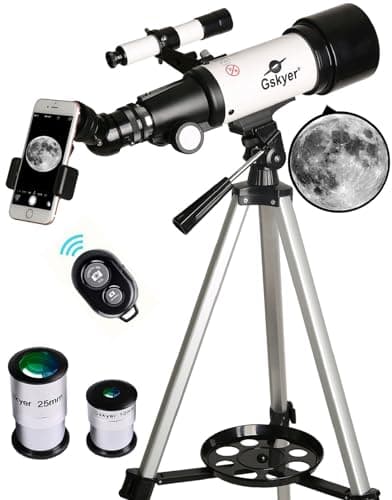 Gskyer AZ 70400 Telescope 70mm at 400mm, 16x and 40x eyepieces, a 3x Barlow topping out at 120x — all honest numbers. Skip this one — see why below | Showing that passing the magnification test is necessary, not sufficient | Not recommended |
| 2 | 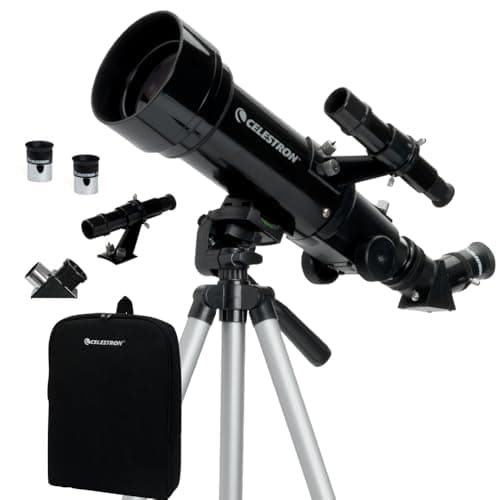 Celestron Travel Scope 70 70mm at 400mm, 20x and 40x, a published 168x ceiling, and a backpack. | The same aperture, from a manufacturer that publishes what it sells | |
| 3 | 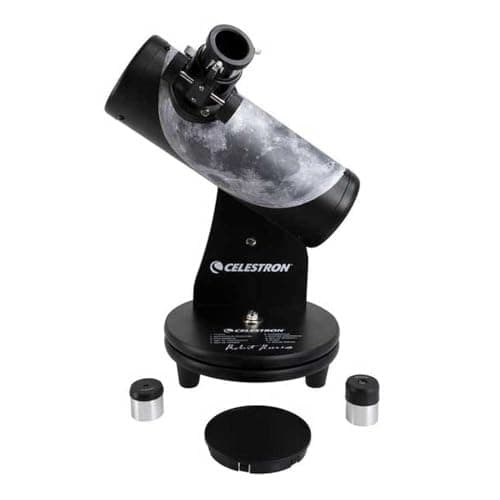 Celestron FirstScope 76mm Tabletop 76mm of mirror against 70mm of lens, with eyepieces inside the published 180x ceiling. | More aperture for less money, if you have a table |
Rows link to the full write-up further down this page. Prices come from the live price layer only; where there is no live figure the button reads “Check price” rather than showing a number we remembered.
What a 70mm telescope actually shows
Worth setting expectations, because this applies equally to the Gskyer and to the Celestron we recommend over it. At 70mm and realistic magnifications a child will see the Moon in genuine detail — craters, mountain shadows along the terminator — plus Jupiter as a small disc with up to four moons, Saturn's rings as a distinct oval shape, and the brighter star clusters.
What they will not see is anything resembling a photograph. Nebulae are faint gray smudges at this aperture, and galaxies mostly are not visible at all from a suburban garden. Our full target-by-target breakdown is on what you can actually see.
Who it is genuinely for
| Situation | Verdict |
|---|---|
| You already own one and wonder if it is broken | Probably not. Start with why can't I see anything. |
| You want 70mm and a carry bag | Buy the Travel Scope 70 — same aperture, less money. |
| You want the most aperture under $100 | Buy the FirstScope if you have a table. |
| You want it to point high overhead easily | Not this. The 45 degree diagonal fights you. |
| You want a published spec sheet before buying | Not this. Gskyer publishes none. |
| It is already bought and wrapped | It is fine. Align the finder in daylight first — see the setup checklist. |
If you already own one
Nothing above means you have been sold junk, and a telescope you already have beats one you are thinking about. Three things get the most out of it: align the finderscope in daylight before the first night, start with the low-power eyepiece and leave the Barlow in the box until the Moon is sharp, and accept that anything high overhead will be uncomfortable with the supplied diagonal.
The sequence that makes a first night work is on your first night with a telescope, and the single most common reason a new telescope seems broken is covered on why can't I see anything.
What we did and did not do
We have not tested this telescope. The aperture, focal length, supplied magnifications, 3x Barlow, 45 degree diagonal, absent manual, missing eyecups and the unfound slow-motion control all come from TelescopicWatch's published hands-on review, linked below and attributed in the text. The aperture and focal length are also stated in the retailer listing we link to.
The f/5.7 focal ratio and the roughly 140x ceiling are our own arithmetic on those published figures, reproducible with a calculator. Gskyer publishes no manufacturer specification page, which is itself part of our assessment and is stated as a finding rather than worked around. We publish no rating of our own and no review count. No price appears in this prose; live figures come only from our price feed with the date they were checked, and our full method is on the methodology page.
The picks in full
Skip this
Gskyer AZ 70400 Telescope
Showing that passing the magnification test is necessary, not sufficient
The arithmetic
This is the arithmetic that matters, and the result is not the one we expected. 70mm of aperture puts the honest ceiling near 140x on the usual rule of twice the aperture in millimeters. The supplied eyepieces give 16x and 40x, and the 3x Barlow takes the top combination to 120x — which sits BELOW the ceiling. Unlike most of the cheap shelf, this telescope does not advertise magnification its optics cannot deliver, and it passes the thirty-second test we apply to every box. The reasons not to buy it are elsewhere: the aperture is small for the money, and the package around the optics is thin.
Start with the part that surprised us. Run this telescope through the thirty-second test we apply to every box on this site — advertised maximum magnification divided by aperture in millimeters — and it passes.
The arithmetic: 70mm of aperture puts the honest ceiling near 140x. The supplied eyepieces give 16x and 40x, and the 3x Barlow takes the top combination to 120x. That is below the ceiling, which is more than can be said for most of the shelf it sits on. Compare the PowerSeeker 50AZ, which reaches roughly 450x on 50mm of glass — about four times what its own maker says the optics can do.
So the reasons not to buy it are not the numbers. They are the package. The hands-on review we cite reports no user manual, only a pictorial assembly sheet; no eyecups on the eyepieces, so stray light degrades the view; and that the reviewer could not find the slow-motion control the listing advertises. It scores the telescope 2.5 out of 5 and calls it, in its own words, a hobby killer.
The 45 degree diagonal is the one we would flag hardest for this site's readers. It is a daytime design: it puts the image the right way up for looking at birds and hills, and it makes looking at anything high overhead a neck-craning job. Children mostly want to look up. We make the same point in favor of that diagonal on the Travel Scope 70, where daylight use is the stated purpose — the component is not bad, it is aimed at a different job.
The honest closing point is value rather than contempt. 70mm is a small aperture for roughly a hundred dollars, and Gskyer publishes no specification page at all, so there is no maker's figure for weight, tripod height, eyepiece focal lengths or a magnification ceiling. You are buying on an Amazon listing alone.
Skip it if
Always, at this price, when the Travel Scope 70 offers the same 70mm aperture for less money with a published specification sheet and a real manual. This is not a scam telescope and we are not calling it one — it is simply beaten on value by something the same size from a manufacturer that tells you what you are buying.
| Optical design | Refractor |
|---|---|
| Aperture | 70mm |
| Focal length | 400mm |
| Focal ratio | f/5.7 (computed from the published 70/400) |
| Eyepieces supplied | Two, giving 16x and 40x |
| Also supplied | 3x Barlow lens |
| Diagonal | 45 degree |
| Mount | Camera-style tripod, alt-azimuth |
| Also included | Carry bag, phone adapter, wireless remote |
| What the box does not do | No user manual, per the hands-on review linked below — a pictorial assembly sheet only. The 45 degree diagonal is a daytime design that makes anything high overhead awkward to look at, which is most of what a child wants to see. That review also reports no eyecups on the eyepieces, and could not find the slow-motion control the listing advertises. Gskyer publishes no manufacturer specification page, so there is no maker's figure for weight, tripod height, eyepiece focal lengths or a magnification ceiling. |
Specifications from TelescopicWatch — Gskyer AZ70400 70mm telescope review (hands-on: magnifications, 3x Barlow, 45 degree diagonal, no manual, rating). We have not handled this one — everything above is the published spec sheet plus our own arithmetic on it.
Pick 2
Celestron Travel Scope 70
The same aperture, from a manufacturer that publishes what it sells
The arithmetic
400mm focal length over the two supplied eyepieces gives 20x and 40x. Celestron's published ceiling for a 70mm objective is 168x, so both eyepieces are comfortably inside it — the box is not overselling. The 3.3 lb total is the number that matters for a gift: a child can carry the whole kit themselves, which is most of why it gets used more than once.
The direct replacement, and the reason this page ends where it does: the same 70mm aperture and the same 400mm focal length, for less money.
What the extra brand buys is information and support. Celestron publishes a full specification sheet, a 168x magnification ceiling, a real manual, and the telescope comes with a custom backpack that makes it the one that actually leaves the house.
It carries the same 45 degree erect-image diagonal, so it shares that overhead-viewing limitation. We are not pretending otherwise — on that telescope the daylight use is the point. Full review.
Skip it if
Steadiness matters most. The tripod is light enough to carry and light enough to wobble when a child touches the eyepiece — a real limitation we do not gloss over.
| Optical design | Refractor |
|---|---|
| Aperture | 70mm (2.8") |
| Focal length | 400mm (15.74") |
| Focal ratio | f/5.7 |
| Eyepieces supplied | 20mm (20x) and 10mm (40x) |
| Finderscope | 5x24 |
| Diagonal | 45 degree erect image, 1.25" |
| Mount | Manual alt-azimuth on aluminum tripod |
| Highest useful magnification | 168x |
| Limiting stellar magnitude | 11.7 |
| Total kit weight | 3.3 lbs (1.5 kg), tripod 1.8 lbs (0.81 kg) |
| Included | Custom backpack, Starry Night Basic software, SkyPortal app access |
| What the box does not do | The tripod is the weak part. At 1.8 lbs it is light enough to carry and light enough to wobble, and a child nudging the eyepiece will lose the target. The 45 degree erect-image diagonal is built for daytime use and costs you a little light at night. |
Specifications from Celestron — Travel Scope 70 specifications. We have not handled this one — everything above is the published spec sheet plus our own arithmetic on it.
Pick 3
Celestron FirstScope 76mm Tabletop
More aperture for less money, if you have a table
The arithmetic
The 20mm eyepiece gives 300 / 20 = 15x, and the 4mm gives 300 / 4 = 75x. Celestron's own published ceiling is 180x, so the 4mm sits well inside what the optics support — unusual honesty at this price. There is no tripod: it needs a table, a wall, a car roof or a stack of books at roughly chest height for the child using it.
The option that buys more light for less money. 76mm of mirror collects noticeably more than 70mm of lens, and Celestron publishes a 180x ceiling with supplied eyepieces giving 15x and 75x — both comfortably inside it.
It also points straight up without a diagonal at all, which removes the overhead problem the 45 degree diagonal creates.
Honest downsides: no tripod, no finderscope, and you nudge the tube by hand to track. Full review.
Skip it if
You have no table, wall, or flat surface at roughly the child's chest height. This is a tabletop telescope with no tripod at all, and that is a genuine requirement rather than fine print.
| Optical design | Newtonian reflector, spherical primary mirror |
|---|---|
| Aperture | 76mm (2.99") |
| Focal length | 300mm (12") |
| Focal ratio | f/3.95 |
| Eyepieces supplied | 20mm (15x) and 4mm (75x) |
| Highest useful magnification | 180x |
| Lowest useful magnification | 11x |
| Limiting stellar magnitude | 11.9 |
| Light gathering vs the eye | 118x |
| Mount | Dobsonian-style tabletop base |
| What the box does not do | No tripod, no finderscope, and no way to track an object as the sky moves — you nudge the tube by hand. The 4mm eyepiece is usable but tight; most children get on better with the 20mm all evening. |
Specifications from Celestron — FirstScope specifications. We have not handled this one — everything above is the published spec sheet plus our own arithmetic on it.
Questions people actually ask
- Is the Gskyer telescope any good?
- It is honest about what it can do, which is more than most cheap telescopes manage — its 120x maximum sits below the roughly 140x an honest 70mm telescope can support. But it offers the same 70mm aperture as the Celestron Travel Scope 70 at a higher price, with no published specification sheet and, per a hands-on review, no user manual. We would buy the Celestron instead.
- What magnification does the Gskyer 70mm telescope have?
- The two supplied eyepieces give 16x and 40x on its 400mm focal length, and the included 3x Barlow lens takes those to 48x and 120x. That 120x maximum is below the roughly 140x ceiling a 70mm aperture supports, so unlike many cheap telescopes it does not advertise magnification the optics cannot deliver.
- Is Gskyer a real telescope brand?
- It is a real seller of real telescopes, not a scam, but it is an Amazon-native brand with no manufacturer specification page. That matters practically: there is no published figure for eyepiece focal lengths, weight, tripod height or a magnification ceiling, so you are buying on a retail listing alone rather than a spec sheet.
- What can you see with a Gskyer 70mm telescope?
- The Moon in real detail including craters and shadows, Jupiter as a small disc with up to four moons, Saturn's rings as a distinct oval, and brighter star clusters. Nebulae appear as faint gray smudges and most galaxies will not be visible from a suburban garden. That is true of any 70mm telescope, not this one specifically.
- Why does the 45 degree diagonal matter?
- A 45 degree diagonal puts the image the right way up, which suits daytime viewing of birds and landscapes. For astronomy it means craning your neck to look at anything high overhead, which is where most of what a child wants to see actually is. A 90 degree diagonal is the more comfortable choice for night use.
- What should I buy instead of a Gskyer telescope?
- The Celestron Travel Scope 70 gives the identical 70mm aperture and 400mm focal length for less money, with a published specification sheet, a 168x published ceiling and a backpack. If you have a table to stand it on, the Celestron FirstScope offers 76mm of aperture for even less.
Sources
Read next
Where to go from here
- Toy telescopes versus real optics: how to tell in thirty seconds
The arithmetic that exposes a 525x claim on a 70mm box, worked through on a real product using its own manufacturer's published numbers.
- Is the Celestron Travel Scope 70 any good?
The most portable telescope we recommend, and the tripod that is the direct price of that portability. What it shows and who it suits.
- The best kids' telescopes under $100
The sub-$100 shelf is where the 525x claims live. What that money genuinely buys, and the one telescope here we tell you not to buy.
- Is the Celestron PowerSeeker 50AZ any good?
Celestron publishes a 118x ceiling for this 50mm refractor, then supplies eyepieces and a Barlow reaching 450x. Why that matters, and the two better telescopes at a similar price.
- Telescope brands for kids, and which ones mean anything
The difference between a telescope brand and a licensed name, and which of the ones you will see in search results actually design what they sell.
- Why can't I see anything through my telescope?
The ranked causes of a telescope that shows nothing, most common first, each with a fix you can do tonight without tools.