Star Projectors
Learning Resources Shining Stars Projector review
The cheapest thing in this category, and the one most often bought by mistake. What it actually puts on the wall.
By Scooter M. · published October 24, 2026
I'm not an astronomer and I don't have a lab. I'm someone who's genuinely into this — I read the manuals, compile the published specs, and do the arithmetic the box doesn't do for you. No lab coat. How we pick.
How this is funded. Lens & Lightyear earns a commission when you buy through a link on this page, at no extra cost to you. It does not change which products we pick or what we say about them — every card below carries a real reason to skip it. Prices are pulled live and were last verified November 2, 2026. Full disclosure.
The short answer
Buy it as a first space toy for a four to seven year old, not as a star projector. It projects 24 full-color photographs of planets, the Moon and astronauts one at a time, with an activity guide of space facts — which is charming and cheap. It does not put a star field on the ceiling. If that is what you wanted, buy the Govee Star Nebula instead.
Almost every disappointed review of this product is a category error rather than a complaint about quality. It is sold alongside projectors that wash a room in stars, it costs a fraction of them, and it does something else entirely.
Three different products share one name
The phrase star projector covers three genuinely different devices, and the price gaps between them only make sense once you can tell them apart.
| Type | What it puts on the ceiling | Example | Who it suits |
|---|---|---|---|
| Slide projector | One photograph at a time | Shining Stars (this page) | Ages 4-7, as a space picture book on a wall |
| Decorative projector | A wash of moving color and dots | Govee Star Nebula | Any age, as room atmosphere |
| Optical planetarium | A real star field in true positions | Pococo, Homestar Flux | Ages 7+, to actually learn the sky |
This page adds the first row. The split between the second and third is the one we work through in detail on accurate versus decorative star projectors.
We had not covered the slide-projector category before this review, because it sits at the toy end rather than the astronomy end. It belongs here anyway: it is what a lot of people end up buying when they search for a star projector for a young child, and they deserve to know before it arrives.
The full published specification
| Specification | Shining Stars Projector (LER2830) |
|---|---|
| Projection type | Full-color slide images, not a star field |
| Discs | 3, with 8 images each |
| Total images | 24 |
| Disc 1 | Planets |
| Disc 2 | Moon and Sun |
| Disc 3 | Astronauts, man-made objects, a comet, the Milky Way, the Little Dipper |
| Projection distance | Up to 10 ft |
| Auto shut-off | After more than 15 minutes |
| Power | 3 x AAA, not included |
| Dimensions | 8.5 x 6.625 x 6.5" (7" high in the stand) |
| Weight | 1.2 lb |
| Grade guidance | PK-4 (publisher) |
| Included | 3 discs, projector with carry handle, stand, activity guide |
Read from the publisher's product description as carried by Rainbow Resource, linked below. Retailer age listings disagree with each other (3-7, 3-6 and 5+ all appear); we report the publisher's grade range and say so.
Quick picks
The Shining Stars, and the two projectors people usually meant instead
| # | Product | Best for | Price |
|---|---|---|---|
| 1 | 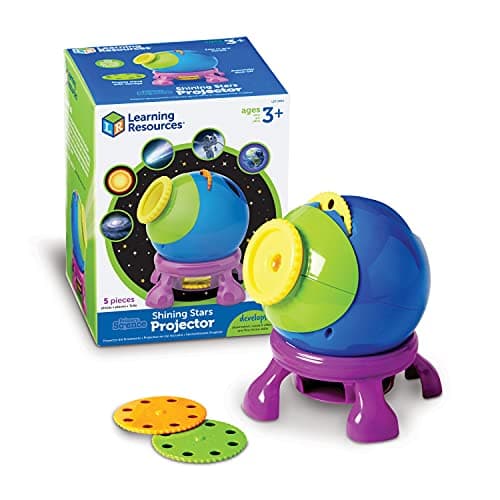 Learning Resources Primary Science Shining Stars Projector 24 full-color photographs on 3 discs, projected up to 10 feet, with a space activity guide. | A three to seven year old who wants to see planets and astronauts on the wall, with something to talk about | |
| 2 | 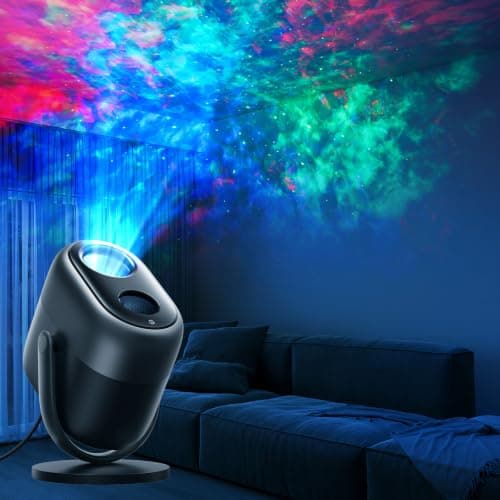 Govee Star Light Projector with Nebula Effect Seven independently driven nebula zones across 540 sq ft, at under 25 dB. | Anyone who actually meant a ceiling washed in stars and nebula | |
| 3 | 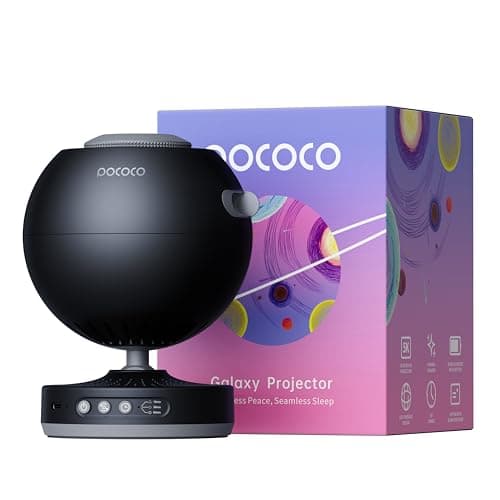 Pococo Galaxy Projector Optical discs through a 2 MP lens — around 40,326 stars on the star disc. | Wanting real star positions rather than either pictures or decoration |
Rows link to the full write-up further down this page. Prices come from the live price layer only; where there is no live figure the button reads “Check price” rather than showing a number we remembered.
What a child actually does with it
The activity guide is the part that justifies the purchase, and it is the part the product photographs never show. Each of the 24 images has a short space fact attached, so the device has a script rather than just an effect.
- It works in the daytime. Because it throws a bright picture rather than faint stars, a darkened room is enough — you are not waiting for a clear night or full darkness.
- It gives a four-year-old something to point at. A photograph of Saturn on the wall is a far easier first conversation than a 2mm disc in an eyepiece, which is genuinely hard for a small child to interpret.
- It is portable and survivable. A carry handle, 1.2 lb, and a price that makes a drop survivable rather than a disaster.
- It runs out of material. Twenty-four images is twenty-four images. There are no expansion discs, so the novelty has a hard ceiling — unlike a disc planetarium, where more discs can be bought.
Who it is genuinely for
| Situation | Verdict |
|---|---|
| A space-mad four to seven year old | Yes. This is the pick, and it is cheap. |
| A stocking filler or add-on gift | Yes — see space gifts under $50. |
| Daytime play, or a room that will not go fully dark | Yes. A bright picture beats a faint star field here. |
| You wanted stars across the whole ceiling | No. Buy the Govee Star Nebula. |
| You want a child to learn real constellations | No. Buy an optical planetarium. |
| A night light | Not really. It shuts off after about 15 minutes. |
| A child of nine or older | No. By then the pictures are a book they already own. |
Where it sits against a telescope
It does not compete with one, and it is worth saying plainly because the two get bought for the same child. A projector of any kind shows a picture indoors; a telescope collects light from a real object outside. For a four-year-old the projector is very often the better first purchase, because the hard part of a telescope at that age is not the optics but the patience.
Our honest view on when a child is ready for the real thing is on what age is a telescope right for, and the three-way comparison is on telescope, binoculars or star projector.
What we did and did not do
We have not tested this projector. The disc contents, the 24-image count, the 10 ft projection distance, the 15-minute shut-off, the battery requirement, the dimensions and the included contents were all read from the publisher's product description on the date at the top of this page, linked below.
Where the published sources disagree — the age range in particular — we have said so rather than picking the number that suited the recommendation. We publish no rating and no review count, because we have measured nothing. Prices come only from our live feed with the date they were checked, and our full method is on the methodology page.
The picks in full
Pick 1
Learning Resources Primary Science Shining Stars Projector
A three to seven year old who wants to see planets and astronauts on the wall, with something to talk about
The arithmetic
The number that reframes this product is 24 — it projects twenty-four fixed photographs, one at a time, not a sky. That is a different category from every other projector on this site: the Govee units wash a ceiling in decorative nebula, the Pococo and Homestar project real star fields, and this shows a planet on the wall like a slide viewer. Judged as a slide projector with a space activity guide for a four-year-old it is good value; judged as a star projector it fails, because it was never one.
This is a slide projector, and understanding that settles almost every question about it. Three discs carry eight images each — 24 photographs in total — and the unit throws one of them at a time onto a wall or ceiling at up to 10 feet.
The disc contents are specific and genuinely well chosen for a young child: disc one is planets, disc two is the Moon and the Sun, and disc three carries astronauts, man-made objects, a comet, the Milky Way and the Little Dipper. The included activity guide gives space facts for each image, which is the part that turns it from a light into a thing you do together.
Practical details in its favor: a carry handle, a stand so it sits steady rather than being held, and a weight of 1.2 lb that a small child can manage. It is sold as durable enough for active play, and at this price being dropped is a realistic test.
The honest downsides are three, and the first is the big one. It is not a star projector, whatever the shelf next to it suggests. The second: 3 AAA batteries are not included, which on a birthday morning is the difference between a working gift and a disappointed child. The third: the light switches off automatically after about 15 minutes, which is fine for a bedtime story and short for a night light.
Published age guidance is inconsistent — the publisher lists it by grade as PK-4, while retailers variously list 3-7, 3-6 and 5+. The EU listings carry the standard under-3 small-parts warning. Our own read, from the disc contents and the activity guide, is that it lands best around four to seven.
Skip it if
You wanted a ceiling full of stars. This shows one photograph at a time — there is no star field, no rotation, no nebula and no constellations beyond a single Little Dipper image. Buyers expecting the swirling galaxy effect they have seen online will be disappointed, and that is the single most common mistake made with this product.
| Model | LER2830 |
|---|---|
| Projection type | Full-color slide images, not a star field |
| Discs | 3 discs, 8 images each (24 images total) |
| Disc 1 | Planets |
| Disc 2 | Moon and Sun |
| Disc 3 | Astronauts, man-made objects, a comet, the Milky Way, the Little Dipper |
| Projection distance | Up to 10 feet |
| Auto shut-off | Switches off after more than 15 minutes |
| Power | 3 x AAA batteries (NOT included) |
| Dimensions | 8.5 x 6.625 x 6.5" (7" high in the stand) |
| Weight | 1.2 lb |
| Grade guidance | PK-4 (publisher) |
| Included | 3 image discs, projection unit with carry handle, stand, activity guide |
| What the box does not do | No star field, no ceiling-filling effect, no rotation and no constellations beyond a single Little Dipper image. Batteries are not supplied, which with a toddler gift is the difference between working on the morning it is opened and not. The 15-minute auto shut-off is short for a night light, and published age guidance is inconsistent across retailers. |
Specifications from Rainbow Resource — Primary Science Shining Stars Projector (disc contents, dimensions, shut-off, contents); Learning Resources — Primary Science Shining Stars Projector (LER2830). We have not handled this one — everything above is the published spec sheet plus our own arithmetic on it.
Pick 2
Govee Star Light Projector with Nebula Effect
Anyone who actually meant a ceiling washed in stars and nebula
The arithmetic
25 dB is the specification that matters in a child's bedroom and the one nobody checks — roughly the level of a quiet library, which is quiet enough to fall asleep next to. 540 sq ft of coverage will fill an ordinary bedroom ceiling with room to spare, and is in fact 79 percent more area than the far more expensive Galaxy 2 Pro covers.
If the phrase star projector made you picture a bedroom ceiling full of drifting color, this is the product you were imagining, and it is the one we recommend most often for a child's room.
Published at under 25 dB and 540 sq ft of coverage — quiet enough to leave running next to a sleeping child, and wide enough to fill an ordinary ceiling.
Honest downside: like the Shining Stars, none of what it shows is a real sky. Full review.
Skip it if
You want it to teach the real sky, or you want a cheap add-on gift. It is several times the price of the Shining Stars and its star field is decorative, not a star map.
| Model | H6095 |
|---|---|
| Nebula rendering | 7 independent light zones, 7 RGBW lamp beads with 7 independent IC chips |
| Coverage area | 540 square feet |
| Noise level | Less than 25 dB |
| Scene modes | 50+ |
| White noise options | 18 |
| Control | Function button, Govee Home app, voice, Matter |
| Connectivity | 2.4GHz Wi-Fi and Bluetooth |
| Voice assistants | Alexa and Google Assistant |
| Power | 10 W; 5 V DC 3 A input, 100-240 V adapter |
| Dimensions | 5.51 x 6.18 x 8.94" |
| Weight | 1.6 kg |
| What the box does not do | Decorative only: the star field is a pattern, not a sky. No optical discs, so what you see on night one is what you see on night two hundred. Needs the app for most of its features. |
Specifications from Govee — Star Light Projector with Nebula Effect. We have not handled this one — everything above is the published spec sheet plus our own arithmetic on it.
Pick 3
Pococo Galaxy Projector
Wanting real star positions rather than either pictures or decoration
The arithmetic
A middle path between an accurate planetarium and a decorative light. The disc system means you can run a real star field one night and a nebula the next, and the focus wheel is large enough for a child to work themselves — which matters more than it sounds, because a projector nobody can focus gets switched off. No speaker and no app is a feature in a bedroom, not a gap.
The third category, and the one neither of the others reaches: an optical planetarium projecting a genuine star field.
A child can learn a constellation on the ceiling and then find the same one out of the window — the one trick a projector can do that actually helps with a telescope.
The focus wheel is large enough for a child to work themselves. Honest downside: no speaker, no app, and extra discs cost money. Full review.
Skip it if
The budget is the point. This costs several times the Shining Stars, and the swappable discs are an ongoing cost.
| Projection type | Optical disc projection, LED (no laser) |
|---|---|
| Disc resolution | 5K discs through a 2 megapixel lens |
| Stars projected | Around 40,326 on the star disc |
| Projection area | Approximately 12 square meters |
| Dimensions | 157 x 120 x 120 mm |
| Weight | 1.63 lb |
| Power | 5 V USB-C, internal battery, about 1.5 W |
| Controls | Focus wheel, on-body rotation, sleep timer, 60 degree tilt |
| Discs | Two included; further sets sold separately |
| What the box does not do | No speaker, no app control, no aurora effects. Extra discs are an ongoing cost. The battery is convenient but it is one more thing to charge. |
Specifications from Space.com — Pococo Galaxy star projector review; Live Science — Pococo Galaxy star projector review. We have not handled this one — everything above is the published spec sheet plus our own arithmetic on it.
Questions people actually ask
- Is the Learning Resources Shining Stars Projector a real star projector?
- No, not in the sense most buyers mean. It projects 24 full-color photographs one at a time — planets, the Moon and Sun, astronauts, a comet, the Milky Way and the Little Dipper — rather than a star field across the ceiling. For stars across a whole ceiling you want a decorative projector such as the Govee Star Nebula, or an optical planetarium for real star positions.
- What age is the Shining Stars Projector for?
- Published guidance is inconsistent: the publisher lists it by grade as PK-4, while retailers list 3-7, 3-6 and 5+. From the disc contents and the activity guide it suits roughly four to seven. EU listings carry the usual not-suitable-under-three small-parts warning.
- How many images does it project?
- Twenty-four. Three discs hold eight images each. Disc one shows planets, disc two the Moon and Sun, and disc three astronauts, man-made objects, a comet, the Milky Way and the Little Dipper.
- Does it come with batteries?
- No. It needs three AAA batteries and they are not included, so buy them at the same time if it is a gift.
- Can you use it as a night light?
- Only briefly. The light switches off automatically after more than 15 minutes, which suits a bedtime story rather than running all night.
- How far can it project?
- Up to 10 feet, according to the publisher. It also comes with a stand, which matters more than it sounds — a hand-held projector in a small child's grip does not hold an image still.
Sources
Read next
Where to go from here
- The best star projector for a toddler's room
For a very young child the useful specifications are noise level, dimming and cable placement. Star count barely matters. What to actually look for.
- The best star projector under $50
The sub-$50 shelf is where most of this category lives and where the specifications get least reliable. What to check and what to ignore.
- Accurate or decorative? The star projector split nobody explains
The single distinction that decides whether a star projector supports a child's interest in astronomy or is simply a very nice bedroom light.
- Govee Star Light Projector with Nebula Effect review
Under 25 dB, 540 sq ft of ceiling and seven independently controlled nebula zones. The best decorative bedroom projector we recommend — and honestly not an astronomy instrument.
- The best star projector for kids, by age
Age decides this purchase more than any specification. What changes between four, eight and twelve, four picks matched to those bands, and the point where a telescope is the better gift.
- Telescope, binoculars or star projector?
Three completely different gifts sold to the same buyer. Which one fits your child, your sky and your household, with a winner named for each.