Telescopes
Equatorial or alt-azimuth? The mount that decides whether it gets used
The third question nobody asks until the box is open, answered with two telescopes that differ in nothing else.
By Scooter M. · published November 3, 2026
I'm not an astronomer and I don't have a lab. I'm someone who's genuinely into this — I read the manuals, compile the published specs, and do the arithmetic the box doesn't do for you. No lab coat. How we pick.
How this is funded. Lens & Lightyear earns a commission when you buy through a link on this page, at no extra cost to you. It does not change which products we pick or what we say about them — every card below carries a real reason to skip it. Prices are pulled live and were last verified November 3, 2026. Full disclosure.
The short answer
Alt-azimuth, for a child, almost always. An alt-azimuth or Dobsonian mount moves the way a person expects — up, down, left, right — and works the moment it is set down. An equatorial mount must be counterweighted, latitude-set and balanced in two axes first, and then moves along axes that feel wrong until you understand why. Buy equatorial only if an adult actively wants to learn it.
This site already answers the other two questions a beginner faces — refractor or reflector and tabletop or tripod. This is the third, and it is the one that most often decides whether a telescope gets used twice.
What each mount actually is
Both mounts hold a telescope and let it swivel. The difference is which directions they swivel in, and that single fact produces every other difference on this page.
- Alt-azimuth moves in altitude (up and down) and azimuth (left and right). It is the way a camera tripod, a pair of binoculars and a human head all work. A Dobsonian base is an alt-azimuth mount sitting on the ground or a table rather than on legs.
- Equatorial is tilted so that one of its two axes points at the celestial pole — near Polaris, if you are in the northern hemisphere. Once it is aligned that way, the sky's apparent rotation happens along one axis only.
- Why anyone bothers: the sky drifts. At 65x an object crosses an ordinary eyepiece field in roughly a minute. On an alt-az mount you correct that with two knobs; on an aligned equatorial, with one — and a motor on that one axis can do it for you.
The comparison, with the optics held constant
Mount arguments are usually made between telescopes that differ in everything. These two differ in almost nothing, which makes the trade unusually clean.
| Heritage 130 (alt-az) | AstroMaster 130EQ (equatorial) | |
|---|---|---|
| Aperture | 130mm | 130mm |
| Focal length | 650mm | 650mm |
| Focal ratio | f/5 | f/5 |
| Primary mirror | Parabolic | Spherical |
| Mount | Tabletop Dobsonian | CG-3 German equatorial |
| Setup before first look | Put it on a table | Counterweight, latitude, balance in 2 axes |
| Axes you push | Up/down, left/right | Right ascension and declination |
| Tracking by hand | Two knobs or a nudge | One slow-motion knob, once aligned |
| Published total weight | Not published | 17 lbs |
| Needs a surface | Yes — no tripod | No, it has legs |
| Motor upgrade path | Limited | Yes, on the R.A. axis |
Published manufacturer specifications as recorded on each product's page. Bold marks the advantage where there is one. Note that the equatorial model's mirror is published as spherical while the alt-azimuth model's is parabolic — the mount is not the only variable between these two, and we are not going to pretend it is.
Quick picks
The same 130mm mirror, three mounts
| # | Product | Best for | Price |
|---|---|---|---|
| 1 | 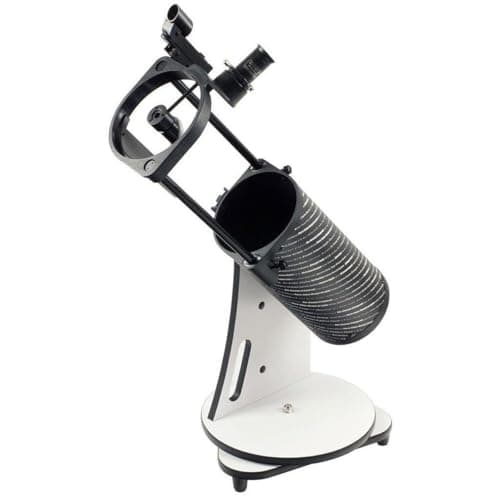 Sky-Watcher Heritage 130 Tabletop Dobsonian 130mm at 650mm on a tabletop Dobsonian base: point it, look, nudge it. | Almost every family — the mount a child can use alone on the first night | |
| 2 | 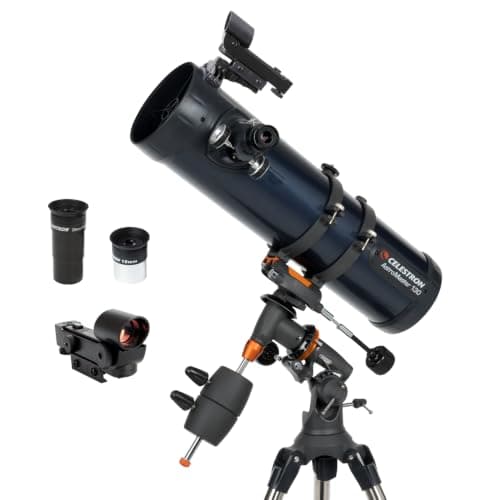 Celestron AstroMaster 130EQ The same 130mm and 650mm on a CG-3 German equatorial — and a spherical mirror. | An adult who actively wants to learn an equatorial mount, with a child watching | $275.47 on Amazon #ad How we’re funded · price as of November 3, 2026 |
| 3 | 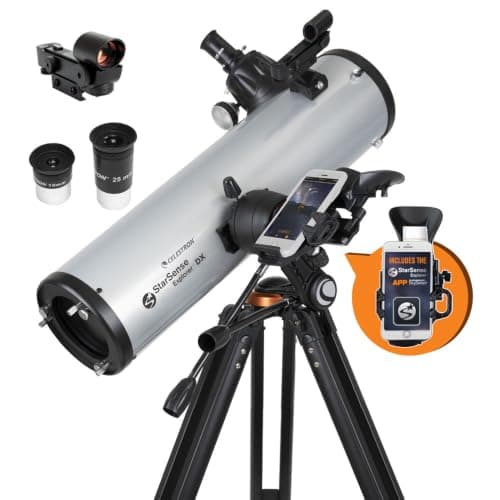 Celestron StarSense Explorer DX 130AZ The same 130mm parabolic optics on an alt-azimuth mount, with a phone app that points you. | Households where finding things, not tracking them, is the real problem | $499.95 on Amazon #ad How we’re funded · price as of November 3, 2026 |
Rows link to the full write-up further down this page. Prices come from the live price layer only; where there is no live figure the button reads “Check price” rather than showing a number we remembered.
Why equatorial goes wrong for children specifically
None of what follows means an equatorial mount is bad. It means it is a tool with a learning curve, and a cold evening with an impatient eight-year-old is the worst possible classroom.
- It arrives as a puzzle. The counterweight goes on the shaft, the tube goes in the dovetail, and then it must be balanced in two separate axes or it swings on its own. That is twenty minutes before anyone sees anything.
- Polar alignment is a concept, not a step. Pointing the mount's axis at Polaris is easy to describe and genuinely confusing the first few times, and until it is roughly right, the single-axis advantage does not exist.
- It moves wrong. Nudge an equatorial toward a target and the view swings along a diagonal. Adults reason their way past this; children conclude the telescope is broken.
- The eyepiece ends up in strange places. As the tube rotates around the polar axis, the eyepiece can finish underneath or behind, at a height a child cannot reach without the whole mount being re-set.
- It is heavier. A published 17 lbs of telescope, mount and counterweight is an adult-carries-it-every-time object.
Which to buy, by household
| Your situation | Mount | Why |
|---|---|---|
| Child will use it alone | Alt-azimuth | Works the moment it is set down; nothing to align |
| Child is under about ten | Alt-azimuth | Setup time is the enemy at this age |
| No table or flat surface outside | Alt-az on a tripod | A tabletop Dobsonian has no legs — see tabletop or tripod |
| An adult wants to learn the sky too | Either — equatorial is defensible | One-axis tracking and a motor upgrade path |
| You want to try astrophotography later | Equatorial | Tracking on one axis is the foundation; alt-az is not |
| Nobody can find anything | Alt-az with app guidance | The problem is finding, not tracking |
| Teenager, serious about it | Equatorial is reasonable | See telescopes for teens |
What about GoTo and motorized mounts?
A third category exists: mounts with motors that find and follow objects for you. They remove the finding problem and the tracking problem together, and they cost the aperture you did not buy.
Our position is unchanged from the under $500 bracket: at a fixed budget, every dollar spent on motors is a dollar not spent on aperture, and aperture is the only thing that changes what is visible. Phone-guided finding gets most of the benefit for much less — you still push the telescope by hand, but you always know where to push it.
If you already own an equatorial
Nothing above means you bought the wrong thing, and three habits make an equatorial behave for a child.
- Set it up in daylight, indoors, once. Fit the counterweight, balance both axes and set the latitude with the lights on. It stays set; you are not repeating this every night.
- Rough polar alignment is enough. Point the polar axis at Polaris by eye. Precision only matters for photography, and the hand-tracking benefit appears long before precision does.
- Teach one knob. Once aligned, the right ascension slow-motion control is the only one needed to follow something. A child who learns that one knob has learned the mount.
- Align the finderscope first, in daylight. This is the top cause of a failed first night on any mount — see why can't I see anything and the setup checklist.
What we did and did not do
We have not tested these telescopes. Apertures, focal lengths, focal ratios, mirror types, mount designations, supplied eyepieces, published magnification ceilings, limiting magnitudes and weights are the manufacturers' own published figures, recorded on each product's page on this site and linked below.
Where Sky-Watcher does not publish a figure — supplied eyepieces, finderscope, assembled weight for the Heritage 130 — we say so rather than estimating, which is why the comparison table has a blank rather than a guess. The description of how each mount behaves is the standard account of how these two designs work, not a test result. No price appears in this prose; live figures come only from our price feed with the date they were checked, and our full method is on the methodology page.
The picks in full
Pick 1
Sky-Watcher Heritage 130 Tabletop Dobsonian
Almost every family — the mount a child can use alone on the first night
The arithmetic
130mm of aperture collects roughly 3.4 times the light of a 70mm refractor — the single biggest jump available at anything like gift money. At 650mm focal length, a common 25mm eyepiece gives 26x and a 10mm gives 65x. The rule of thumb astronomers use for a maximum useful magnification is about 2x the aperture in millimeters, which puts a sensible ceiling near 260x on a genuinely steady night.
A Dobsonian base is the simplest mount ever put under a telescope: it swings left and right, it tips up and down, and that is the entire user interface. A seven-year-old understands it in about four seconds.
The optics are the reason to want this specific one: 130mm of aperture collects roughly 3.4 times the light of a 70mm refractor, which is the single biggest jump available at anything like gift money, and Sky-Watcher publishes the primary as a parabolic mirror rather than spherical — which matters at f/5, where a spherical mirror struggles.
At 650mm, a 25mm eyepiece gives 26x and a 10mm gives 65x, against a ceiling near 260x on the usual twice-the-aperture rule. There is room to grow into with one better eyepiece.
Honest downsides: no tripod, so it needs a surface; Sky-Watcher does not publish the supplied eyepieces, finderscope or assembled weight, so we do not state them; and the collapsible tube is open to the air, so it collects dust and will want occasional collimation.
Skip it if
You have no table, wall or flat surface at roughly the child's chest height. This has no tripod at all, and that is a genuine requirement rather than fine print.
| Optical design | Newtonian reflector, borosilicate parabolic primary mirror |
|---|---|
| Aperture | 130mm |
| Focal length | 650mm |
| Focal ratio | f/5 |
| Mirror coatings | Sky-Watcher Radiant Aluminum Quartz (RAQ) |
| Focuser | 1.25" helical |
| Mount | Tabletop Dobsonian base, Teflon bearings, altitude locking knob |
| Tube | Collapsible for storage, retains collimation |
| What the box does not do | Sky-Watcher's product page does not publish the supplied eyepieces, finderscope or assembled weight, so we do not state them. No tripod — this is a tabletop instrument. The collapsible tube is open to the air, so it collects dust and will need occasional mirror cleaning and collimation. |
Specifications from Sky-Watcher USA — Heritage 130 Tabletop Dobsonian. We have not handled this one — everything above is the published spec sheet plus our own arithmetic on it.
Pick 2
Celestron AstroMaster 130EQ
An adult who actively wants to learn an equatorial mount, with a child watching
The arithmetic
Its published spec sheet is the StarSense Explorer DX 130AZ's, line for line — 130mm, 650mm, f/5, a 307x ceiling, 13.1 limiting magnitude, 345x the light of the eye, 34 percent obstruction — with one exception that matters at this focal ratio: Celestron publishes this primary mirror as SPHERICAL, where the DX 130AZ and the Sky-Watcher Heritage 130 are parabolic. The supplied eyepieces give 33x and 65x, and with no Barlow in the box the kit reaches about 21 percent of its own 307x ceiling. At 17 lbs it works out to about 7.6mm of aperture per pound.
This is the honest comparison this page exists for, because against the Heritage 130 it holds the same 130mm aperture, the same 650mm focal length and the same f/5 at a nearly identical price. The mount is the variable.
What the equatorial buys is real: once polar aligned, following an object as the sky turns becomes one knob instead of two. For an adult who intends to learn the sky properly, or who may later add a motor, that is the foundation to be on.
What it costs is three things before any of that. The counterweight must be fitted and the tube balanced in two axes, the latitude must be set for where you live, and the whole assembly runs to a published 17 lbs. None of it is difficult; all of it stands between a cold child and the Moon.
One optical note we will not skip: Celestron publishes this primary mirror as spherical, where the Heritage 130 and the StarSense DX 130AZ are parabolic. At f/5 that is the focal ratio where the difference shows most. The mount is not the only thing you are choosing here.
Skip it if
The child is meant to use it alone. Before the first look this needs its counterweight fitted, a latitude setting, and balancing in both axes — and then it moves in two diagonal-feeling axes rather than up-down and left-right.
| Optical design | Newtonian reflector, spherical primary mirror |
|---|---|
| Aperture | 130mm (5.11") |
| Focal length | 650mm (25.6") |
| Focal ratio | f/5 |
| Optical tube length | 552mm (21.7") |
| Eyepieces supplied | 20mm (33x, built-in erect image corrector) and 10mm (65x) |
| Barlow | Not included |
| Finderscope | Built-on StarPointer red dot |
| Mount | CG-3 German equatorial, setting circles, R.A. and Dec. slow-motion controls |
| Tripod | 812.8mm-1295.4mm (32"-51") height range, 1.25" steel legs |
| Secondary mirror obstruction | 34% by diameter, 11% by area |
| Highest useful magnification | 307x |
| Limiting stellar magnitude | 13.1 |
| Total kit weight | 17 lbs (7.71 kg) |
| What the box does not do | No Barlow and no motor, so the top supplied magnification is 65x and you track objects by turning the slow-motion knobs by hand. The equatorial mount needs its counterweight fitted, balancing in both axes and a latitude setting before the first look. As a Newtonian it will need occasional collimation, and at f/5 the alignment matters more than it would on a slower tube. |
Specifications from Celestron — AstroMaster 130EQ specifications; Celestron — AstroMaster EQ instruction manual (PDF, covers the 130EQ). We have not handled this one — everything above is the published spec sheet plus our own arithmetic on it.
#ad How we’re funded · price as of November 3, 2026
Pick 3
Celestron StarSense Explorer DX 130AZ
Households where finding things, not tracking them, is the real problem
The arithmetic
The most aperture of anything on this site: 130mm collects about 1.6 times the light of the DX 102AZ, 1.3 times the LT 114AZ and roughly 3.4 times a 70mm refractor, and Celestron's published limiting magnitude of 13.1 is the deepest we list. The published 307x ceiling is 60x per inch of aperture (5.11 inches times 60 is 306.6). The supplied eyepieces give 26x and 65x, so the box reaches about 21 percent of that ceiling — and, like the DX 102AZ, the DX omits the 2x Barlow the cheaper LT models include. The 635mm tube for a 650mm focal length is what a plain Newtonian looks like: nothing in the light path is stretching the focal length.
The third answer, for the household whose actual complaint is not that objects drift but that nobody can find them in the first place.
Optically it matches the Heritage: 130mm, 650mm, f/5, a parabolic mirror, a published 307x ceiling and 13.1 limiting magnitude — the deepest figure we list. The mount is a straightforward alt-azimuth with dual-axis slow-motion controls, so the pointing stays intuitive.
Honest downsides beyond the price: 18 lbs total, with the mount and tripod alone at 9.2 lbs. No Barlow, so the supplied eyepieces top out at 65x against that 307x ceiling. Full review.
Skip it if
The budget matters. This costs roughly 85 percent more than either telescope above for the same aperture, and at a published 18 lbs it is the heaviest telescope on this site — an adult carries it, every session.
| Optical design | Newtonian reflector, parabolic primary mirror |
|---|---|
| Aperture | 130mm (5.11") |
| Focal length | 650mm (25.59") |
| Focal ratio | f/5 |
| Optical tube length | 635mm (25") |
| Eyepieces supplied | 25mm (26x) and 10mm (65x) |
| Barlow | Not included |
| Finderscope | StarPointer red dot |
| Mount | Manual alt-azimuth, dual-axis slow-motion controls |
| Tripod | 1244.6mm (49") max height |
| Secondary mirror obstruction | 34% by diameter, 11% by area |
| Highest useful magnification | 307x |
| Limiting stellar magnitude | 13.1 |
| Total kit weight | 18 lbs (8.16 kg) |
| Phone requirement | Android 12 and later; iOS 18 and newer, iPhone XR and newer |
| What the box does not do | No Barlow, so the top supplied magnification is 65x against a 307x ceiling — a shorter eyepiece belongs in the budget. At 18 lbs total this is the heaviest telescope on this site, and the mount and tripod alone weigh 9.2 lbs; an adult carries it, every session. A reflector's mirrors will eventually need collimation, and at f/5 the alignment matters more than it does on a slower tube. |
Specifications from Celestron — StarSense Explorer DX 130AZ specifications. We have not handled this one — everything above is the published spec sheet plus our own arithmetic on it.
#ad How we’re funded · price as of November 3, 2026
Questions people actually ask
- Is an equatorial or alt-azimuth mount better for a child?
- Alt-azimuth, in almost every case. It moves up-down and left-right the way a person expects and works the moment it is set down. An equatorial mount must have its counterweight fitted, its latitude set and its tube balanced in two axes before the first look, and it then moves along axes that feel wrong until the user understands why.
- What is the difference between an equatorial and an alt-azimuth mount?
- An alt-azimuth mount swivels in altitude and azimuth — up-down and left-right. An equatorial mount is tilted so one axis points at the celestial pole, which means the sky's rotation is followed with a single axis instead of two. That single-axis tracking is the equatorial's whole advantage, and it only exists once the mount is polar aligned.
- Do you need to polar align every time?
- You need to set the latitude once, and then point the polar axis roughly north each time you set up outside. Rough alignment by eye on Polaris is enough for visual observing; precise alignment only matters for astrophotography. If the mount lives in one spot, the setup largely stays put.
- Is a Dobsonian an alt-azimuth mount?
- Yes. A Dobsonian base is an alt-azimuth mount that sits on the ground or a table instead of on tripod legs. It is the simplest mount design in common use, which is exactly why it suits children — point it, look, nudge it.
- Can you add a motor to an alt-azimuth mount?
- Some have motorized versions, but tracking the sky with an alt-azimuth mount needs both axes driven and coordinated, where an equatorial needs only one. That is why motorized upgrade paths are simpler and more common on equatorial mounts, and it is a genuine reason to choose one if you expect to go that way.
- Does the mount affect what you can see?
- Not directly — aperture decides that. But the mount decides whether the telescope gets carried outside, set up and used, and an unused telescope shows nothing at all. On the two 130mm telescopes compared here the optics are nearly identical, so the mount is almost the entire difference in the experience.
Sources
Read next
Where to go from here
- Tabletop or tripod? The choice your garden makes for you
A tabletop reflector buys more aperture for the money and needs a solid surface. A tripod telescope stands anywhere and costs you glass. Which one your garden allows.
- Refractor or reflector for a child?
Mirrors are cheaper per millimeter of aperture; lenses never need aligning. Which trade suits which child, with the arithmetic on both.
- Sky-Watcher Heritage 130 review
130mm of parabolic mirror that collapses for storage. The biggest single jump in what a child can see, and the planning problem that comes with it.
- Celestron AstroMaster 130EQ review
130mm at f/5 on a German equatorial mount, with a spherical primary where its siblings are parabolic. The one spec that differs, what it implies, and the honest case for buying it anyway.
- The telescope setup checklist
The indoor, daylight pre-flight that removes the common first-night failures before anyone goes outside.
- Best telescopes under $300
Under $300 buys 130mm — nearly three times the light of the best telescope on our under-$100 page. Which of the four to buy depends on mirror figure, mount, and how much of the ceiling is actually in the box.