Telescopes
Which eyepiece should you actually buy?
One cheap eyepiece fixes more telescopes than any other purchase. Which one depends entirely on a number printed on your tube.
By Scooter M. · published October 31, 2026
I'm not an astronomer and I don't have a lab. I'm someone who's genuinely into this — I read the manuals, compile the published specs, and do the arithmetic the box doesn't do for you. No lab coat. How we pick.
How this is funded. Lens & Lightyear earns a commission when you buy through a link on this page, at no extra cost to you. It does not change which products we pick or what we say about them — every card below carries a real reason to skip it. Prices are pulled live and were last verified November 2, 2026. Full disclosure.
The short answer
Buy one eyepiece, not a kit, and pick it from your telescope's focal length. Divide that focal length by 9: if the answer is between about 50x and 120x, the Celestron Omni 9mm is your upgrade. If your tube is short — 300mm to 450mm — divide by 6 instead and buy the Omni 6mm. If you already own an eyepiece that gives a similar number, buy nothing.
The word eyepiece appears on eighty pages of this site, almost always to say that the ones in the box are the weak part. This is the page that finally says what to do about it.
The one division that decides everything
Magnification is not a property of the eyepiece. It is the telescope's focal length divided by the eyepiece's focal length, which means the same eyepiece is a completely different purchase on two different telescopes.
Your telescope's focal length is printed on the tube or the box, usually next to the aperture — something like 130/650, where the second number is the one you want.
What each eyepiece gives on the telescopes we recommend
| Telescope | Focal length | With a 6mm | With a 9mm | Honest ceiling |
|---|---|---|---|---|
| FirstScope | 300mm | 50x | 33x — too low | about 152x |
| Travel Scope 70 | 400mm | 67x | 44x — too low | about 140x |
| StarSense 114 tabletop | 450mm | 75x | 50x | about 228x |
| PowerSeeker 50AZ | 600mm | 100x | 67x | about 100x |
| Heritage 130 | 650mm | 108x | 72x | about 260x |
| Inspire 100AZ | 660mm | 110x | 73x | about 200x |
| Heritage 150 | 750mm | 125x | 83x | about 300x |
| AstroMaster 70AZ | 900mm | 150x — too much | 100x | about 140x |
Focal lengths are the manufacturers' published figures as recorded on each telescope's page. Magnifications are that figure divided by the eyepiece focal length — our arithmetic, reproducible with a calculator. The ceiling column is the standard rule of roughly twice the aperture in millimeters. Bold marks the sensible choice for each telescope.
Read the two bottom rows together and the whole point of this page appears. On the AstroMaster 70AZ a 6mm gives 150x against a ceiling near 140x — past the limit. On the FirstScope a 9mm gives 33x, which is lower than the eyepiece already in the box. One eyepiece, two telescopes, two wrong answers.
Quick picks
Two worth buying, matched to your telescope, and one to skip
| # | Product | Best for | Price |
|---|---|---|---|
| 1 | 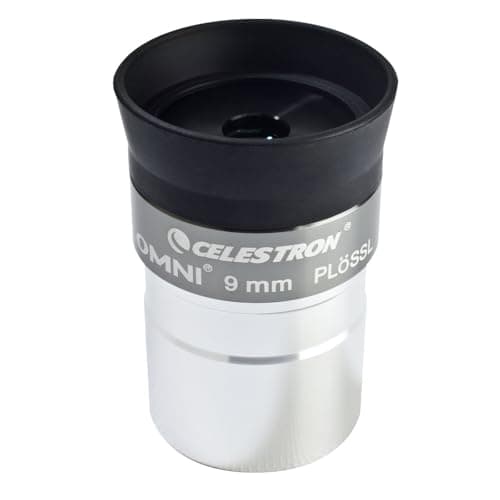 Celestron Omni 9mm Eyepiece A 4-element Plossl giving 72x on a Heritage 130 and 100x on an AstroMaster 70AZ. | Telescopes of roughly 600mm focal length and up — the Heritage 130 and 150, AstroMaster, Inspire, PowerSeeker | $27.95 on Amazon #ad How we’re funded · price as of November 2, 2026 |
| 2 | 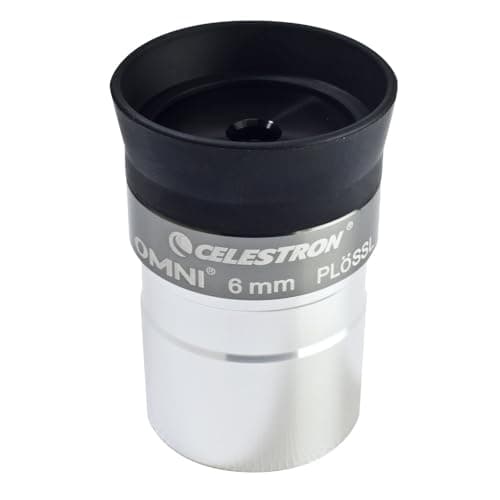 Celestron Omni 6mm Eyepiece The same Plossl family at 6mm: 75x on a 450mm tabletop, 67x on a Travel Scope 70. | Short tubes — the FirstScope, Travel Scope 70 and the StarSense 114 tabletop | $31.95 on Amazon #ad How we’re funded · price as of November 2, 2026 |
| ! | 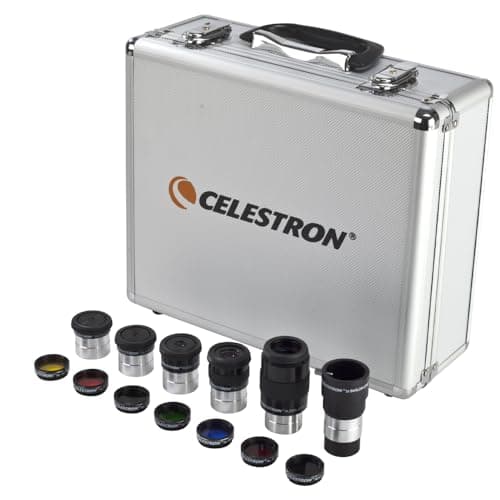 Celestron Eyepiece, Barlow and Filter Accessory Kit Five Plossls, a 2x Barlow and seven filters in an aluminum case — none of it bad, all of it premature. Skip this one — see why below | Showing why the accessory kit is the wrong first purchase | Not recommended |
Rows link to the full write-up further down this page. Prices come from the live price layer only; where there is no live figure the button reads “Check price” rather than showing a number we remembered.
When to buy nothing at all
This is the most likely correct answer and it deserves its own section, because the site that sells you an eyepiece should also tell you when not to buy one.
- You already own something that gives a similar magnification. Do the division on the eyepieces in your box first. If one of them already lands in the 50x to 100x range for your telescope, a new eyepiece at a similar number changes nothing.
- The telescope is the problem, not the eyepiece. A 0.96 inch focuser will not take these at all, and on a telescope like the PowerSeeker 50AZ no eyepiece rescues the package.
- Nothing is sharp at any power yet. That is a focus, cooling, collimation or seeing problem. Work through why can't I see anything before spending.
- You have not used the low-power eyepiece properly. Most first nights fail at finding things, not magnifying them. A new high-power eyepiece makes finding harder, not easier.
- A Barlow may be the cheaper route. A 2x Barlow doubles every eyepiece you own, which can be better value than one new focal length — we work that through on Barlow lenses.
Why a Plossl, and why not something fancier
A Plossl is a four-element design that has been the honest budget standard for decades. It gives a 50 degree apparent field, it is sharp across most of that field on the slow-to-medium telescopes a child is likely to own, and it costs about thirty dollars.
Premium eyepieces buy a wider apparent field and longer eye relief, both of which are genuinely nicer. They also start at around three times the price, and the ones we looked at cost more than the FirstScope telescope itself. On a child's first telescope that is the wrong place for the money — which is the same argument we make about the accessory kit above.
How many eyepieces does a child actually need?
- One low power, for finding things. Almost always the one that came in the box — a 20mm or 25mm. This is the eyepiece most sessions should start and stay in.
- One medium-to-high power, for the Moon and planets. This is the one worth buying, and it is what this page is about.
- That is it, for the first year. A third focal length is a refinement; aperture, a steady mount and dark adaptation all change the view more.
The order matters too: start every session at low power, find the object, then swap up. Children who start at high power see nothing and conclude the telescope is broken, which is the failure mode this whole site exists to prevent.
What we did and did not do
We have not tested these eyepieces. Every figure — item numbers, focal lengths, Plossl design, element counts, 50 degree fields, field stops, the 6mm and 5mm eye relief figures, coatings, filter threading and the 2-year warranty — was read from Celestron's own published product pages on the date at the top of this page, and those pages are linked below. The accessory kit's full contents are from Celestron's published listing for item 94303.
Every magnification in the table is our arithmetic on published telescope focal lengths divided by published eyepiece focal lengths, and a reader can check any of them with a calculator. The ceiling figures use the standard twice-the-aperture rule, which we apply identically across the site. No price appears in this prose; live figures come only from our price feed with the date they were checked, and our full method is on the methodology page.
The picks in full
Pick 1
Celestron Omni 9mm Eyepiece
Telescopes of roughly 600mm focal length and up — the Heritage 130 and 150, AstroMaster, Inspire, PowerSeeker
The arithmetic
Magnification is telescope focal length divided by eyepiece focal length, so this one eyepiece does a different job on every telescope. On a 650mm Heritage 130 it gives 72x; on a 750mm Heritage 150, 83x; on a 900mm AstroMaster 70AZ, 100x. Those are the useful planetary powers for those telescopes. On a short tube it is a different story: 300 / 9 on a FirstScope is only 33x, which is LESS than the 75x its own supplied 4mm delivers. This is the eyepiece for telescopes of roughly 600mm focal length and up, and the wrong one below that.
This is the single upgrade that fixes the most common complaint on this site. Nearly every telescope we review ships with a usable low-power eyepiece and a high-power one that is either unusable or barely there, and this replaces the second one for about the price of two cinema tickets.
The specification is unremarkable and that is fine: 4 elements in 2 groups, a 50 degree apparent field, multi-coated optics, an 8.5mm field stop and a 2-year warranty. A Plossl is the standard honest design at this price.
What matters is the arithmetic against your telescope. 650mm Heritage 130 gives 72x. 750mm Heritage 150 gives 83x. 900mm AstroMaster 70AZ gives 100x. Those are genuine planetary magnifications on telescopes that can support them.
Honest downsides, and the first is real: 6mm of eye relief means your eye goes very close to the glass, and over spectacles it is uncomfortable to the point of unusable. The 50 degree field is narrow, so on an undriven mount the planet drifts out of view quickly. And it fits 1.25 inch focusers only.
Skip it if
Your telescope is a short tube. On a 300mm FirstScope this gives 33x, which is less than the 75x its own supplied 4mm already delivers — you would be buying a duplicate of an eyepiece you own. Also skip it if the observer wears glasses at the eyepiece: 6mm of eye relief is not enough.
| Item number | 93318 |
|---|---|
| Focal length | 9mm (0.35") |
| Barrel size | 1.25" (32mm) |
| Optical design | Plossl, 4 elements in 2 groups |
| Apparent field of view | 50 degrees |
| Field stop | 8.5mm (0.33") |
| Eye relief | 6mm (0.24") |
| Coatings | Multi-coated |
| Filter threading | Yes, accepts 1.25 inch filters |
| Warranty | 2 years |
| What the box does not do | 6mm of eye relief is genuinely short. You put your eye close, and over glasses it is uncomfortable to the point of unusable — if the observer wears spectacles at the eyepiece, this is the wrong buy. The 50 degree apparent field is narrow by modern standards, so the object drifts out of view quickly on an undriven mount. And it fits 1.25 inch focusers only, which rules out the cheapest 0.96 inch department-store telescopes. |
Specifications from Celestron — Omni 9mm Eyepiece 1.25 inch (item 93318). We have not handled this one — everything above is the published spec sheet plus our own arithmetic on it.
#ad How we’re funded · price as of November 2, 2026
Pick 2
Celestron Omni 6mm Eyepiece
Short tubes — the FirstScope, Travel Scope 70 and the StarSense 114 tabletop
The arithmetic
The short-tube answer. On a 450mm StarSense 114 tabletop this gives 75x, on a 400mm Travel Scope 70 it gives 67x, and on a 300mm FirstScope it gives 50x — real planetary powers on telescopes where a 9mm would not get there. Check it against the ceiling before buying: twice the aperture in millimeters is the honest limit, so 75x on 114mm of mirror is comfortable, while 67x on the Travel Scope's 70mm is about half of its 140mm-based ceiling. On a 650mm or longer telescope this becomes 108x and up, which is pushing most small scopes harder than the sky usually allows.
The answer for the short-focal-length telescopes this site recommends most often to younger children, where a 9mm simply does not reach a useful planetary power.
450mm StarSense 114 tabletop gives 75x. 400mm Travel Scope 70 gives 67x. 300mm FirstScope gives 50x. Check each against the honest ceiling of twice the aperture in millimeters: 75x on 114mm of mirror is comfortable, 67x on the Travel Scope's 70mm sits at about half its limit.
Specification is the same family as the 9mm — 4-element Plossl, 50 degree field, multi-coated, threaded for filters, 2-year warranty.
Honest downsides: 5mm of eye relief, shorter still than the 9mm, which is the standard complaint about short Plossls and means eyelashes on glass. The 6.4mm field stop is a very small circle of sky. And no eyepiece fixes a telescope whose mount is the real problem.
Skip it if
Your telescope is 650mm or longer. There it gives 108x and up, which is more than most small telescopes and most nights of seeing will actually support — you will spend the session looking at a bigger, dimmer blur.
| Item number | 93317 |
|---|---|
| Focal length | 6mm (0.24") |
| Barrel size | 1.25" (32mm) |
| Optical design | Plossl, 4 elements in 2 groups |
| Apparent field of view | 50 degrees |
| Field stop | 6.4mm (0.25") |
| Eye relief | 5mm (0.2") |
| Coatings | Multi-coated |
| Filter threading | Yes, accepts 1.25 inch filters |
| Warranty | 2 years |
| What the box does not do | 5mm of eye relief is shorter still than the 9mm's, and it is the single biggest complaint about short Plossls — your eyelashes touch the glass. Not usable over spectacles. The 6.4mm field stop means a very small circle of sky, so an object on an undriven mount crosses it in well under a minute. Nothing about this eyepiece fixes a telescope whose optics or mount are the real problem. |
Specifications from Celestron — Omni 6mm Eyepiece 1.25 inch (item 93317). We have not handled this one — everything above is the published spec sheet plus our own arithmetic on it.
#ad How we’re funded · price as of November 2, 2026
Skip this
Celestron Eyepiece, Barlow and Filter Accessory Kit
Showing why the accessory kit is the wrong first purchase
The arithmetic
The arithmetic that decides this is not optical, it is budgetary. This kit costs more than every telescope we recommend for a child except two. Buying it alongside a 130mm tabletop means spending roughly 80 percent of the telescope's price again on accessories — and the thing that most changes what a child sees is aperture, not eyepieces. Five eyepieces plus a 2x Barlow is also ten magnifications on a telescope that can usefully support perhaps three.
We want to be fair here, because this is not a junk product: these are genuine Celestron Plossls — 32mm, 17mm, 13mm, 8mm and 6mm, 4 elements, 52 degree fields, fully multi-coated — plus a 2x Barlow and seven filters in a foam-fitted aluminum case.
The problem is allocation. Spending this much alongside a 130mm tabletop means paying roughly 80 percent of the telescope's price again in accessories. That money buys considerably more sky as a bigger telescope than it does as ten extra magnifications.
Six of the seven filters are colored planetary filters, and on small apertures their effect ranges from subtle to counterproductive — each one blocks most of the light the objective just worked to collect. We make the same argument on do you need a moon filter, where the single neutral filter is the exception worth making.
Five eyepieces plus a Barlow is ten magnifications on a telescope that can usefully support about three. A child will use two or three of the twelve items in the box.
Skip it if
You are buying for a child's telescope, which is every reader of this site. This kit costs more than every telescope we recommend except two, and the thing that changes what a child sees is aperture, not a drawer of eyepieces.
| Item number | 94303 |
|---|---|
| Eyepieces | Five 1.25 inch Plossl: 32mm, 17mm, 13mm, 8mm, 6mm |
| Eyepiece design | 4 elements, 52 degree apparent field, fully multi-coated |
| Barlow | 2x, 1.25" |
| Filters | Seven: #80A blue, #58 green, #56 light green, #25 red, #21 orange, #12 yellow, Moon |
| Case | Foam-fitted aluminum carry case |
| Barrel size | 1.25" throughout |
| Warranty | 2 years |
| What the box does not do | Nothing here is bad, which is the honest part — these are real Celestron Plossls in a real case. What it does not do is improve the telescope, and six of the seven filters are colored planetary filters whose effect on small apertures ranges from subtle to counterproductive, because each one blocks most of the light a small objective worked to collect. A child using one telescope will use two or three of these twelve items. |
Specifications from Celestron — Eyepiece and Filter Kit 1.25 inch (item 94303): full contents. We have not handled this one — everything above is the published spec sheet plus our own arithmetic on it.
Questions people actually ask
- Which eyepiece should I buy for my telescope?
- Divide your telescope's focal length by the eyepiece focal length to get magnification. For telescopes around 600mm and longer, a 9mm Plossl lands at a useful 67x to 100x. For short tubes of 300mm to 450mm, a 6mm gives 50x to 75x. Buy one eyepiece that fills a gap your existing ones do not, rather than a kit.
- What magnification does a 9mm eyepiece give?
- It depends entirely on the telescope. In a 650mm Sky-Watcher Heritage 130 a 9mm gives 72x; in a 900mm Celestron AstroMaster 70AZ it gives 100x; in a 300mm FirstScope it gives only 33x. Magnification is telescope focal length divided by eyepiece focal length.
- Are telescope eyepiece kits worth it?
- Rarely, for a child's telescope. A typical kit costs more than most beginner telescopes, and six of its seven filters are colored planetary filters whose effect on small apertures ranges from subtle to counterproductive. One well-chosen eyepiece does more, and the money saved buys aperture, which is what actually changes the view.
- Is a Plossl eyepiece good enough?
- Yes, for a beginner telescope. A four-element Plossl gives a 50 degree apparent field and is sharp across most of it on the slow-to-medium telescopes a child is likely to own. Premium designs buy a wider field and more eye relief, but start at roughly three times the price — more than some of the telescopes we recommend.
- Can you use these eyepieces with glasses?
- Not comfortably. Celestron publishes 6mm of eye relief for the Omni 9mm and 5mm for the 6mm, which means putting your eye almost against the glass. If the observer must keep glasses on, buy a long-eye-relief eyepiece instead and expect to pay more.
- Should I buy a Barlow lens or another eyepiece?
- A 2x Barlow doubles the magnification of every eyepiece you already own, so it can be better value than a single new focal length. The catch is that it multiplies the weaknesses too, and a cheap Barlow on a cheap eyepiece is a poor combination. We compare the two routes on our Barlow lens page.
Sources
Read next
Where to go from here
- Barlow lens for a telescope: the arithmetic before the purchase
One number decides whether a Barlow helps or hurts: your shortest eyepiece, multiplied, against the telescope's published ceiling. Work it out first, then buy.
- Why can't I see anything through my telescope?
The ranked causes of a telescope that shows nothing, most common first, each with a fix you can do tonight without tools.
- Do you need a moon filter?
Transmission percentage against your aperture decides which filter to buy — or whether to skip it and observe a crescent instead. Three options, and the free alternative.
- Toy telescopes versus real optics: how to tell in thirty seconds
The arithmetic that exposes a 525x claim on a 70mm box, worked through on a real product using its own manufacturer's published numbers.
- What to buy a kid who already has a telescope
A telescope's real problems are dark adaptation, steadiness and knowing where to point it. None of them cost much to fix.
- Do you need to collimate a kids' telescope?
Refractors never need it. Small tabletop reflectors usually hold it for months. Do the free star test first, and only buy a tool if it fails — here is which one, and why a laser is not the obvious answer.