Guides
Can a child look at the Sun through a telescope?
The one target a child can observe before bedtime — and the only one that can blind them in a second. Both facts are true, and the second is entirely preventable.

By Scooter M. · published November 5, 2026
I'm not an astronomer and I don't have a lab. I'm someone who's genuinely into this — I read the manuals, compile the published specs, and do the arithmetic the box doesn't do for you. No lab coat. How we pick.
How this is funded. Lens & Lightyear earns a commission when you buy through a link on this page, at no extra cost to you. It does not change which products we pick or what we say about them — every card below carries a real reason to skip it. Prices are pulled live and were last verified November 5, 2026. Full disclosure.
The short answer
Yes, safely, but only one way: a certified filter fitted over the FRONT of the telescope, matched to your exact model, fitted and inspected by an adult before every session. Never a filter that screws into an eyepiece. Done properly, the Sun is the one object a young child can observe before bedtime — which is why it is worth the care it demands.
This site has told readers twice that solar viewing needs a proper front-mounted filter and never once explained what that means or which one to buy. This page closes that gap, because a warning without an instruction is not much use to a parent.
The one rule: the filter goes on the front
A telescope collects light and concentrates it. Pointed at the Sun without protection, a 130mm mirror gathers roughly three hundred times what your eye does and brings it to a point hot enough to melt an eyepiece. The damage to an eye is instant and permanent, and there is no pain to warn you — the retina has no pain receptors.
A front-mounted filter rejects that energy before it enters the telescope. The light that reaches the eyepiece has already been reduced to a safe level, and nothing downstream is under stress.
Fit is the safety question, not aperture
This is the part that surprises people. Celestron does not sell one solar filter per aperture; it sells one per telescope model, because what has to fit is the outside diameter of the tube. A filter that does not grip properly can be knocked loose while a child has their eye at the eyepiece.
The clearest proof is printed on Celestron's own page for the 127/130mm filter: a note that it is not for use with the AstroMaster 130 models — a telescope of exactly the aperture in the product title.
| Telescope on this site | Matched Celestron filter? | What to do |
|---|---|---|
| PowerSeeker 127EQ | Yes — item 94222 | Named in Celestron's compatibility list |
| StarSense Explorer DX 130AZ | Yes — item 94222 | Named on the product page |
| AstroMaster 70AZ | Yes — AstroMaster 70 filter | Named in Celestron's listing |
| AstroMaster LT 70AZ | Yes — AstroMaster 70 filter | Named in Celestron's listing |
| AstroMaster 130EQ | No — explicitly excluded | Celestron states 94222 is not for AstroMaster 130 models |
| Heritage 130 / 150 | Not a Celestron tube | Sky-Watcher publishes no tube diameter — measure it and match a filter to that figure |
| FirstScope / Travel Scope 70 | No model-specific filter found | Measure the tube's outer diameter before buying anything universal |
Compatibility is Celestron's own published list for item 94222 plus the models named in its AstroMaster 70 filter listing. Where no matched filter exists we say so rather than suggesting a near-fit, because a near-fit is the failure this page exists to prevent. Celestron's universal filter covers 75-100mm tubes only, which is narrower than most of the telescopes above.
Quick picks
Filters by telescope, and the glasses everyone else needs
| # | Product | Best for | Price |
|---|---|---|---|
| 1 | 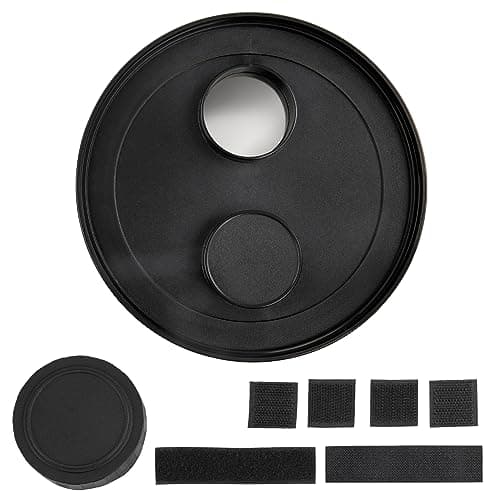 Celestron EclipSmart Solar Filter for 127mm and 130mm Newtonians ISO 12312-2:2015(E) Mylar over the objective, held by two hook-and-loop straps. | Owners of a Celestron PowerSeeker 127EQ or StarSense Explorer DX 130AZ | |
| 2 | 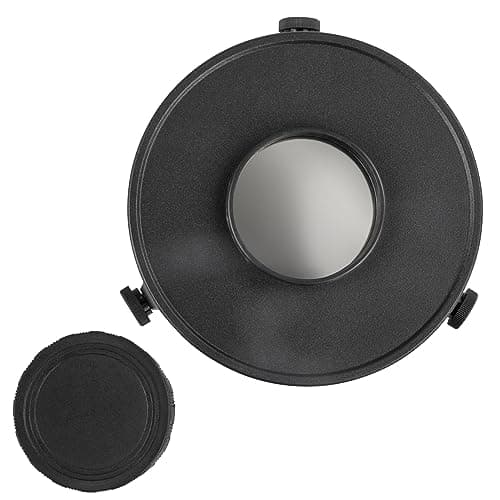 Celestron EclipSmart Solar Filter for AstroMaster 70 Refractors ISO 12312-2 certified, with a three-screw clamp rather than straps. | Owners of an AstroMaster 70AZ or AstroMaster LT 70AZ | $26.95 on Amazon #ad How we’re funded · price as of November 5, 2026 |
| 3 | 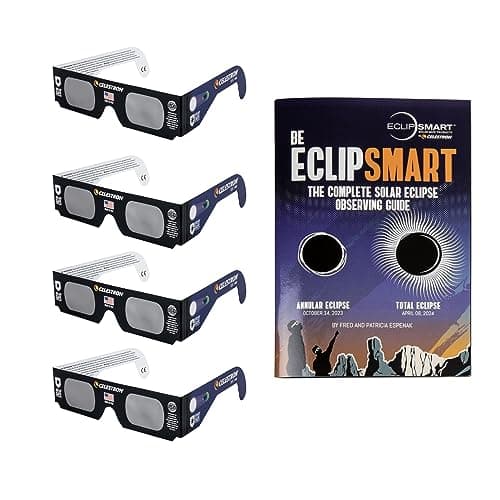 Celestron EclipSmart Solar Shades Observing Kit Four pairs of ISO 12312-2:2015(E) eclipse glasses and a guidebook. | Everyone standing around the telescope, and every household without one |
Rows link to the full write-up further down this page. Prices come from the live price layer only; where there is no live figure the button reads “Check price” rather than showing a number we remembered.
The finderscope nobody remembers
A finderscope is a small telescope bolted to a big one, and it has no filter. Two things go wrong with it, and both are avoidable in ten seconds.
- Somebody looks through it. It is at eye level, it is the thing you normally use to aim, and the habit is automatic. Through an unfiltered finder the Sun will injure an eye as surely as the main tube will.
- It burns things. Even a 5x24 finder concentrates enough energy to scorch a finder bracket, a cap or a hand placed behind it.
- The fix: cap it or take it off entirely before the telescope goes anywhere near the Sun. Aim instead by watching the telescope's shadow on the ground and making it as small and round as possible — no looking required.
- A red dot finder is no safer. It has no magnification, but people still put an eye to it out of habit. Cover it too.
What you can actually see
White-light filters like these show the Sun's visible surface. Expect a crisp orange disc, and on it the dark sunspot groups that come and go over days — which is the real reward, because a child can draw them one afternoon and watch them move across the disc over the next week.
What you will not see are the red flares and loops from photographs. Those are prominences, visible only through a hydrogen-alpha telescope that costs several times anything on this site. Setting that expectation beforehand is the difference between delight and disappointment, same as on what you can actually see.
The adult's checklist, before every session
- Inspect the filter in bright light. Celestron's own instruction is to check before every use and to discard the filter if it is damaged, torn, punctured or separated from its frame. Hold it up to a lamp: any pinhole of white light means it goes in the bin.
- Fit it to the front and check it is firm. Tug it gently. On the strap-mounted filters this is the step that matters most.
- Cap or remove the finderscope. Every time, before the tube moves toward the Sun.
- Aim by shadow, not by eye. Move the telescope until its shadow on the ground is smallest and roundest, then look in the eyepiece.
- Stay with it. Celestron's wording is to never leave the optic unsupervised and to make sure an adult familiar with its operation is with it at all times. A telescope left pointed near the Sun with a child nearby is the scenario to design against.
- Cap the front when you finish, and store the filter where it cannot be crushed or scratched.
When the honest answer is just the glasses
If your telescope has no matched filter, or the child is young enough that fitting and supervising a filter every time is unrealistic, the correct purchase is eclipse glasses and nothing else. They cost a fraction of a filter, they work for the whole family at once, and large sunspot groups are genuinely visible through them.
There is no shame in that answer and it is often the better one. A telescope that stays capped during the day is not a loss — it still has the Moon, which is the target that converts more children than anything else, and we cover that on what you can actually see.
What we did and did not do
We have not tested these filters, and we are not an authority on eye safety. The ISO standard, the compatibility lists, the materials, the dimensions, the attachment methods, the inspect-before-every-use instruction and the never-leave-it-unsupervised wording are all Celestron's own published statements, quoted or paraphrased from the pages linked below and attributed in the text.
Where Celestron does not publish a reachable specification page — the AstroMaster 70 filter — we say so and cite its retail listing instead. Where no matched filter exists for a telescope we list, we say that too rather than proposing something that nearly fits. We publish no rating and no review count. No price appears in this prose; live figures come only from our price feed with the date they were checked, and our full method is on the methodology page.
The picks in full
Pick 1
Celestron EclipSmart Solar Filter for 127mm and 130mm Newtonians
Owners of a Celestron PowerSeeker 127EQ or StarSense Explorer DX 130AZ
The arithmetic
The specification that decides whether this is safe for you is not optical, it is the internal diameter: 149.6mm, which is the tube it slips over. That is why Celestron sells a different filter for almost every telescope it makes and prints a note that this one is NOT for the AstroMaster 130 — a filter that does not grip the tube properly is a filter that can be knocked off while a child is looking through the eyepiece, which is the one failure mode that matters here. Match the filter to the exact model name on your tube, not to the aperture in the product title.
Celestron publishes a compatibility list rather than an aperture, and that is the whole point: PowerSeeker 127EQ, Astro Fi 130, NexStar 130SLT, Omni XLT AZ 130, SkyProdigy 130 and StarSense Explorer DX 130AZ. Two of those are telescopes this site recommends.
The specification that decides safety is the 149.6mm internal diameter — the tube it slips over — not the 127 or 130 in the title. That is why Celestron sells a different filter for nearly every model it makes.
The film is a Celestron proprietary Mylar, with Solar Safe film produced in the USA by American Paper Optics, and the page states it conforms to ISO 12312-2:2015(E), the international standard for filters used to look directly at the Sun. The solar image comes out orange.
Honest downsides: hook-and-loop straps are secure when fitted properly but are not a locking mechanism, so an adult fits and checks it; it does nothing for the finderscope; and Celestron's own instruction is to inspect it before every use and discard it if damaged, torn, punctured or separated from the frame.
Skip it if
Your telescope is an AstroMaster 130. Celestron prints the exclusion on its own product page — *this is not for use with the AstroMaster 130 models* — and a filter that does not grip the right tube diameter is the one failure that matters here.
| Item number | 94222 |
|---|---|
| Safety standard | Conforms to ISO 12312-2:2015(E) for filters directly viewing the Sun |
| Filter material | Celestron proprietary Mylar; Solar Safe film made in the USA by American Paper Optics |
| Solar image color | Orange |
| Mounting | Over the telescope's objective, held by two hook-and-loop straps |
| Supplied straps | 2 x 1" x 4" hook and loop straps, 4 x 1" x 1" tabs |
| External diameter | 165.8mm (6.52") |
| Internal diameter | 149.6mm (5.89") |
| Weight | 88 g (3.10 oz) |
| Fits | PowerSeeker 127EQ, Astro Fi 130, NexStar 130SLT, Omni XLT AZ 130, SkyProdigy 130, StarSense Explorer DX 130AZ |
| Explicitly NOT for | AstroMaster 130 models — Celestron states this on the product page |
| Warranty | 2 years |
| What the box does not do | Nothing for the finderscope, which is a small unfiltered telescope of its own and must be capped or removed before the telescope is pointed anywhere near the Sun. Hook-and-loop straps are secure when fitted correctly and are not a locking mechanism, so this needs an adult to fit it and check it. Celestron's own instruction is to inspect the filter before every use and discard it if it is damaged, torn, punctured or separated from the frame. |
Specifications from Celestron — EclipSmart Solar Filter for 127mm/130mm Newtonian (item 94222): compatibility, ISO standard, materials, dimensions, safety wording. We have not handled this one — everything above is the published spec sheet plus our own arithmetic on it.
Pick 2
Celestron EclipSmart Solar Filter for AstroMaster 70 Refractors
Owners of an AstroMaster 70AZ or AstroMaster LT 70AZ
The arithmetic
This is the filter for two telescopes this site already recommends: the AstroMaster 70AZ and the AstroMaster LT 70AZ. A three-screw clamp is a firmer fitting than hook-and-loop, which is worth something on a telescope a child is leaning on. At 70mm the Sun is a small, sharp orange disc rather than a detailed one — enough for sunspots and for every phase of a partial eclipse, which is all most families want.
The filter for the other two telescopes this site recommends that have one: the AstroMaster 70AZ and the AstroMaster LT 70AZ, both named in Celestron's listing along with the 70EQ.
The three-screw attachment is a firmer fitting than hook-and-loop, which is worth something on a telescope a child is leaning against. It is a white-light filter, so it shows the Sun's surface and sunspots rather than the red prominences you see in photographs.
At 70mm the Sun is a small, sharp orange disc. That is enough for a decent sunspot group and for every phase of a partial eclipse, which is what most families actually want.
Honest downsides: it is model-locked and useless on any other telescope in the house, and Celestron does not publish a specification page we could reach for it — the compatibility, standard and attachment above come from Celestron's own retail listing rather than a maker's spec sheet, and we would rather say so than imply otherwise.
Skip it if
You own anything else. This fits the AstroMaster 70 family only, and a solar filter that nearly fits is not a solar filter.
| Safety standard | ISO 12312-2 certified |
|---|---|
| Fits | AstroMaster 70AZ, 70EQ and LT 70AZ |
| Mounting | Over the objective, secure 3-screw attachment |
| Viewing type | White light — Sun and eclipse viewing |
| What the box does not do | It fits the AstroMaster 70 family and nothing else, so it is useless on any other telescope in the house. Celestron does not publish a specification page we could reach for this model, so the compatibility, standard and attachment above are from Celestron's own retail listing rather than a maker's spec sheet. As with every solar filter, nothing here protects the finderscope, which must be capped or removed. |
Specifications from Celestron (retail listing) — EclipSmart Solar Filter for AstroMaster 70 Refractor Telescopes: fits AstroMaster 70AZ, 70EQ and LT 70AZ, ISO 12312-2 certified, 3-screw attachment. We have not handled this one — everything above is the published spec sheet plus our own arithmetic on it.
#ad How we’re funded · price as of November 5, 2026
Pick 3
Celestron EclipSmart Solar Shades Observing Kit
Everyone standing around the telescope, and every household without one
The arithmetic
The cheapest correct answer on this page, and the one most households actually need. Four pairs matters more than it sounds: solar viewing is a group activity in a garden, and the adult fitting the telescope filter cannot also be the only person with eye protection. These are also the only safe way for everyone who is not at the eyepiece to look up at the same time.
The cheapest correct answer here, and the one most households actually need first. Four pairs matters more than it sounds: solar observing happens in a garden with other people in it, and the adult who fitted the telescope filter should not be the only person with eye protection.
They meet the same ISO 12312-2:2015(E) standard as the telescope filters, and a guidebook is included. Large sunspot groups are visible with the naked eye through them, which surprises most children.
Honest downsides: no magnification at all — the Sun stays the size your eye sees it. Paper frames need the same inspection as any filter: hold them up to a bright lamp, and discard them for any scratch, pinhole or separation from the frame.
Skip it if
You think they make a telescope safe. They do not and cannot — they protect the eye looking at the sky, not the eye at an eyepiece, and no eyepiece-side filter is ever the answer.
| Safety standard | Meets ISO 12312-2:2015(E) |
|---|---|
| Included | Four eclipse glasses and a guidebook |
| Use | Naked-eye Sun viewing and sunspots |
| Magnification | None — these are filters, not optics |
| What the box does not do | No magnification at all — the Sun stays the size it looks to your eye, so you see large sunspot groups and eclipse phases, not detail. Paper-framed glasses need the same inspection as any filter: hold them up to a bright lamp first, and discard them if there is any scratch, pinhole or separation. They do nothing to make a telescope safe. |
Specifications from Celestron (retail listing) — EclipSmart Solar Shades Observing Kit: meets ISO 12312-2:2015(E), four eclipse glasses and guidebook. We have not handled this one — everything above is the published spec sheet plus our own arithmetic on it.
Questions people actually ask
- Can you look at the Sun through a telescope?
- Only with a certified filter fitted over the front of the telescope, matched to that exact model, and fitted and inspected by an adult. Without one, a telescope concentrates enough sunlight to cause instant and permanent eye damage. Never use a dark filter that screws into an eyepiece — those sit at the focus of the concentrated beam and are known to crack.
- Is a solar filter safe for a child to use?
- The filter is safe; the fitting and supervision are the adult's job. Celestron's own guidance is to inspect the filter before every use, discard it if it is damaged or punctured, and never leave the telescope unsupervised, with an adult familiar with its operation present at all times. Cap or remove the finderscope as well — it has no filter.
- Will any solar filter fit my telescope?
- No, and this is the part most people get wrong. Filters are matched to the outer diameter of a specific tube, not to an aperture. Celestron even prints on its 127mm/130mm filter page that it is not for use with the AstroMaster 130 models — a telescope of the same aperture. Match the filter to the model name on your tube.
- What can you see on the Sun with a small telescope?
- A sharp orange disc and any sunspot groups present, which change over days — a child can sketch them and watch them cross the disc over a week. You will not see the red prominences from photographs; those need a hydrogen-alpha telescope costing several times a beginner scope.
- Are eclipse glasses enough without a telescope?
- For many families, yes, and they are the right first purchase. ISO 12312-2 glasses let everyone look at once, show large sunspot groups and every phase of a partial eclipse, and cost a fraction of a telescope filter. They do not make a telescope safe — they protect an eye looking at the sky, not an eye at an eyepiece.
- Do I need to cover the finderscope?
- Yes, every time. A finderscope is an unfiltered small telescope: someone will put an eye to it from habit, and it concentrates enough energy to scorch what is behind it. Cap or remove it, and aim the main telescope by making its shadow on the ground as small and round as possible instead.
Sources
- Celestron — EclipSmart Solar Filter for 127mm/130mm Newtonian (item 94222): compatibility list, AstroMaster 130 exclusion, ISO 12312-2:2015(E), materials, dimensions, inspection and supervision wording
- Celestron (retail listing) — EclipSmart Solar Filter for AstroMaster 70 Refractor Telescopes: fits AstroMaster 70AZ, 70EQ, LT 70AZ; ISO 12312-2 certified; 3-screw attachment
- Celestron (retail listing) — EclipSmart Solar Shades Observing Kit: meets ISO 12312-2:2015(E), four glasses and guidebook
Read next
Where to go from here
- Do you need a moon filter?
Transmission percentage against your aperture decides which filter to buy — or whether to skip it and observe a crescent instead. Three options, and the free alternative.
- What you can actually see with a kids' telescope
The honest target-by-target list for 70mm, 76mm and 114mm telescopes, so nobody is disappointed on night one.
- The telescope setup checklist
The indoor, daylight pre-flight that removes the common first-night failures before anyone goes outside.
- Celestron AstroMaster 70AZ review
70mm at 900mm focal length — f/13, the slowest refractor on this site, with 45x and 90x in the box against a 165x ceiling. Excellent on the Moon, heavy for what it gathers.
- Your first night with a telescope
Do these eight things in this order and night one works. Most first nights fail on sequence, not on equipment.
- Which eyepiece should you actually buy?
Magnification is focal length divided by eyepiece. Get that one division right and a $30 eyepiece transforms a telescope; get it wrong and you have bought a duplicate of what came in the box.